Arduino Camera Shutter Tester - the Shutter Tester
by billbill100 in Circuits > Cameras
1470 Views, 7 Favorites, 0 Comments
Arduino Camera Shutter Tester - the Shutter Tester


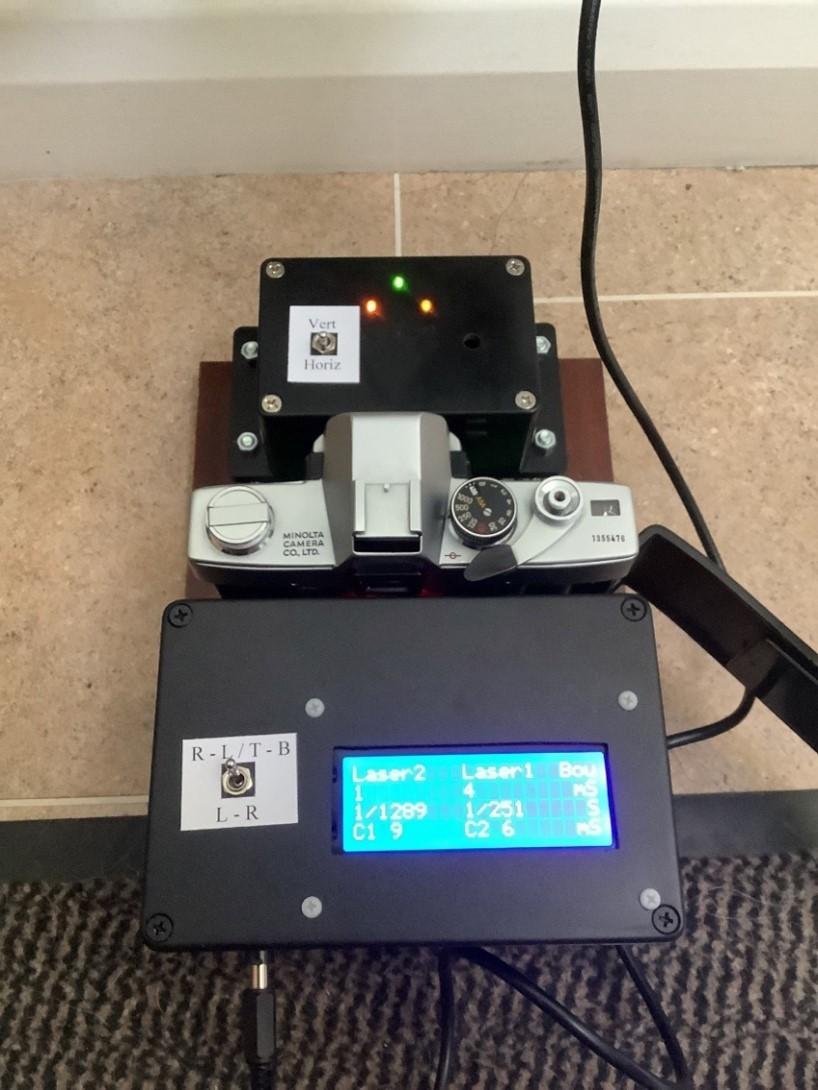
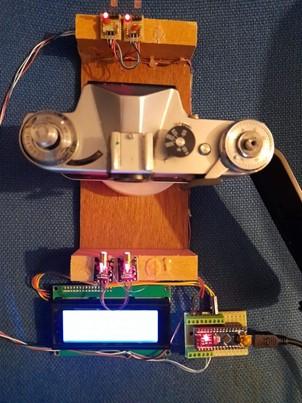

Fully featured & 100% accurate Arduino based film camera Shutter Tester
The Shutter Tester
There are many different shutter Tester circuits on the web. However, most of them simply do not work accurately. Rest assured, this one works 100% accurately.
At slower speeds, other testers maybe ok, but as 'speed' increases, the accuracy will rapidly decline, giving spectacular under-'speed' readings.
This is because of a fundamental mis-understanding how focal-plane shutters actually work and how to measure them.
The shutter 'speed' does not in fact change. There are two curtains in a focal-plane shutter mechanism and it is the time between the first curtain being released and the second being released, which controls exposure.
So we actually have to measure the slot-width between the two curtains, i.e. the gap that allows light to hit the film.
The error is exaggerated because the sensors have width, far greater than a single photon. Unless calibration is applied to correct sensor width vs photon width, great reading errors will occur.
Similarly, if the two curtains are not balanced correctly, they will cause exposure variation across the frame, often resulting in one side being far brighter or over-exposed than the other. A shutter tester has to measure and display this, whilst others cannot (single senor, sound recorded Audacity or 'plug' type tester) The Shutter Tester does all of this and more.
There are two versions of the the The Shutter Tester, this Instructable is for the Arduino version
The Shutter Tester Arduino
Arduino remains a very popular platform. Many people are familiar with Arduino and have many of the parts to make The Shutter Tester. The Shutter Tester will accurately display the shutter 'speed' and crucially the travel time of each curtain.
Shutter problems, like bounce and capping can easily be identified. Average shutter & curtain travel times are recorded and displayed.
The Arduino platform, makes The Shutter Tester cheap and easy to make, using easily available and cheap modules. No complicated circuit boards or 3d printed parts are required.
Cost to make The shutter Tester with parts from Aliexpress is £16 (+ local tax) at time of writing.
Optional parts, project box etc not included in the above price.
The Shutter Tester ESP32 (See separate Instructable)
The second version, is still Arduino based, but uses a much faster ESP32 processor and TFT display. This version can be found on my Instructables & Github. It is a slightly more complex build, as it has additional buttons, a rotary encoder and TFT screen, requiring more wiring, a project box and some soldering.
Whilst documents here are kept up to date, the latest versions always go to Github first.
Instructables do not allow hosting of the firmware, so for this, drivers and flash tools, are found on Github.
There is a full forum thread, with discussion & help.
Latest documents & Firmware
Parts required are cheap and easy to obtain. The attached document lists them all, as well as optional items.
At the heart is an Arduino Nano board, costing less than £2. An Arduino Uno board would work as well, but not fit into the screw-terminal board.
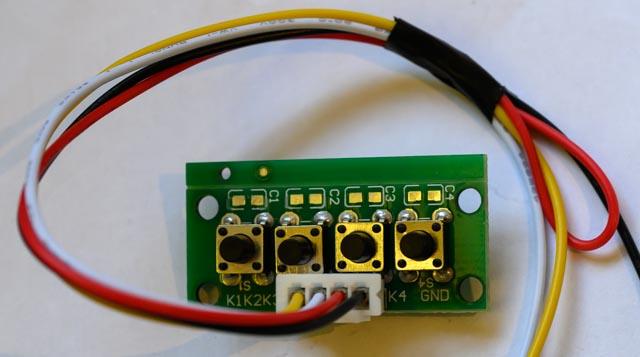
Two push-buttons are required (a four-button module is shown in the photo)
The sensors are pre-made modules and the light sources are a matching pair of very low power Lasers. Again all readily available at cheap prices.
The test results are shown on a four line LCD module and optionally can be displayed on the computer screen, which gives more detail than the LCD alone.
Downloads
Hardware & Wiring
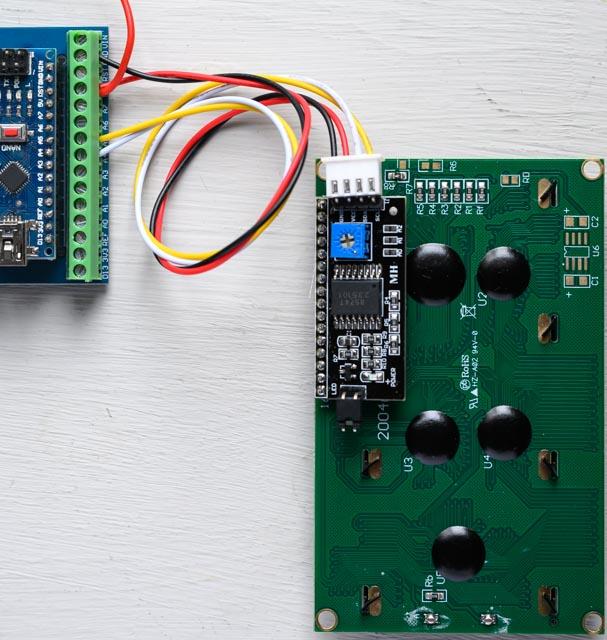
The Arduino is easily connected to the modules, either using Dupont wires, which Arduino users will be familiar with, or pre-made JST XH connectors, which cost little more than Dupont wires.
There is no soldering required, although it can make things a little neater when connecting the sensors, as there are lots of 5V and 0V wires.
The comprehensive build guide and schematic diagram is attached.
Software
The LCD shows the latest test data and accumulated average. More detailed results can be displayed on the computer screen, using a program called Arduino IDE.
Those familiar with Arduino will already have this program. Attached is a guide how to install it and another detailing driver installation if your computer does not auto-install it.
The software and drivers themselves are found on Github.
Firmware Load
The Shutter Tester firmware is supplied as pre-complied (.hex) file.
This file has to transferred, or 'flashed' onto the Arduino board. This is easily accomplished using a small piece of software called AVRDUDESS
Detailed instructions are attached.
The firmware and AVRDUDESS can be found on Github.
User Instructions.


Here is the User Guide.
It explains all of the functions & how to use them.
On first uses, a one-time passkey is required.
This is supplied free of charge upon request. The quickest way is a DM to the originator on Photrio.
The photo shows the sensor frame, simply made from scrap wood, with the sensors & Lasers hot-glued in place.
This works very well and a simple way to get the project up and running.
The central card is a test piece, to simulate the slot in a focal-plane shutter.
The finished project can be housed in a project box or the bespoke 3d printed enclosure.
Print files are on Github
Build a Box
The parts list details a suitable box for The Shutter Timer.
However The shutter Timer does not have to be boxed, it can be left loose, as some of the photographs of other users builds, show.
Additionally, a new 3d printable box is available.
3d Printing Parts - Optional
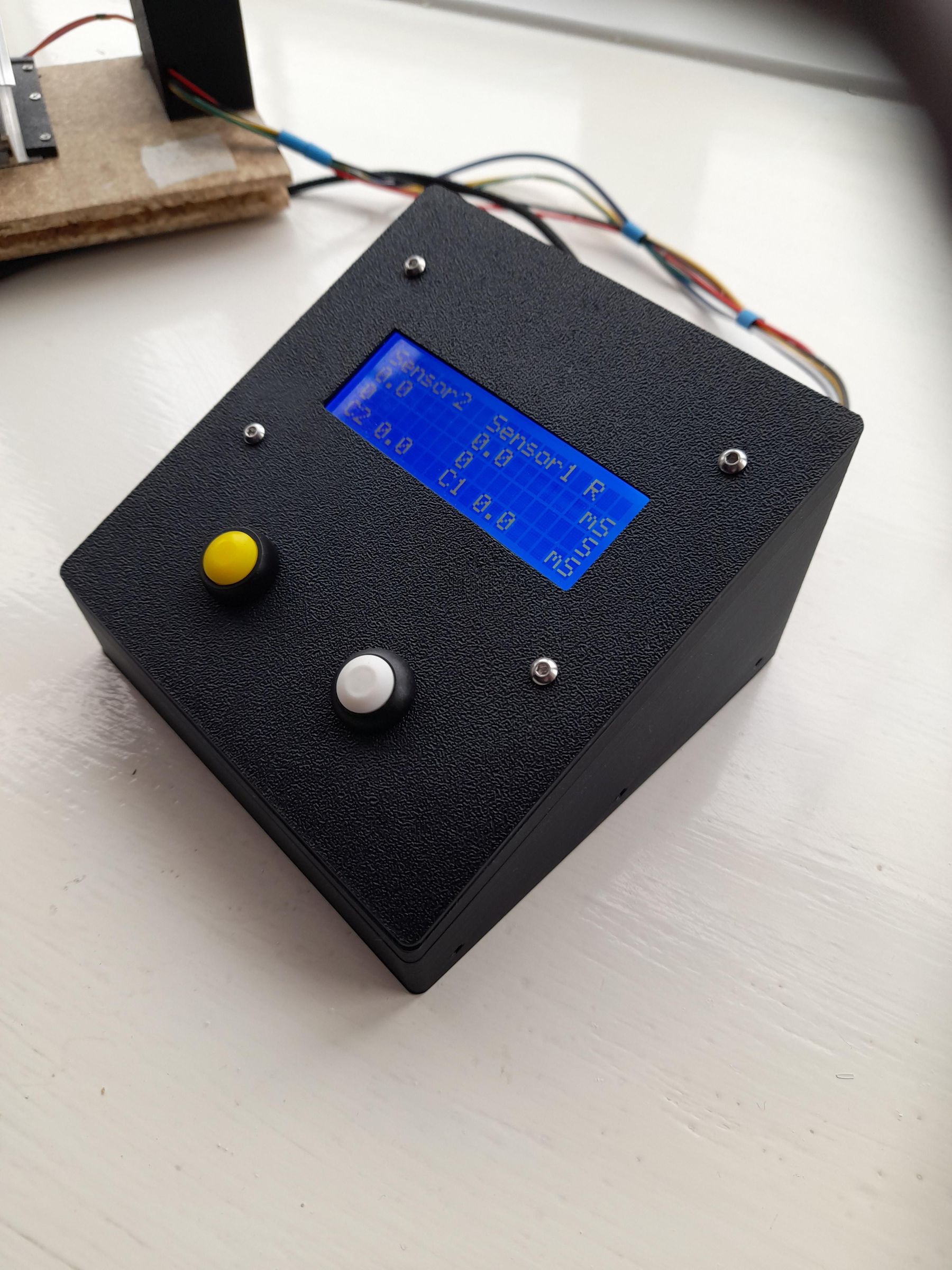


The Shutter Tester was designed to be accurate and also to be built with basic hand tools, without the need for complex machining or manufacture of pcb etc.
This is still true, however with the growing popularity of 3d printers, many new parts have been designed for The Shutter Tester.
The optional parts are
3d printed case
3d printed sensor & Laser enclosures
3d printed camera steady to fit on the (AliExpress purchased) platform lift.
The 3d print files can be found on Github.
Note additional parts are required if using the sensor & Laser enclosure.
Instructions below. Print files can be found on Github.
3d Printed Camera Steady for Lift Platform


The little AliExpress platform lift works ok for raising the camera to vertically align the Lasers.
However, the table is a little small for a camera and there is no way to horizontally align the camera, meaning one has to visually move the camera to align the Lasers with the film gate.
This 3d table-topper fits onto the table and with it's adjustable end, allows the camera to be positioned quickly and easily in the left/right/horizontal position.
The camera can then be easily be held in the same position for multiple tests, or removed and replaced during timing adjustment.
Full details in the pdf.