Automatic Pencil Breaker

Are you constantly bothered by pencils being too sharp? Do you tire of breaking pencils? We introduce an automatic pencil breaker: Inarguably one of the most useless machines ever invented. Opposite to an automatic pencil sharpener, when you insert your pencil into the automatic pencil breaker, the tip is automatically snapped off.
This project was created as part of the Physical Computing course (ARC385) at the John H. Daniels Faculty of Architecture, Landscape and Design HBA in Architectural Studies program at the University of Toronto.
Team Members: Yilin Cheng, Alex Rubin
Supplies
Components
x1 Arduino Nano R4
x1 breadboard
x1 DS-R005 servo motor
x1 photocell sensor
x1 1kΩ resistor
Jumper Wires
Non-electrical Components
plywood for mechine body
3D printer mechine lid
pencils
Tools and Materials
3D Printer
plywood
Handsaw
electric drill
sand paper
ruler
wood glue
hot glue
tape
Automation Logic

Understanding the Logic
When the photoresistor detects the pencil blocking the light, the servo motor will rotate halfway, then return to its original position.
Circuit Layout


In TinkerCAD, we simulated the applicable resistors and wiring, then tested them on a breadboard. During the actual build, we used extension cords to ensure all circuits were hidden behind the machine and remained out of sight.
Downloads
Assembly Instructions

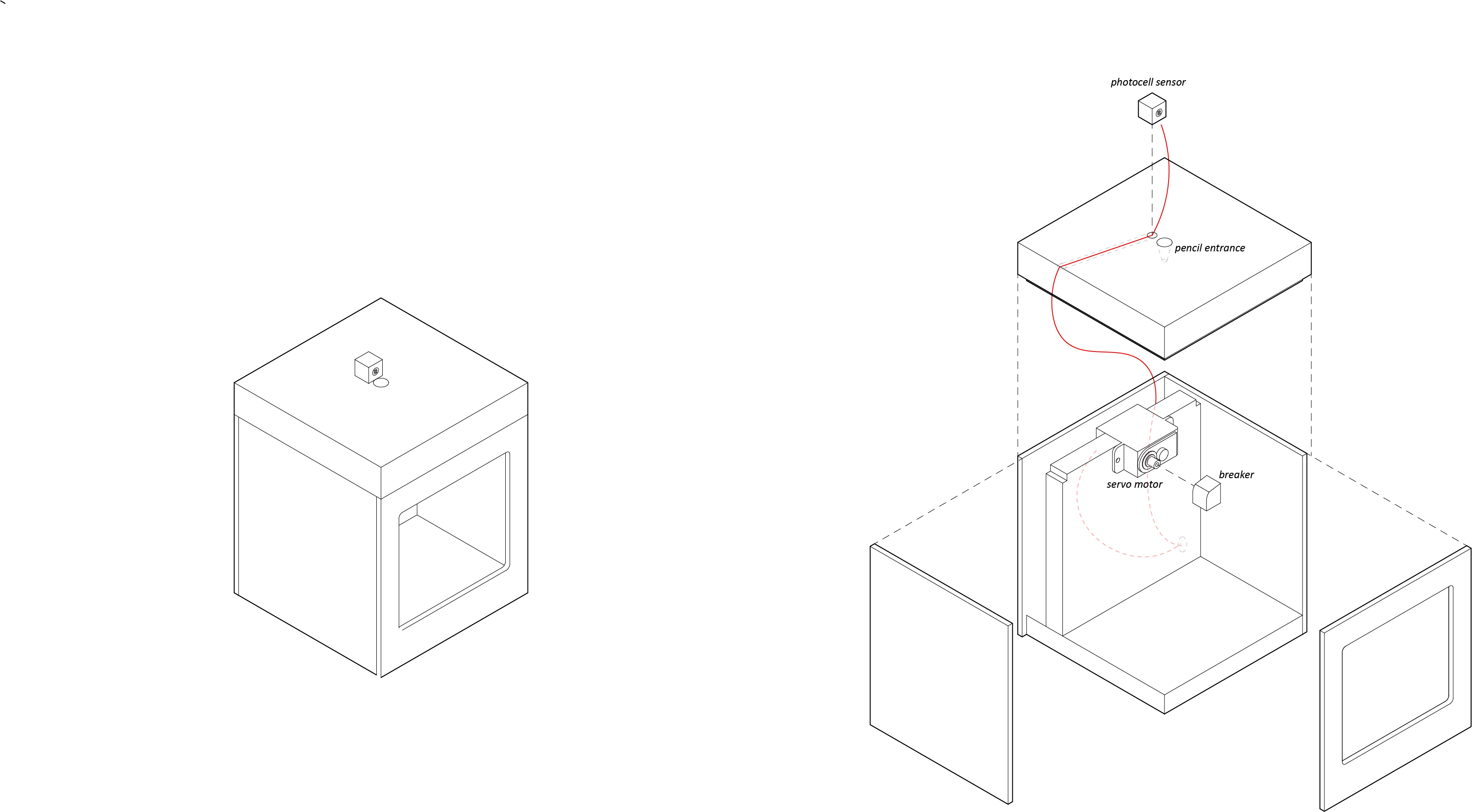
In terms of dimensions, we built a machine similar in size to an automatic pencil sharpener. Beyond the outer casing, the interior features a wooden board supporting the servo motor, with all wiring concealed at the rear. This design ensures that only the breaker and broken pencil tips are visible from the front, maintaining a clean appearance. Additionally, we routed all wire channels along the machine's back panel, hiding the entire circuitry within the rear section.
We 3D-printed grooves of varying depths for the pencil tip, allowing the pencil to be inserted to different depths to ensure the tip is cut off precisely.
Conclusion
We were incredibly excited to take on this project; the brief task of “building a useless machine” presented us with many opportunities. We decided that, to construct a hilariously useless machine, we first had to invent a problem to solve that would never occur. After deducing that the world’s pencils are much too useful, we envisioned a robot that would first sharpen a pencil and then immediately snap it in half. However, the design was unnecessarily complicated, requiring many joints for little added value. We ultimately decided that a simpler approach of mimicking an automatic pencil sharpener held the most comedic value.
When we first experimented with the photoresistor, we quickly achieved the desired result, but as expected, when we moved the machine to a different lighting environment, we had to recalibrate the sensor. This meant we needed to manually adjust the preset under various lighting conditions.
If we were to build another version of this machine, we would incorporate a more reliable sensing system. Whether this means using a physical button to trigger the machine or controlling the light detected by the sensor by placing an LED on the other side of the hole for the pencil, and protecting it from external light sources.
Ultimately, we created a project we're proud of, and we found the process of turning an idea into reality very rewarding.