Building a Complete Chess-Set
by vijoms00 in Workshop > Woodworking
294 Views, 3 Favorites, 0 Comments
Building a Complete Chess-Set

A close friend of mine recently graduated, and I wanted to create something lasting to commemorate this achievement. I decided on a handmade chess set—a timeless game that doubles as a beautiful piece of home decor.
My design was originally inspired by this video by Foureyes Furniture, which features a stunning minimalist board and pieces. However, my project evolved significantly as I went along. What started as a simple board expanded into a custom casing, 3D-printed pieces, and personalized touches.
I’ll admit: I didn't start with a complete blueprint. I figured out the final result during the build process. While not the most efficient way to work, it was a valuable learning experience that led to a truly unique piece. I hope this Instructable provides some insight and inspires you to embrace the "build and learn" approach for your own projects!
In order to improve the writing and make the textes easier to read, as english isn't my native language, I used the AI tool Gemini.
Supplies
Materials used:
- 18 mm Thick light colored Wood (50 cm in Length and 25 cm Wide, will be used for the board)
- 18 mm Thick dark Wood (50 cm in Length and 25 cm Wide, will be used for the board)
- 18 mm Thick Wood (45 cm in length and 6 cm wide, wil be used for the case)
- 3 mm thick MDF Panel (42,5 cm x 42,5 cm, will be used for the bottom plate of the box)
- 3 mm Thick Plywood (8 cm x 4,5 cm, 2 times, will be used to make the customized parts with text on them)
- Wood Glue
- White 3d-Printing Filament
- Black 3D-Printing filament
- 4 x M4 Screws (16 mm Length), countersunk
- 4 x M4 Nuts
Tools
- Laser-Cutter
- Shaper Origin
- Router
- Drill
- Track-Saw
- Some sort of dust collection is nice (Workshop-Vacuum)
- Some type of Clamping with a clamping lenght of 50 cm
Making the Board
.jpeg)
To begin the project, I prepared the board using the traditional "strip-glue" method. I started by cutting four strips of light wood and four strips of dark wood, each measuring 500 mm x 50 mm with a thickness of 18 mm, using a track saw.
The First Glue-Up: I glued these strips together, alternating light and dark. During this stage, my clamping setup caused the board to warp slightly. To correct this, I used a flattening jig (as shown in the video) to ensure both sides were perfectly level before moving forward.
The Second Glue-Up: Once the glue was dry, I cross-cut the board into eight new strips, each 50 mm wide. By flipping every second strip 180 degrees, the classic checkerboard pattern emerged. I paid close attention to aligning the corners of the squares perfectly during this second glue-up to ensure a professional, precise result.
Finishing the Board: After the second glue-up, I flattened both sides once more and trimmed the board to its final dimensions of 400 mm x 400 mm (resulting in 50 mm squares). While sanding, the dark wood appeared a bit dull, but I knew that applying oil later would restore the deep color and make the contrast between the wood species really pop. I also fixed small holes and gaps in between the glue lines by adding a bit of glue and sanding over it without dust collection, so that the small glue in the imperfections would bind the sanding dust and fill these.
Printing the Pieces
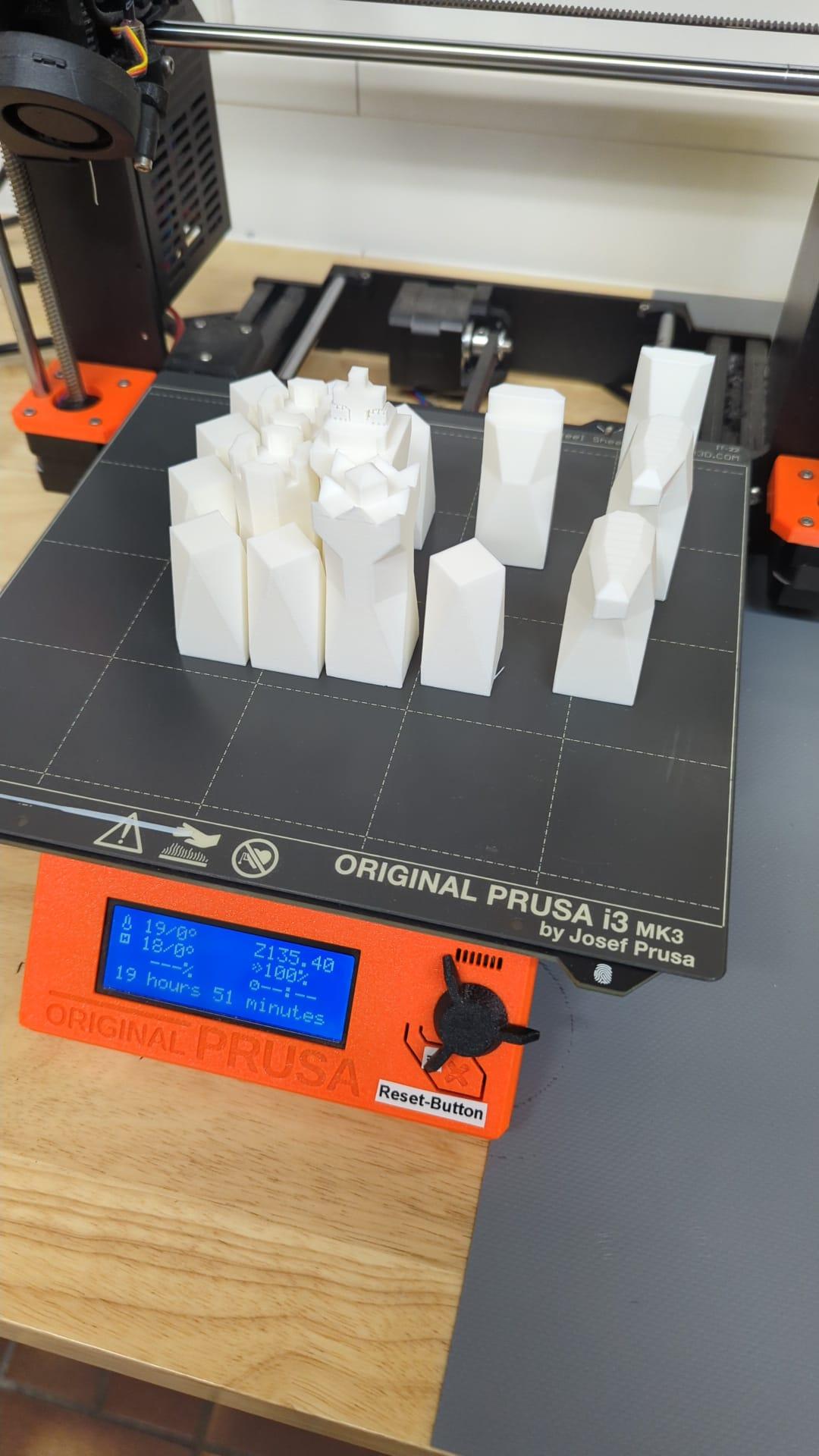
Because I was on a bit of a time-crunch, I decided not to design the pieces from scratch. Instead, I used a fantastic set of Modern Chess Pieces found on Printables. The design is minimalistic and sharp, which perfectly complements the clean lines of the wooden board.
Printing Details:
- Slicer: OrcaSlicer
- Printer: Prusa MK3S
- Material: any filament you want, White and Black, I opted for PLA as it is uncomplicated to print
The print process was very smooth. These models are well-optimized for FDM printing and didn't require complex supports. As you can see in the photo, the white pieces came off the build plate with a very clean finish.
Important Note on Scaling: If you are following this guide but chose a different board size, you must scale the pieces accordingly.
- The Proportional Rule: For a professional feel, the base of the King should be roughly 75-80% of the width of your square.
Pro Tip: If the pieces feel too light, you can pause the print in the middle and add some lead shots or a metal nut in, before the printer closes the top of the piece. This will give the pieces some weight, which might feel nice hen using them.
Building the Case
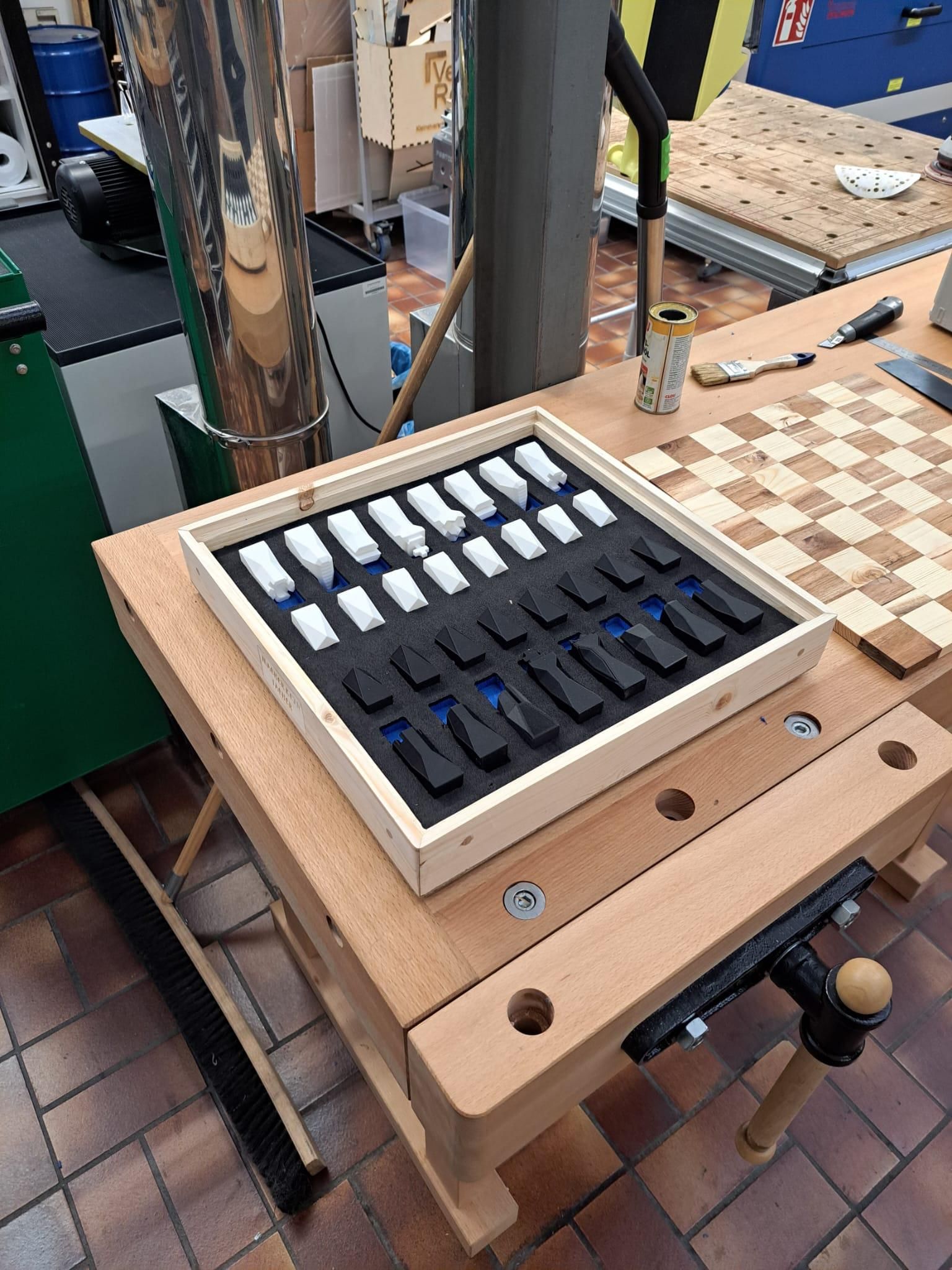


This stage was where the project became a bit more complex. My goal was to build a frame using four side pieces connected with 45-degree miters, with the chessboard recessed into the top for a sleek look.
Overcoming Tool Limitations: Since I didn't have access to a miter saw, I had to cut the miters using a track saw. This proved to be quite challenging; the cuts weren't as perfect as I had hoped, leading to small gaps during glue-up. To house the board, I cut a rabbet (a step-shaped recess) into the top inner edge of each side piece, again using the track saw piece by piece.
To reinforce the frame and ensure it wouldn't pull apart under tension, I attached an MDF base plate to the bottom using staples. This provided structural integrity to ensure, that the miters wouldn't fall apart.
Custom 3D-Printed Feet: To hide the staples and protect table surfaces from scratches, I designed and 3D-printed custom feet.
- Hardware: I used countersunk M4 screws to fix them securely to the case.
- Stability: I added anti-slip pads to the bottom of each foot to ensure the board stays exactly where you place it.
Organizing the Pieces (Shaper Origin): For the interior, I wanted professional-grade organization. I used a Shaper Origin to cut custom pockets into tool-box foam. This was my first time using the Shaper, and the workflow was incredibly intuitive:
- Create an SVG file of the piece contours.
- Load it onto the Shaper.
- Cut to the desired depth.
The result is a tight, "wiggle-free" fit that keeps the 3D-printed pieces safe and silent when the set is being moved. The final casing, with the board and foam inserts in place, can be seen in the figures below. A video of the use of the Shaper is also included, in which you can see the setup that has been used.
Finishing Detail
.jpeg)
.jpeg)


To make the chess set a truly unique gift, I added personalized inlays to the sides of the casing. I used the Shaper Origin to cut precise recesses, then inlaid laser-engraved wood slabs featuring custom text dedicated to my friend. This gave the project a professional, bespoke feel.
The "Best" Part: Sanding and Repairs Then came the most "glamorous" part of any woodworking project: sanding. I worked my way through the grits on both the casing and the chessboard. During this process, I also:
- Rounded the Edges: I softened the sharp corners of the casing for a better feel and look.
- Fixed the Miters: To hide the small gaps in my miter joints, I used the classic trick of mixing fine sanding dust with wood glue to create a matching filler. Once dry and sanded, the gaps became nearly invisible.
The Reveal (Oiling): Finally, I treated the wood with worktop oil. It provided a durable finish and made the contrast between the light and dark squares of the board really "pop."
Conclusion
Initially, I didn't expect this project to be so time-consuming, as I started with a very simple plan for just a board and some pieces. However, as the project evolved, it grew into something much bigger—and I am genuinely glad it did! I learned how to use new tools, gained invaluable hands-on experience, and created a project that is a true labor of love. While it may not be "factory-perfect," those small imperfections are exactly what make it a one-of-a-kind, handmade piece.
I want to give a massive shout-out to the MakerSpacES! at the UAS Esslingen, where this project came to life. Without access to such incredible facilities, ambitious projects like this would often remain just ideas. High-end tools are expensive, and having a dedicated space where students can experiment, learn, and let their creativity roam freely is invaluable.
I hope you found this Instructable educational, entertaining, or—most importantly—inspiring. If you have any questions about the design, the materials, or the tools I used, please feel free to reach out in the comments below.
Thanks for reading to the end!