Chair Upgrade
by Alexander Palacios Herzog in Workshop > Furniture
41 Views, 0 Favorites, 0 Comments
Chair Upgrade
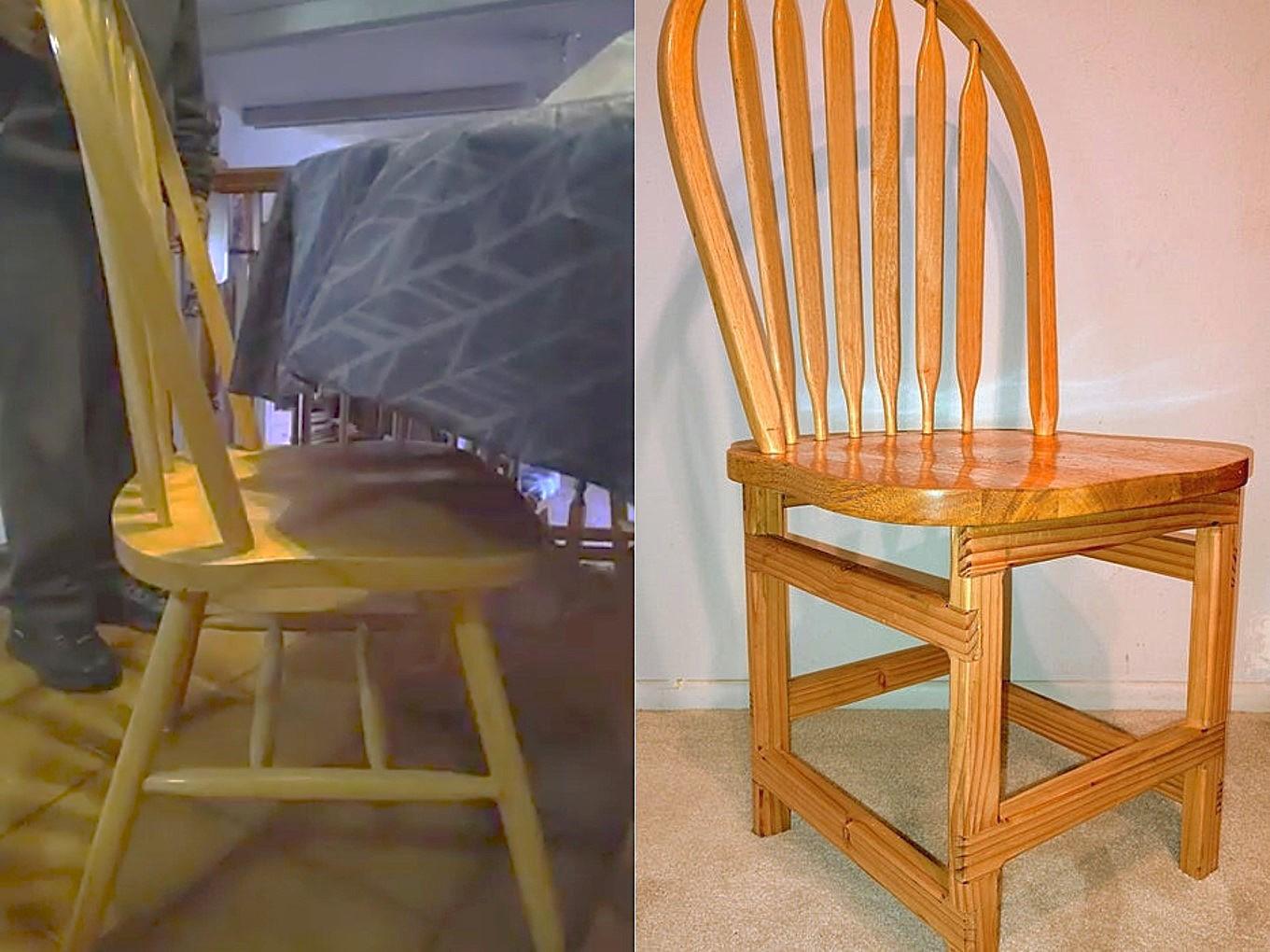

When a chair starts to get on in years, you might notice some parts start to wear out or get loose. This inconvenience prompted the journey to create a new set of legs for some aging furniture. The primary goal of this project was a quick and simple replacement, as the chairs were still being used daily.
Supplies
This is certainly not an exhaustive list of the tools one could use to create these legs. Anything from hand tools to CNC machines could achieve the same results. The tools I used to make these legs are:
- Dimensional Lumber
- Radial Arm Saw (a table saw would probably be preferred)
- Router
- Sander (or sandpaper and block)
- Glue
- Wood Finish (of your choice)
- Felt Furniture Pads
- 2" Wood Screws
Gathering Critical Dimensions


When beginning any project, taking note of certain critical measurements greatly eases the process. A range of processes can be used, from the humble tape measure and your own judgment to tracing images in CAD or 3D scanning. The simplest method, using a tape measure gave me measurements of the seat end of the legs being near 14" square and the seat being about 16" above the ground. The more detailed methods are very nice to have once you get into CAD so you can see exactly how your design looks with the rest of the chair in real life.
Sketching

While CAD drawings cad be made quickly, a rough sketch takes seconds and lets you think about both the shape and how you would make that shape from parts before spending time detailing every dimension to perfection.
Here I explored several ideas, including reusing the legs of the original chairs and simply making new stretchers from wood reinforced with an outer tensioned cable. In the end, for reasons of speed and cost, the simplest design won out, resulting in the wide lap joints and straight cuts of the final design.
CAD Parts

A good design not only looks nice, but is also made of digital versions of the real parts you plan to make. Fusion 360 makes this easy with solid design and part management features that are intuitive and easy to use.
Assembly

Assemblies are sort of like digital Lego for your parts. Each part snaps to other parts with constraints. These tell the computer how each part is located in relation to the ones it's connected to.
3D Seat Model


To get a better idea of what the final product will look like, the seat of the chair was 3D scanned and placed into the assembly. An easy alternative is taking a good picture to trace the outline from. A good trick is to have an object with a known length in the photo. Of course, you can also use a known dimension of the object instead. Creating digital parts from images like this is just as useful for seeing how your design will look as a real 3D scan. (There may have been a bit of a side quest that resulted in fully modeling the original chair.)
With either of these visualization methods, any issues with our design are easier to spot and correct before we spend time making actual parts.
Prints

There are only a few important dimensions in these parts, so simply remembering all half-dozen or so of them is entirely possible. However, there's already enough to pay attention to when you're making dozens of parts, so a good readable print lets you focus on what you're doing instead of worrying about remembering numbers.
If you want to copy the exact design I made here, there's a PDF here for your convenience.
There is also a link to the web viewer for the assembly.
https://a360.co/47damVE
Downloads
Jigs
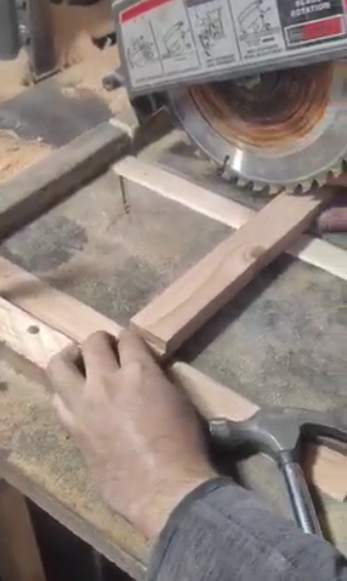
Each set of replacement legs needs four legs and eight stretchers. For the four chairs I plan to repair that's 48 parts in four different patterns! Cutting each part by carefully measuring and marking cuts is certainly possible, but using jigs makes the process much faster and easier. I made a couple of special considerations to reduce the number of jigs needed during design. The spacers on the sides of the chair are both 4" from each end, meaning I only have to flip the legs around to use the same jig to cut both dadoes for the stretchers. Two of the stretchers lining up with the top of the legs and having the same dimensions as the legs means that the legs and stretchers can be cut in the same jig once again. This reduces the number of jigs needed from 6 to 4. This saves significant time since even setting up these simple blocks on the saw takes almost as long as cutting all the parts that the jig will work for.
Test Article

There's always time to make a test piece. This is where you figure out how you want to make the parts, and discover the mistakes you can make along the way. Cutting a lap joint on a stretcher the wrong way now is much better than when you're cutting them four at a time! I chose some pretty weathered wood to make these test pieces since I knew they probably wouldn't turn out perfect, so any mistakes are no great loss. To assemble this test piece, I cut some 16 gauge sheet steel to make cut nails of the right length. After roughly assembling the parts, I discovered that the cuts were a little less perpendicular than I would have liked, and had a looser fit than I was expecting. I adjusted the saw and how I was setting up the jigs I would use to mass produce the parts.
Material
I believe the original chairs are made of birch, but I chose to make these legs from simple, common pine. The first reason is obviously cost. Birch would cost me about $100, more than just buying new chairs in their entirety, while pine only cost me a little over $10. While birch would be more durable and match the color of the rest of the chair better, I don't expect the legs of a chair to really be facing significant abrasion and the color is easy enough to adjust slightly.
With that decision made, I took a trip to the store to pick up a couple of 2"x6" dimensional lumber boards as the main material for this project.
Breaking Up Stock
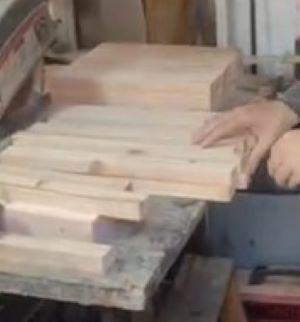
I don't have the most room in my shop, so I always prefer to cut my stock to length before ripping it to width. After breaking down the stock into blanks for all the parts I'd need, I found that I had an entire extra chair's worth of wood. That's no problem, it'll let us select the best pieces to make the actual parts.
Producing Parts
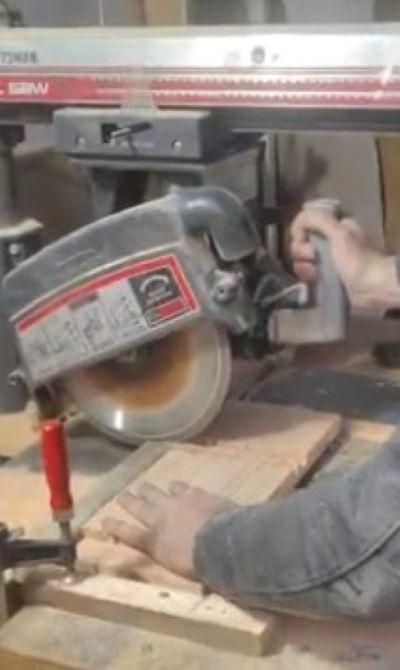
With the material ready and the process planned, it's time to cut parts. Paying attention to detail here will make the next steps much easier, reducing the need to trim parts or worry about gaps.
With so many parts to make, this still took nearly all day.
Flat Glueup
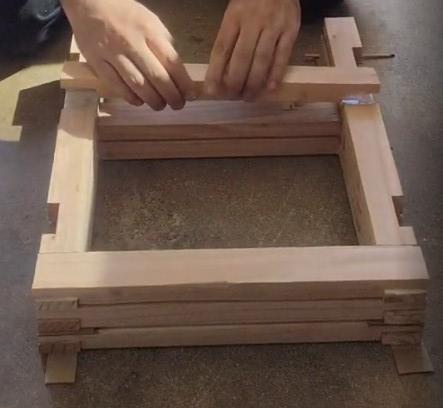
Before gluing the parts together I quickly broke (added a small bevel to) the sharp corners that would be on the inside of the legs and stretchers, as these places would be hard to reach later.
Keeping the parts in separate piles makes it easy to track which parts you need to pull out while gluing things together. I chose to also use small pieces of cardboard between the stacked legs to prevent them sticking together and to ensure good pressure on the joints being glued. Small pieces of wood could also be used here. As I finished each frame, I placed weights on the stack while preparing to assemble the next frame. This kept the stack under pressure for most of the time I spent assembling frames. The final joints came out gap-free, so this method worked well.
Completing Glue Up
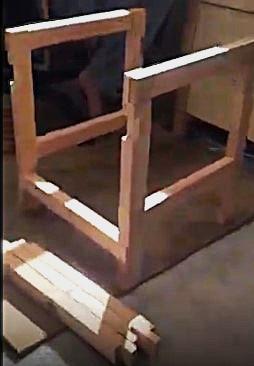

With pairs of legs glued into frames, it's time to pair them up and complete the full sets of legs. To keep pressure on the stretchers while gluing I simply used cord and small sticks to apply pressure to the parts. By wrapping a string once around the stick, I could tension the cord by twisting the stick to wrap the cord onto itself. I added a few extra cords running across the corners of the legs to pull the joints square and keep the legs perfectly vertical using the same technique. The final result came out quite well, and I used a hand plane to clean up any glue drips or slightly over-sized joints.
Cleaning Up Joints

Cutting the ends of the joints flush with the surface can be done with a chisel or a flush cut saw, but I prefer to use an aggressively set hand plane as I find it cuts faster and requires less sanding than the other options.
Routing and Sanding
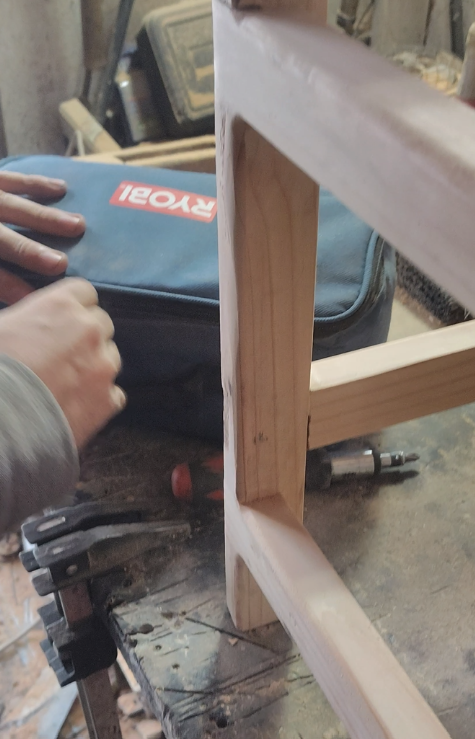
The legs at this point are quite sharp and would be rather uncomfortable to handle. While lightly breaking the edges with a plane would suffice to make handling the chairs tolerable, to better match other parts of the chair, a round over was routed into the outside edges of the legs.
Finally, the legs were sanded to remove any saw marks. This would have been easier to do before assembling and gluing the parts together, but it was not terribly inconvenient.
Finishing

Since I knew that I needed to darken the wood slightly I mixed up a mixture of paraffin and oil to use as a finish. To tint the mixture a darker shade I harvested some darker wax from a beeswax candle.
Replacing the Legs
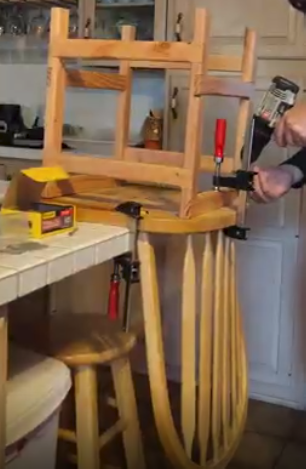
The first step to replacing the legs of a chair is obviously to remove the old legs of the chair. With those out of the way, the new legs were temporarily clamped to the seat, before pilot holes were drilled into the wood to accept 2-1/2 inch wood screws, permanently affixing the new legs to the chair.
Adding Felt Pads
While the soft pine is unlikely to damage the floor, The floor damaging the legs is much more likely. To protect the ends of the chair legs, felt furniture pads were used.
Enjoy
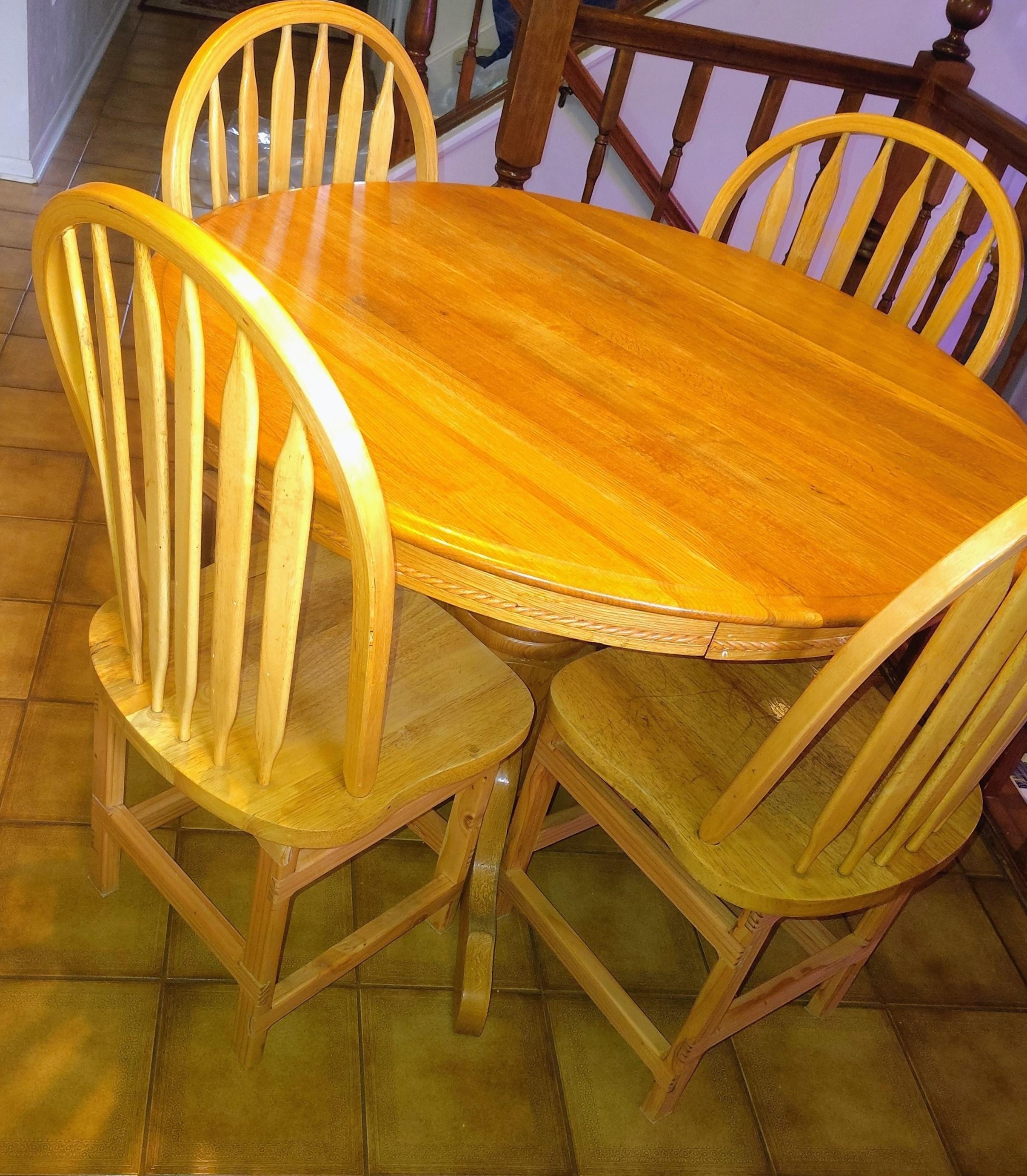
With all that completed, the chairs are finally back in service with their new legs. Overall, exchanging the legs only took a few minutes since the design of the legs allowed for the legs to be assembled completely independently from the rest of the chair, and then quickly affixed. How long they'll truly last is yet to be seen, but so far they are holding up well and have completely eliminated the creaking and shifting that lead to the desire to replace the old legs. The new legs have also freed up a surprising amount of floor space around the table.