Crystal Radio: Build a Battery-Free AM Radio Receiver With Adjustable Tuner Design
by ScienceKitShop in Teachers > 8
12 Views, 0 Favorites, 0 Comments
Crystal Radio: Build a Battery-Free AM Radio Receiver With Adjustable Tuner Design
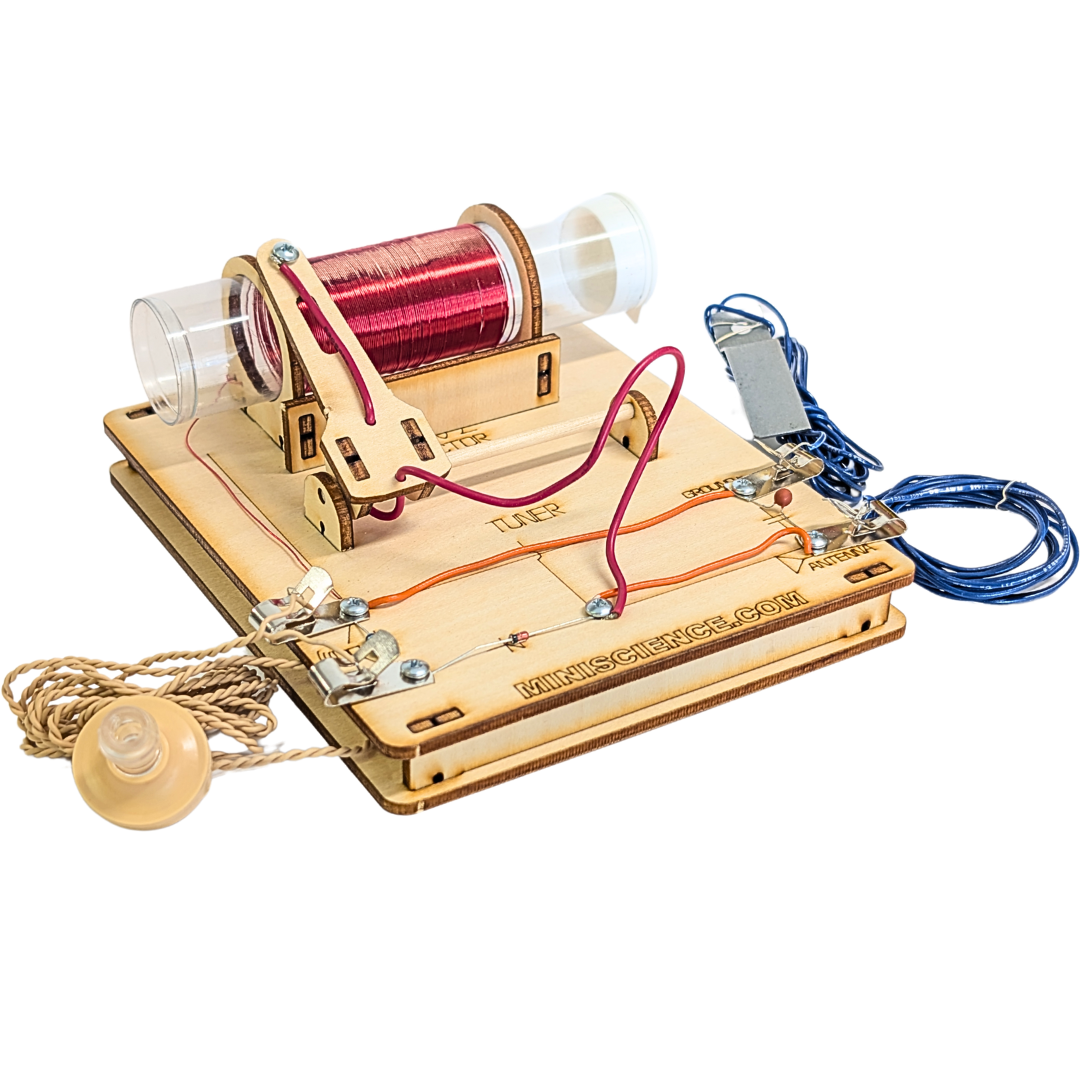
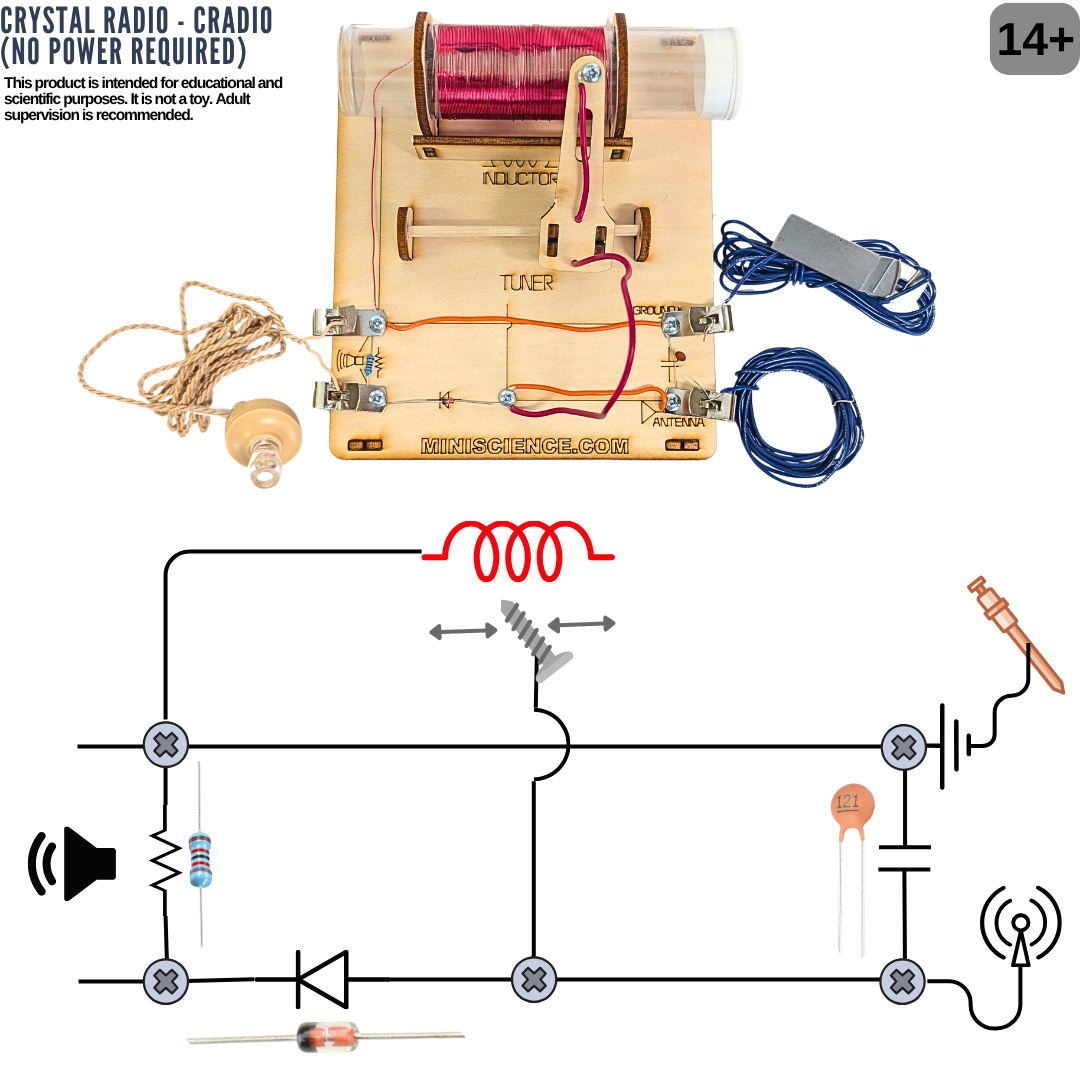
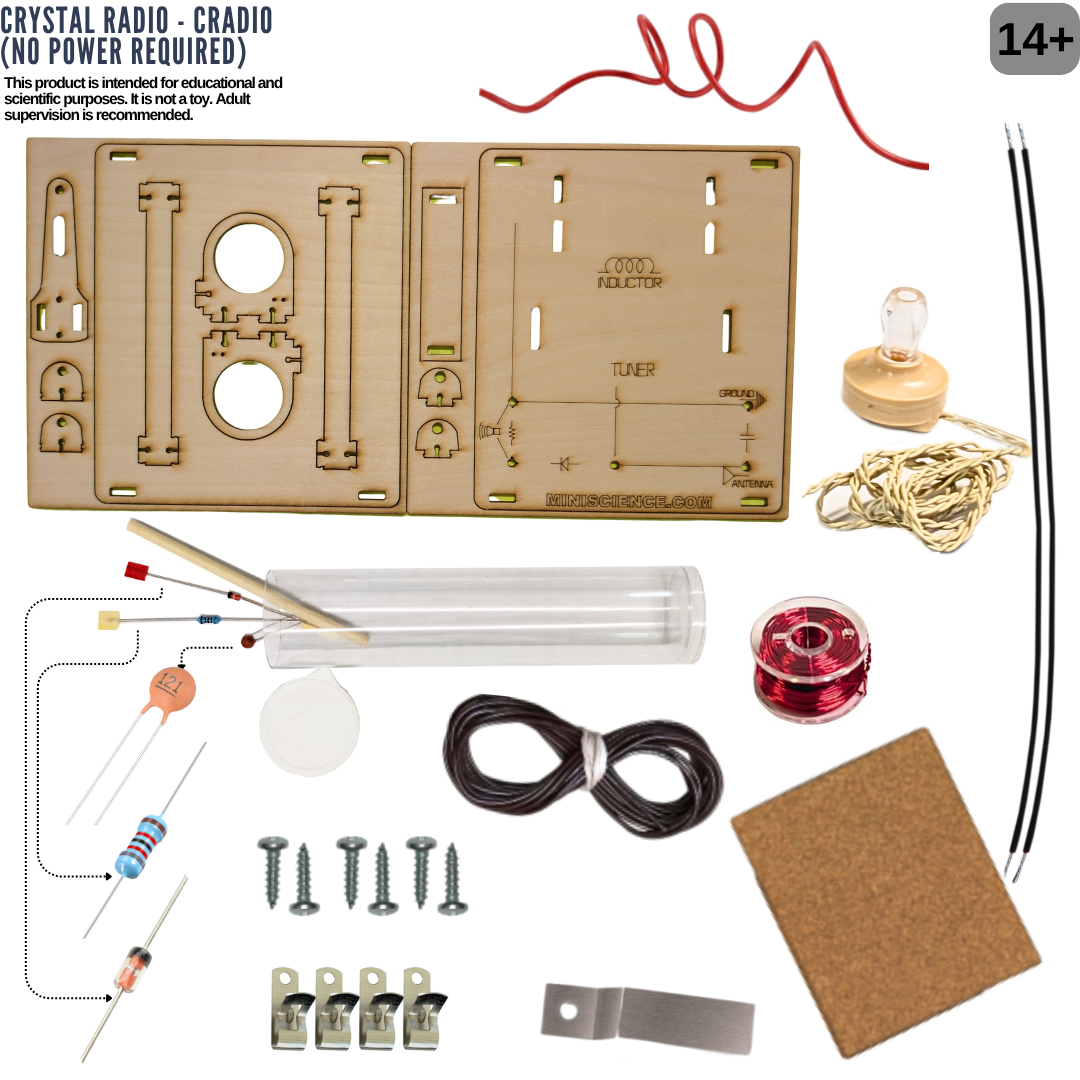
CRADIO: Crystal Radio Kit, Sound DIY AM, No Batteries Needed, with adjustable tuner design
Welcome to the DIY Crystal Radio project, where you'll build a battery-free AM radio receiver using our innovative Crystal Radio Kit. In this engaging DIY AM radio project, you'll explore key electronics principles like electromagnetic induction and resonance while assembling a simple radio receiver that captures radio waves without batteries. Ideal for STEM enthusiasts and beginners alike, this project offers a hands-on introduction to creating a functional radio wave receiver and delving into the world of DIY AM radio.
Supplies

Unpack the Core Components
.png)
Remove from the cylindrical container:
- 1 resistor (82kΩ)
- 1 ceramic capacitor (120pF)
- 1 diode (1N34A)
- 1 wooden tuner axle
Install Cylinder Holders
.png)
Attach the cylinder holders to each end of the coil.
Each holder has holes to lock the wire in place.
- Make sure both holders face the same direction (front and back are different).
Attach the Front Faceplate & Mount the Inductor to the Base
.png)
Attach the Front Faceplate
Attach the cylinder holders to each end of the coil.
Each holder has holes to lock the wire in place.
- Make sure both holders face the same direction (front and back are different).
Mount the Inductor to the Base
Place the assembled coil into the marked inductor location on the base.
Ensure the 4-inch wire from Step 3 is on the left.
Snap the holders into place firmly.
Prepare the Tuner Contact Wire & Assemble the Tuner Axle System
.png)
Prepare the Tuner Contact Wire
Take the flexible red wire.
Insert a screw into the top end of the tuner arm, and place the stripped tip of the red wire under the screw — metal-to-metal contact is essential.
Feed the rest of the wire through the two small holes on the tuner arm.
Assemble the Tuner Axle System
Use the four axle holders:
- Two that allow movement go on the tuner arm
- Two fixed holders go on the base
Install the wooden axle through the holders so the tuner arm can slide smoothly across the coil.
Prepare the Coil Surface for Tuning
.png)
With the tuner installed over the coil:
- Check that the screw on the tuner arm touches the copper coil
- Use sandpaper to gently remove enamel along the full length of the coil where the tuner will slide
- This ensures proper electrical contact during tuning
Complete the Wooden Base
.png)
Assemble the full base structure:
- Attach the two side walls
- Add the top layer for mounting components
- Install the bottom layer to create space underneath for screw clearance
Install and Connect Components
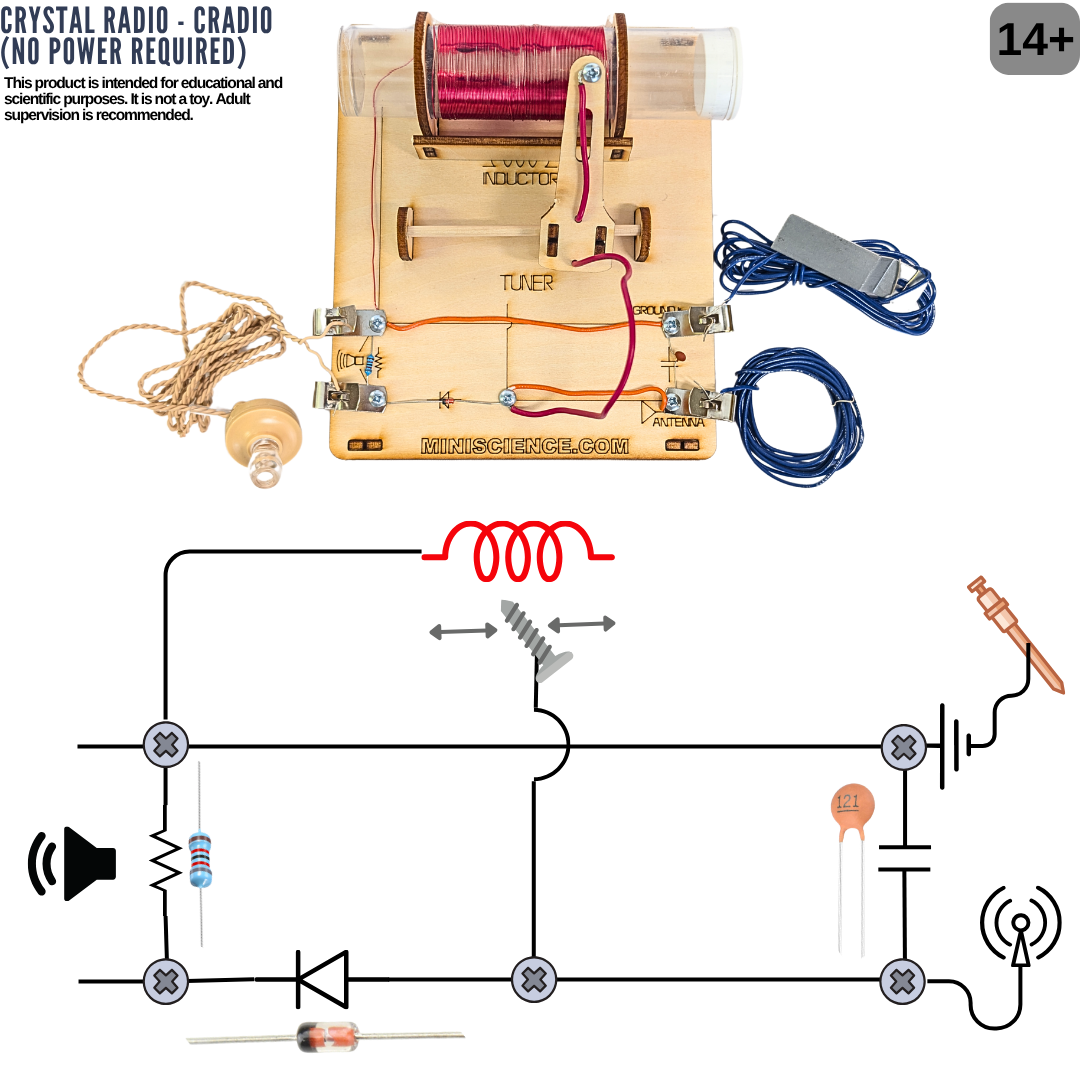
🔧 Wiring Instructions:
- Top-left hole:
- Connect the 4-inch extra copper wire
- One leg of the resistor
- A project wire (~4.5 inches, stripped 1/5 inch)
- Secure all with a screw and Fahnestock Clip
- Top-right hole:
- Connect the other end of the project wire
- One leg of the capacitor
- Secure with a screw and Fahnestock Clip
- Bottom-right hole:
- Connect the second leg of the capacitor
- Add a new project wire (~3 inches, stripped 1/2 inch)
- Secure both with a screw and Fahnestock Clip
- Center hole:
- Use only a screw (no clip)
- Connect:
- The project wire from previous step
- One leg of the diode (1N34A)
- The red tuner wire
- Bottom-left hole:
- Connect the other leg of the diode and the other side of the resistor
- Secure both with a screw and Fahnestock Clip
Connect the Crystal Earphone & Connect the Antenna and Ground Wires
.png)
Connect the Crystal Earphone
On the left side of the base, find the earphone symbol.
Use the two Fahnestock Clips to connect the leads of the piezoelectric earphone.
Ensure the wires are securely fastened and making metal contact.
Connect the Antenna and Ground Wires
On the right side, locate the clips labeled antenna and ground.
- Use the provided long wire, cutting it into two parts:
- One for antenna
- One for ground
Additional Information
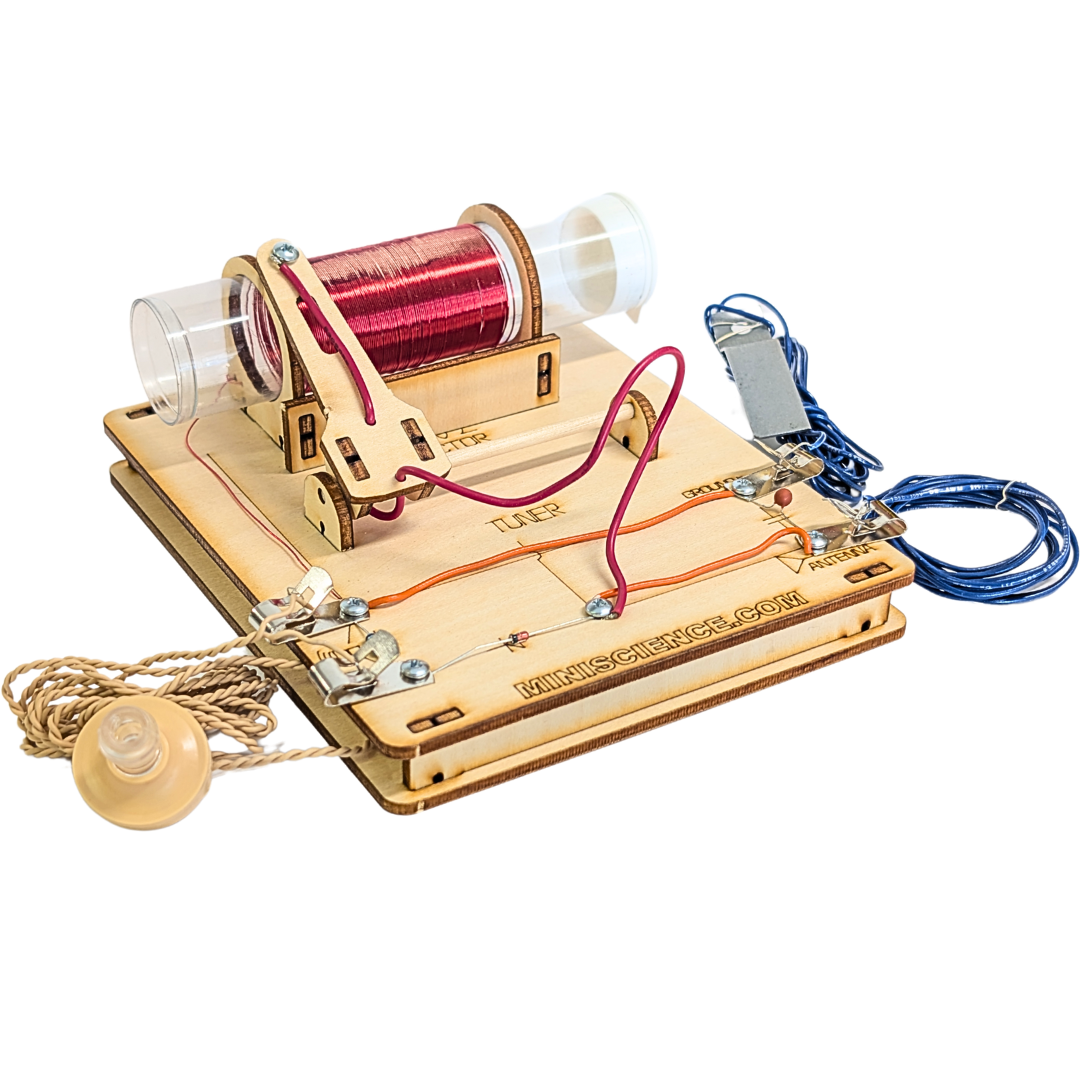
Note: Being closer to an AM radio station, using a good ground connection like a copper pipe, and setting up a large antenna will significantly improve the sound quality.
Additional Information:
Caution: Small and sharp parts. Not suitable for children under 8.
Recommended Age: Ages 12 and above. Adult supervision required.
Before assembly, use sandpaper to smooth the wooden parts. Even with laser cutting, some residue or rough edges may remain that could affect the fit and performance.
FAQ
Q: Can I use regular headphones or earbuds with the Advanced Crystal Radio Kit (CRADIO)?
A: No. Standard headphones and earbuds have very low impedance and are not compatible with crystal radio circuits. The Advanced Crystal Radio Kit requires a high-impedance output device, such as a crystal earphone or piezoelectric earphone, to properly detect and reproduce audio from the passive AM signal. Using low-impedance headphones will significantly reduce or eliminate reception.
Q: Does the Advanced Crystal Radio Kit (CRADIO) require batteries or external power?
A: No. The Advanced Crystal Radio Kit is completely passive and does not require batteries or any external power source. It operates by harvesting energy directly from ambient AM radio waves through the antenna, using a diode to detect the audio signal.
Q: Is a ground connection required for the Advanced Crystal Radio Kit?
A: A ground connection is not strictly required for basic operation, but it greatly improves signal strength and audio clarity. Using a proper ground along with a long wire antenna allows the radio to capture more signal energy, resulting in better reception. Without a ground connection, performance may be limited depending on local signal strength.
Q: Can the Advanced Crystal Radio Kit work without a long antenna?
A: The kit can operate with a short antenna only if it is located very close to a strong AM transmitter. For most locations, a longer external antenna is recommended to achieve reliable reception. AM radio wavelengths are long, and longer antennas are more effective at capturing usable signal energy.
Q: How does tuning work on the Advanced Crystal Radio Kit (CRADIO)?
A: The Advanced Crystal Radio Kit uses an adjustable tuning system based on the interaction between the coil and capacitance in the circuit. By adjusting the tuner, the resonant frequency of the circuit changes, allowing selection of different AM broadcast stations within the standard AM band.
Q: What frequency range can the Advanced Crystal Radio Kit receive?
A: The kit is designed to receive standard AM broadcast frequencies, typically within the approximate range of 500 kHz to 1600 kHz. Actual reception depends on antenna length, grounding quality, and local broadcast availability.
Q: Why does the kit use clips, screws, or modular connections instead of twisted wires?
A: Modular connections improve reliability and ease of assembly, especially for beginners and educational use. Crystal radios operate with extremely weak signals, and poor connections can significantly reduce performance. Secure connectors help reduce troubleshooting issues and user frustration.
Q: Can the reception or volume be improved on the Advanced Crystal Radio Kit?
A: Yes. Reception can be improved by using a longer antenna, adding a proper ground connection, carefully adjusting the tuner, and minimizing nearby electrical interference. Since the radio is passive, audio volume is limited by the available signal energy and cannot be amplified without adding powered electronics.
Q: Is the Advanced Crystal Radio Kit safe to use?
A: Yes. The kit contains no internal power source and is safe when used as instructed. Normal precautions should be taken when installing antennas or ground wires, especially during thunderstorms. It is recommended to disconnect the antenna and ground during severe weather.
Q: Who is the Advanced Crystal Radio Kit (CRADIO) intended for?
A: The kit is suitable for students, beginners, educators, and electronics hobbyists. It is designed as a hands-on STEM project that demonstrates fundamental radio principles without requiring soldering or prior electronics experience.