Customized Footrest for a Power Chair
89 Views, 0 Favorites, 0 Comments
Customized Footrest for a Power Chair

Shortly after my wife got her power wheelchair, we went to the orthopedic hospital for some help. My wife’s hips are a bit wider than the chair was designed for, so she could not get both of her feet on the footrest. We met with an orthopedic therapist and a representative of the company that services the power chair.
They said that they could make the footrest longer and wider, but it would prevent my wife from bring able to get into the chair. The footrest could be flipped up, but the added material would cut into my wife legs when she would sit down. She would also have a difficult time getting her legs up so I could flip the footrest down. The therapist and representative said that they had no other ideas to help her.
I then asked if she could put her feet on a skateboard after getting into the chair. The skateboard would then move as the chair would move. The two individuals looked at each other, and then at me, like I had three eyeballs, and said that they don’t have anything like that.
Undeterred, I set forth to make her a custom rolling footrest for her power chair. This instructable is how I crafted a prototype of the rolling footrest.
Supplies
Materials Used:
- A Tool Creeper (I found this at my local Harbor Freight, but I cannot find it online. It is a tool tray with 2 inch caster wheels)
- 5/8” X 3 ½” Plywood board
- Wood screws
- Large sheet of paper
Tools Used:
- Hex wrench
- 1/8” drill bit
- Pencil/Marker
- Screw Driver
- Utility Knife
- Jig Saw
- Circular Saw
- Drill
- Sharpie
Cut the Tool Creeper in Half
- Using the hex wrench, remove the hex screws from the handle.
- After removing the handle, use the jig saw to cut the creeper in half.
Measure the Distance of the Feet

- Lay the large sheet of paper on the floor.
- Have the power chair user place their feet on the sheet while sitting in the power chair.
- Using the sharpie, trace the outline of the feet on the paper.
Cut the Board


- Take the sheet of paper and measure the distance from the farthest parts of each foot.
- Measure that same distance on the board, and mark the cut line.
- Using a circular saw, cut the board down to the required size.
Assemble the Footrest


- Drill pilot holes in the caddy where the the screws will connect it with the board.
- Mark the holes on the board, and drill pilot holes in the board.
- Take the wood screws and attach the caddy foot boxes to the board.
Conclusion
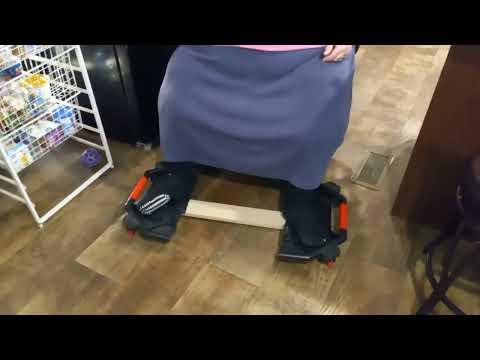
As you can see from this demonstration video, my wife was able to get her feet into and out of the footrest herself. Your experience may vary.
While my wife moved the power chair, her feet in the footrest moved with the chair. No additional effort was needed.
If you plan on building this customized footrest yourself, be aware that adjustments and modifications will be necessary. Each person is different, which is why customization is key. Use feedback from the person using the chair to improve the design—it is surprising how a small change can make a big difference.
Please let me know what modifications that you did for your build. We will continue to refine this design to make it the best it can be, so she can be more mobile.
Happy making!