Drag Kart

I made this drag kart for one reason, and that was to achieve maximum speed in a straight line. Although I wasn't able to get it to the speed I wanted it to go I was able to make an amazing drag kart.
Supplies


There were a few things needed to complete this project but none of them are overly expensive.
-Wire Strippers
-Electrical Tape
-Wire
-AA Battery
-Screwdriver
-4 small 15mm screws
-3d Printer
-Hot Glue Gun
-Motor
-Switch
-Zip Tie
The motor and switch came from this air pump I bought from Walmart. The timing for this kart was videoed and a measuring tape was set up to 2 feet. The kart was timed to find out how long it took the kart to travel the 2 feet from 5 feet away.
The First Design


This was the hardest step as there were a few problems that had to be fixed before it could work taking over 4 designs to get a working model. At first I had a small motor and designed the frame in one piece. This seemed to work but as I started to try and make the rear axle move it snapped due to the fragile design. I tried making another design that had a smaller tolerance for the rear axle but it still fused to the frame. Also the pieces holding the axle were very thin and fragile. The motor ended up breaking so I had to dissect the motor of the air pump to get a larger more robust motor.
The Working Model


After the few problems I encountered I decided to scrap printing the frame in one piece and tried adding notch into the axle and gear so that I could print those separately and assemble the entire thing later. This started out promising but I quickly realized that the tolerance on the axle to gear was to loose and caused the gear to spin off when the machine got to any type of speed. After thinking about the design for longer I realized I can use 4 small screws and print the axle as one piece and have the frame in two pieces that close over the axle. This seemed to work and I was able to get the first working model of the drag kart. This model was able to complete 2 feet in 1.01 seconds this was fast but not fast enough.
More Speed

This step was the easiest of the steps and only took 2 versions. This included making the gear on the motor larger and the gear on the axle smaller. Everything fit together well but the motor lacked torque and couldn't move the kart even with help. I had to make the gear smaller on the motor so the motor could handle the gear ration I went from a 18 to 18 gear ratio originally to a 20 to 16 gear ratio. This helped a little dropping the 2 foot time trial from 1.01 seconds to .54 seconds dropping just under .1 seconds. This was good but I wanted to try and make it faster.
Even More Speed?


My last step was to make the kart all wheel drive. This was my most ambitious idea and took a lot of designing to get right. I wanted to add power to both axles to try and increase the top end speed for the kart. My first design had 5 gears from the motor to the front but this was way to complex so I ended up going with 3 gears from the motor which was perfect and everything fit together amazingly. I set the kart at the start line and went to start it but nothing happened. I realized that the motor was to underpowered and couldn't fight against the friction from a total of 4 gears all resting on rough plastic. I wanted to try and get a speed test but the motor couldn't push all 4 of the gears and I ended up stopping the drag kart at .27 seconds per foot.
Making of the Kart


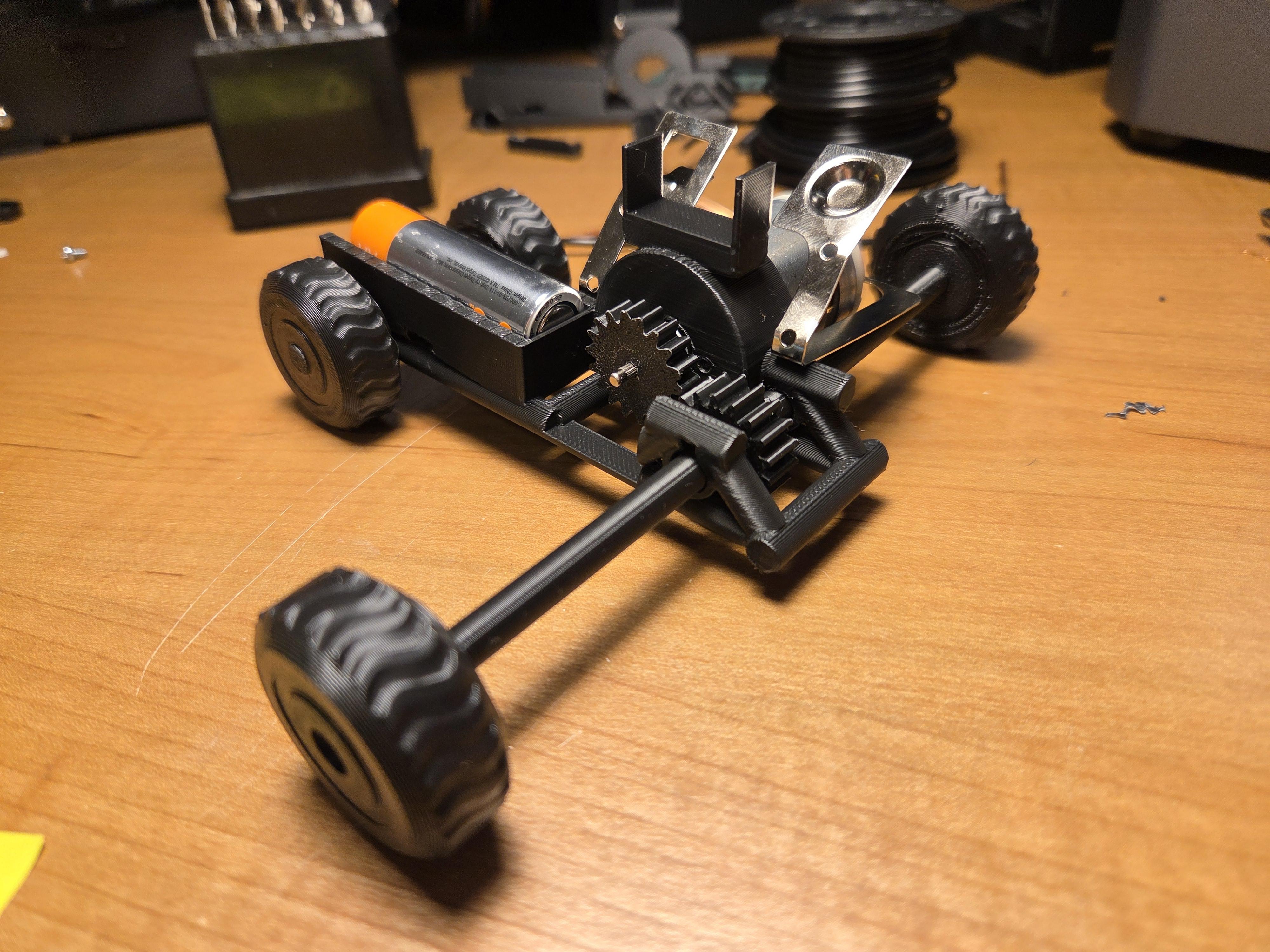

The kart was made by printing out the rear axle, frame, wheels, front axle, and the top of the axle holder. Next you have to put the front axle on and friction put the wheels on, then the motor can be put in the holder and screwed in with the screws included in the air pump. Then you can put the gear on the shaft for the motor and screw the top of the frame over the axle and put the rear wheels on. Then you can wire the wires from the motor to the switch then from the switch to the battery and from the battery back to the other terminal of the motor. Lastly zip tie the battery to the tray and then you have a working drag kart.