How to Mine Crypto With the ESP32 (or Any Other Microcontroller)
by ArihantNag in Circuits > Microcontrollers
603 Views, 1 Favorites, 0 Comments
How to Mine Crypto With the ESP32 (or Any Other Microcontroller)

Hey there! I'm Ari, an inquisitive middle schooler passionate about electrical engineering and being a couch potato. Recently I found myself with nothing but an ESP32 S3 (not to get that confused with the xiao esp32s3). After consulting my friends for advice, I realized I had made a critical mistake they were absolutely hopeless. So, I did what any normal person would do and turned to the world of AI. After some research, I discovered Duino coin (DUCO). You see, for all the project ideas I had in mind, there was always one flaw -- the esp32 s3 is way to overkill for these little circuits. I realized crypto mining was intense, fun, and educational. That's why I think it's the perfect project to learn about JSON and API requests while making real money 🤑🤑🤑🤑. DUCO mining demonstrates core ideas behind cryptocurrencies, hashing, proof-of-work, difficulty adjustment, and block validation, without the computational complexity or energy cost of mainstream blockchains like Bitcoin or Ethereum. If you're wondering what that even means... you've got some serious learning to do. So, let's get at It and dive into the world of crypto! While you try to understand my grammar which is basically the equivalent to a chimpanzee in 2nd grade, feel free to listen to Wolfgang Amadeus Mozart: Symphony No. 25 in G Minor, K. 183: I. Allegro con brio by the Academy of St Martin in the Fields (It's really good). Duino was founded in 2019 and is a for-fun, fully original crypto coin project developed by a team of young developers that focuses on energy efficient mining. It's mostly, but not only, dedicated to people who are just starting out in the crypto world as it doesn't require any expensive equipment.
Supplies

Well lucky you! All you need is an ESP32 (or any other microcontroller). Yep, that's it! No modules or anything like that, your microcontroller doesn't even need to have integrated Bluetooth or Wi-Fi!
You also might want to make your Duino Coin account at this phase of the tutorial and make your wallet.
You can do this at Duino-Coin | Get Started. After that, you're basically halfway done... is what I would say if that were true. You're just getting started with the work and docs, but at least you have Symphony No. 25 in G Minor, K. 183: I. Allegro con brio by the Academy of St Martin in the Fields to listen to while you bang your head on the desk repeatedly trying to understand what in the world a Hashrate is or what an Orphan Block is. now thankfully, DUCO is made for those who are a hybrid of a couch potato and the next Steve Jobs and it doesnt deal with any of that hashrate-blah blah blah nonsense, I mean who would actually study that? (apparently ~562–650+ million people worldwide)
Oh God No!
Did I fail to mention there's a behemoth of code? Oh yeah... sorry about that!
Ok, I'll make it easy for you, get your custom code for your microcontroller at Duino-Coin | Get Started. They make it easy to understand what board you have and what your system specification is. All you have to do is enter your credentials for your router and the crypto Gods will bestow upon you the code! Now because I'm just so kind here's the code for esp32: replace Wi-Fi credentials (mandatory) and your username (Optional)
You're Done! (No You're Not)
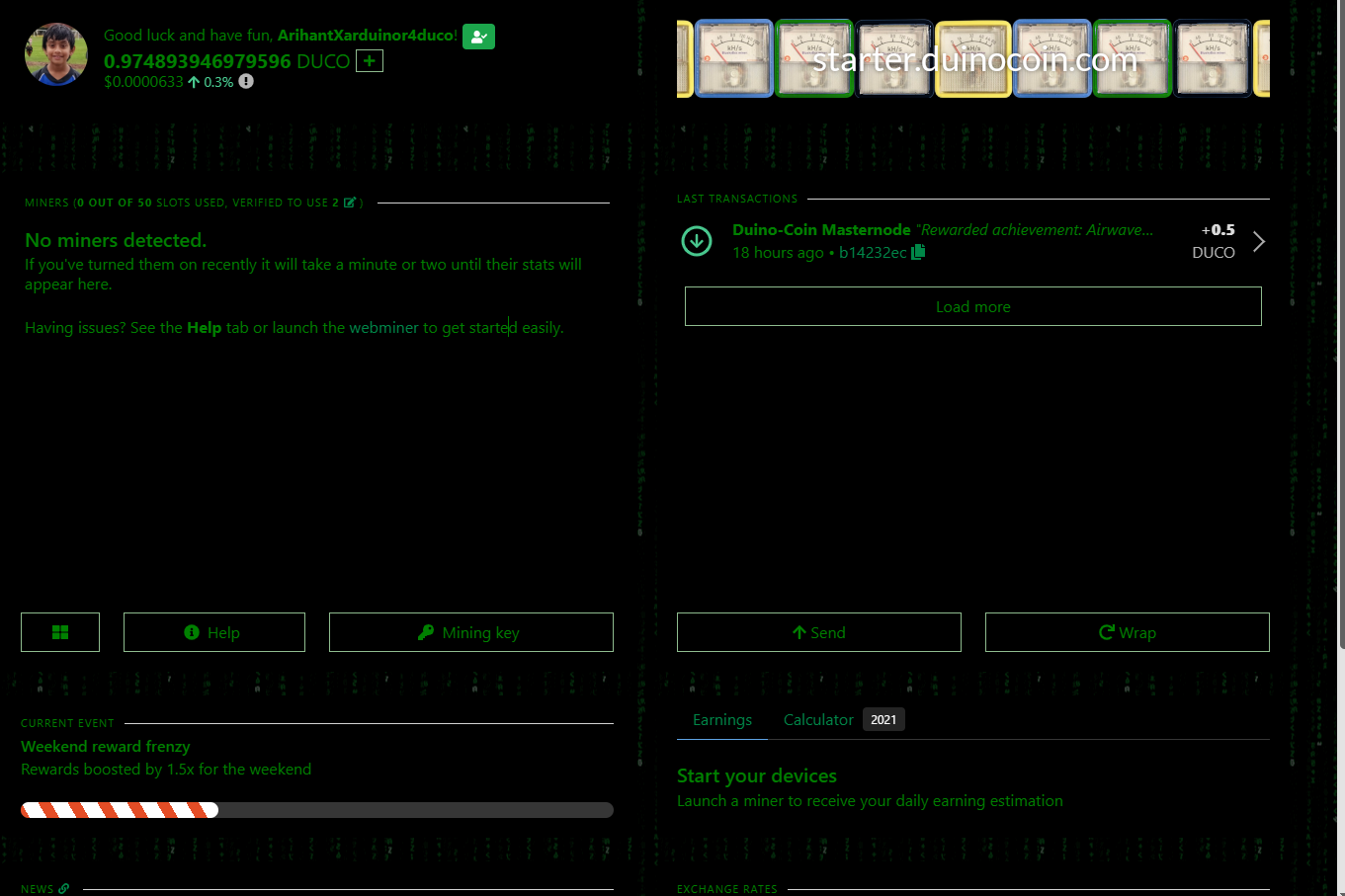

After uploading your code, go to your wallet: Duino-Coin | Web wallet. Check if your ESP32 is making that good ol' money. But mining Duino-Coin (DUCO) on an ESP32 can make the board run quite hot because the CPU is under constant heavy load. To keep the ESP32 safe and efficient, there are several strategies you can use. Lowering the CPU frequency from 240 MHz to 160 MHz or even 80 MHz reduces heat without drastically affecting mining performance. Adding small delays in your mining loop gives the chip brief pauses, which helps prevent overheating. Physical cooling also helps significantly: placing the ESP32 in an open space, using ventilation, adding a tiny heatsink on the metal RF shield, or even a small fan can all reduce temperatures. Monitoring the ESP32’s temperature is important, and if it consistently exceeds 85 °C, additional cooling or intermittent mining is recommended. With these adjustments, you can safely mine DUCO on an ESP32 without damaging the board.
GET VERIFIED!!!

Getting verified on Duino-Coin (DUCO) is INCREDIBLY IMPORTANT because it adds a layer of security and trust to your account. Verification proves that your account actually belongs to you, which helps prevent impersonation, unauthorized access, or loss of mining rewards. It also ensures that any activity you perform—like mining, trading, or using scripts—is reliably tied to your account, reducing the risk of errors or disputes. For miners, especially those running multiple devices or using third-party scripts, verification ensures that all rewards are properly credited and not lost due to account issues.
Verification also unlocks additional features and credibility within the Duco community. Verified accounts can access higher payout limits, participate in community events, contests, or giveaways, and use certain premium mining scripts that are restricted to trusted members. It signals to the community that you are a legitimate and responsible participant, which can be important for joining pools or collaborative projects. Overall, getting verified makes your Duco experience safer, more productive, and opens doors to tools and opportunities that unverified accounts do not have. you must get verified when you add another machine.
About DUCO
Duino‑Coin (DUCO) is a cryptocurrency designed to be accessible, educational, and lightweight, making it ideal for beginners and hobbyists. Unlike traditional cryptocurrencies such as Bitcoin, which require expensive hardware and high electricity consumption, DUCO can be mined using low-power devices like microcontrollers, Raspberry Pi, and even Arduino boards. Its design focuses on teaching users about blockchain technology, mining, and digital transactions in a safe, low-risk environment. By simplifying the core concepts of cryptocurrency, Duino‑Coin allows people of all ages and technical backgrounds to explore the digital currency world.
The mining process in Duino‑Coin is based on a simplified version of Proof-of-Work (PoW). Miners solve lightweight computational problems assigned by the DUCO server, which verifies the solutions and rewards the miner with DUCO tokens. Unlike Bitcoin mining, which relies on high-speed GPUs or ASICs to perform massive numbers of hashes per second, DUCO mining can be completed on ordinary CPUs or even microcontrollers. This approach ensures that anyone can participate in the network without needing expensive equipment, while still learning the principles behind proof-of-work and reward-based systems.
Duino‑Coin uses a client-server architecture rather than a fully decentralized peer-to-peer network. The DUCO server handles the assignment of mining tasks, tracks users’ balances, and validates transactions. This centralized system reduces network complexity and latency, making it possible for low-power devices to participate efficiently. While traditional blockchain networks require every participant to maintain a full copy of the ledger, Duino‑Coin allows devices with limited memory and processing power to contribute meaningfully to the network, emphasizing education over raw performance.
Transactions in Duino‑Coin are simple and fast, reflecting its educational purpose. Users can send and receive DUCO using the official wallet software, with the server verifying and recording every transaction. Because the network is designed for low-power devices, transaction fees are minimal, and processing times are short. This simplicity allows users to focus on learning the mechanics of cryptocurrency transactions without the financial risks associated with higher-value coins or complex blockchain systems.
Overall, Duino‑Coin works by combining lightweight proof-of-work mining, a centralized client-server system, and accessible transaction management. It provides an educational platform for anyone interested in cryptocurrency, enabling practical experimentation with mining and digital transactions on low-power hardware. By removing the barriers of expensive hardware and energy-intensive mining, DUCO allows learners to explore the fundamentals of blockchain technology safely and effectively, making it one of the most approachable entry points into the world of digital currencies.
I'm Proud of You
And there you have it! You’re now officially a DUCO miner. Your ESP32 might be sweating, your PC might be buzzing, but hey, at least you’re earning imaginary internet money while learning real skills! Remember, mining DUCO is like cooking instant noodles: fast, slightly hot, and somehow educational. Go forth, mine responsibly, brag about your low-power hardware, and don’t let your devices start thinking they’re alive… yet. Happy mining and may your hashes be ever in your favor. You’ve just turned your humble ESP32 into a tiny money-making machine… okay, maybe not actual money, but still, digital glory! Your microcontroller is now officially a miner, sweating pixels and hashing like a caffeinated squirrel. Remember: with great mining power comes great responsibility… and possibly a very warm board. Go forth and mine, young padawan, and may your hashes strike faster than your Wi-Fi disconnects (I would never hope for your Wi-Fi to disconnect).
Why Not Learn Some More?



here are some videos to gain some mining knowledge.
DUCO mining works by using a lightweight Proof-of-Work system where your device, whether an ESP32, Arduino, Raspberry Pi, or regular CPU—solves small computational problems assigned by the Duco server. The server acts as a central coordinator, giving out mining tasks, verifying solutions, and crediting DUCO rewards to your account. Miners can work solo or join pools, and because the problems are intentionally easy, even low-power hardware can participate. This setup not only allows mining without expensive GPUs or ASICs but also teaches users about hashing, proof-of-work, network communication, and blockchain fundamentals in a safe, educational environment.