Huge Floor Sitting Cushion


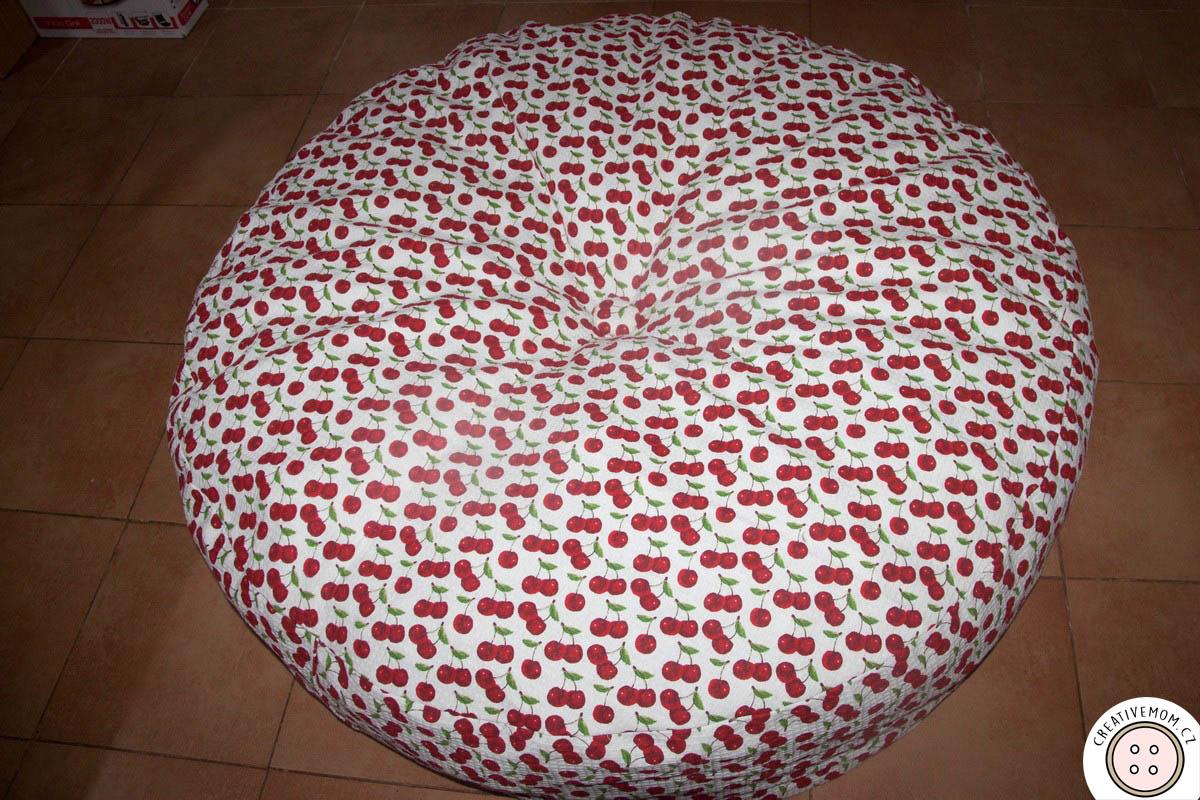


Floor sitting cushions are a great accessory for your home chill area, especially if you have children. I would like to show you how to make a huge cushion which you can also lay down on.
While this huge cushion isn't extremely demanding when it comes to your sewing skills, it's not the ideal project to start with if you're a complete beginner. You will need to handle large pieces of fabric and I recommend having and least a little experience with pinning round pieces.
Also, this project can be quite time-demanding if you - like me - are working with large pieces of soft foam which you need to cut into small pieces. The finished cushion is absolutely worth the time and effort but read through the instructable first. I will also give you the formulas for making this same sitting cushion in any size.
I was working with some very large fabric pieces which I couldn't fit into photos comfortably (given the space I work in) so I used my awesome digital drawing skills for some steps :-D
Supplies
- 1,8 x 2,6 m/5.9 x 8.5 ft of heavier non-elastic fabric such as waffle cotton, softshell, upholstery fabrics etc.
- aprox. 452 liters of filling
- thin layer (aprox 1 cm/0.4 in) of soft foam
- sewing machine + matching thread
- pins
- scissors
- aprox. 452 liters of filling
- measuring tape
- circular shape (glass, mug, mason jar lid)
- hand sewing needle
- long sewing needle
- strong thread (such as jeans thread)
- marking chalk
Fabric: If you cannot find a piece large enough, stitch several pieces together. Watch the pattern when sewing two pieces together.
Filling: The volume is approximate to fill the cylinder. The formula to calculate the volume of the cylinder is V=πr^2v where V is the volume, π is the constant (its value is 3,14), r is the radius of the base and v is the height of the cylinder. Calculate without the seam allowances. For this exact huge cushion it goes like this:
V = 3,14 ⋅ 60^2 ⋅ 40 = 452 l (rounded down)
You can get materials ready to be used or, for example, use the inside blocks from sofas or bed mattresses (I used inside foam block from a sofa). As for the material itself, you can use soft foam, cotton, hollow fiber or anything else commonly used for stuffing pillows or plush toys.
Thin layer of soft foam: At about 1 cm/0.4 in thick, a piece of 10 x 30 cm/4 x 12 in is enough.
Fold Fabric and Cut Shapes


Start with your 1,8 x 4 m/5.9 x 13.12 ft piece of fabric extended on the floor, long sides up and down and short sides left and right, fabric facing right side up (I started wrong side up and then had to draw the shapes on the right side which made the lines of the drawing less visible). Fold the fabric in half vertically. (picture 1)
Find the center of the folded fabric and fold both short sides to the center. (picture 2)
Align the short sides with the central line. (picture 3)
On each side, there's a corner which doesn't have any open side next to it. Find that corner.
Place the end of your measuring tape with the number 0 in that corner and measure the radius of the base of the future cushion on one side from that corner. If you're making my huge cushion, that radius (seam allowance incl.) is 62,5 cm/24.6 in. Make a small mark on the fabric at that point. Then keep the number 0 in the corner and move the other end just a little away from the side you started at. Mark again. Keep moving and marking always a little away from the original marking. (picture 4)
The idea is to make a quarter circle around that corner. Once you're done, connect all the markings. I have drawn that connection digitally so it's better visible and it's not perfectly round. You will connect the markings by hand and make sure it IS perfectly round. If you see that it's not, measure again. Pin all the layers on the inside or outside of the quarter circle. (picture 5)
Follow these same steps in the other corner. You will have a quarter circle drawn in both corners. (picture 6)
Cut out both quarter circles, when you open them, you'll have two full circles.
For different sizes: if you want your cushion to be a different size, just measure the diameter of the base (the "length" of the circle measured from one side to another crossing the center) and divide it by 2. The result will be the radius you'll be measuring and marking for your quarter circle. E. g. if you want a cushion 94 cm/37 in in diameter, you need to measure the radius of 47 cm/18.5 in.
The last cutting step is the side, which is literally a very long rectangle. This large stripe of fabric will be as tall as you want the cushion + seam allowance, here 45 cm/17.7 in. The length will be the circumference of the base + seam allowance. The formula is o=πd, in our case, o=3,14 ⋅ 125 cm = 392,5 cm/154.2 in - And because you'll sew the short ends together, you need to add seam allowance here as well, I rounded it up to 400 cm/157.5 in.
Open the whole fabric piece so it remains folded only vertically in half (the first fold you did). You'll see the holes from both circles (since it's folded, you'll see half-circles) and under them there's enough space to cut the long stripe, or, in fact, two stripes because there are two layers. So, measure and cut a rectangle of 200 cm/78.7 in x 45 cm/17.7 in. (picture 7)
Sewing the Cushion


We'll start by connecting the two long stripes. Mark the seam allowance of 1,9 cm/0.74 in on each short side of both stripes. (picture 1)
Place both stripes on each other, right sides facing each other. Stitch the seam allowance on both sides. Open and you'll now have a single piece which will be the sides to your cushion. (picture 2)
Open the seam allowances on both sides (they're on the wrong side) and iron them to the sides. (picture 3)
Place one base on the floor wrong side up. Place the side piece around it, wrong side facing out. Pin the edge of the side piece to the edge of the base, all around it. (picture 4)
Stitch it 2,5 cm/1 in from the edge.
Now turn the piece so that the base is on the floor. Stitch the other base to the other edge of the side piece, only this time, leave a 20 cm/8 in opening unstitched. (picture 5)
Turn the cushion right side out through this opening. (picture 6)
Now your cushion is ready to be filled. (picture 7)
Preparing the Filling


If you have bought filling that is ready for use, you can skip this step. If you're re-purposing old mattresses etc., read on.
I was lucky enough to get the soft foam blocks from our old sofa that was very clean. I removed the upholstery and checked all the blocks for mold. No mold, yay! Next, I let the block stand in a dry airy place for a few days. If you got your hands on soft foam that is a little wet but is otherwise ok, you can use this to your advantage. Dry soft foam tends to stick to the skin as you cut it into small pieces but not if it's wet. I wouldn't be cutting foam that's dripping but if it's only a little wet, you can cut it first and let it dry after and it won't stick to your fingers.
You'll need so cut the foam into pieces as small as possible. I went for not more than 2,5 cm/1 in although some of my pieces were a little longer in the end (and other were much smaller). The smaller the pieces, the better the result but realistically, cutting more than 450 l worth of foam takes a lot of time and I decided that 1 inch max was reasonable.
Some of the blocks had some hollow fiber casing, so I cut that and used it as well.
Finally, I found out that using large scissors for prolonged periods of time causes scratches and blistering. Just one hour in I had to tape my fingers. I cut all the foam within 3 days, allowing my skin to recover after day 1 and I was surprised to see that from the 2nd day of cutting my skin didn't get scratch or blister anymore.
Cutting your own filling has the advantage that you can just cut a portion of it, fill your cushion and then decide if you're ok with the result or want to cut more. The indicated volume is for a perfect cylinder with flat bases. If you want the bases and sides more plump, you will need more filling, if you want to add that small button in the center of the cushion, you don't want to overfill the cushion.
Filling the Cushion
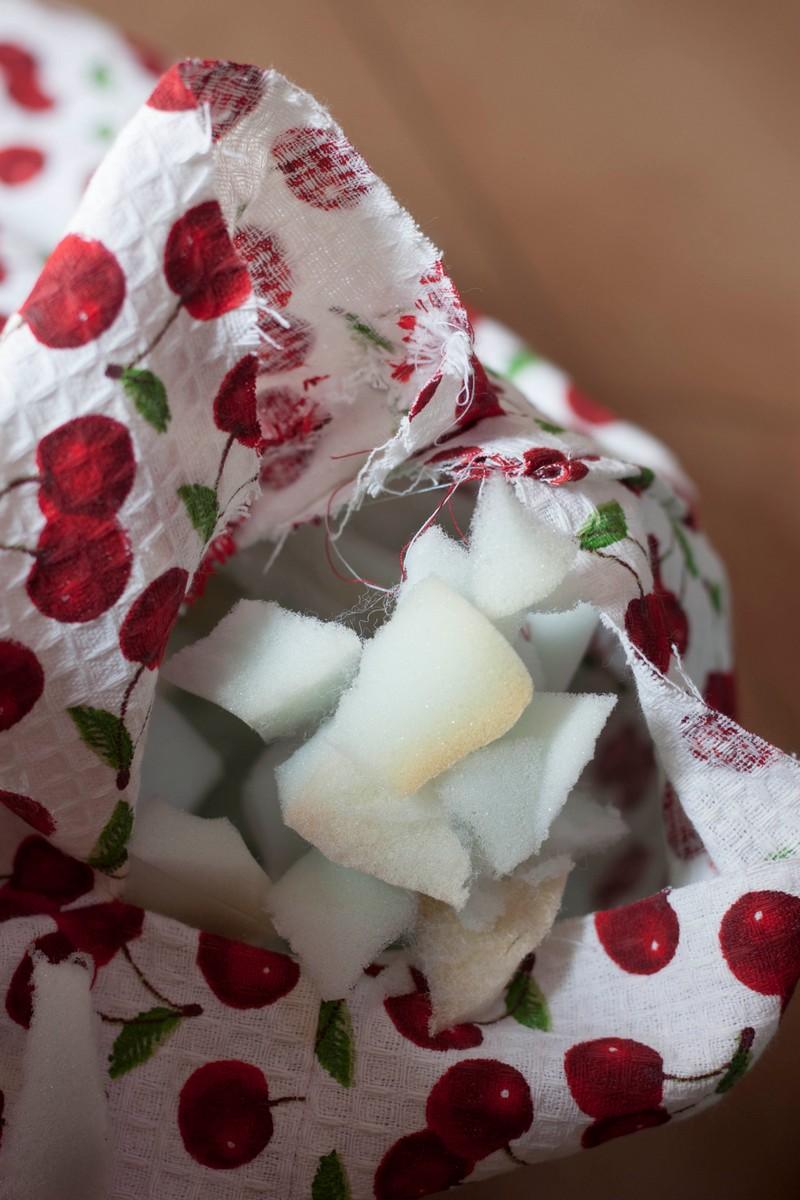


Fill the cushion through the opening. (picture 1)
Try to distribute the filling equally inside the cushion, especially as you come close to having the cushion completely full.
Close the opening with an invisible stitch. Here's how to make an Invisible Stitch. (picture 2)
If the filling isn't equally distributed, you'll see bumps on the cushion. (picture 3)
We don't want that, so shake the cushion until it looks fine. (picture 4)
You can see in the last picture that my cushion is slightly underfilled. That is because I want to add a button in the center and it works better if the cushion isn't filled to the max. Also, you can stop here and not add the button or you can even fill the cushion more and make it more plump (but them you definitely can't add the button).
Making the Button


Find anything round that is just a little smaller than the size of the button you want. I wanted a button that's 8 cm/3.15 in diameter so I used a 7 cm/2.8 in jar lid. This will be your stencil.
You want your final button to be about 4 cm/1.6 in tall without the fabric at its bottom. So you'll need to do just a little bit of counting here.
Take the thin layer of soft foam and trace the stencil as many times as is the number of layers you need to get to about 3 cm/1.18 in. I traced the lid 4 times but because my foam was 1 cm/0.4 in thick, I used only 3 layers. (picture 1)
Cut the circles out. (picture 2)
Stack the circles on top of each other. (picture 3)
Stitch all the layers together s few times. The stitches don't need to be pretty, just pull the needle a few times through all of them there and back. (picture 4)
Use the scissors to round the top layer a little. This layer will be the top of the button. (picture 5)
Take a piece of the leftover fabric and cut out a square that it twice as long as the diameter of your stencil. In my case, my stencil is 7 cm/2.8 in in diameter, so my square is 14 x 14 cm/5.6 x 5.6 in. Fold the square in half horizontally and then also vertically, so now you have a quarter square. Following the same steps like when you were tracing the bases of the cushion - find the corner with the closed sides. Holding the number 0 in that corner, measure the diameter of your stencil (here 7 cm) and make the round shape from one side to another. (picture 6)
Cut the curve, open and you'll have a circle. Place the circle wrong side up and place the button in its center. The button will be facing top side down. (picture 7)
Make a running stitch about 4 cm/1.6 in from the edge, leave both ends longer. (picture 8)
Pull on the edges and close the fabric around the button and make a knot. (picture 9)
Now run the needle through the fabric again with a running stitch, only this time closer to the button, around 1 cm/0.4 in above it. (picture 10)
Make several rounds pulling on the thread, closing the fabric tighter around the button. (picture 11)
Check the button from the top and watch if you're not pulling the fabric too much and deforming the round shape of the button. (picture 12)
Cut the excess fabric a little above the stitches above the button. (picture 13)
Now run the needle across the fabric a few times. (picture 14)
Adding the Button


The button will be in the center of the top base. The first thing you need to do is to find the center of each base. If you measured correctly, the diameter of each base is 120 cm/47.2 in which means you need to find the spot across the base which is exactly this length and the center will be in the center of this line (at 60 cm/23.6 in). Mark the center of each base with a pin. (picture 1)
Take the long needle and thread it with a stronger thread. Pull it through the fabric at the bottom of the button so that the needle comes out in the center. (picture 2)
Find the marked center of the base where you wish the button to be and pinch the needle there. (picture 3)
Now you'll need to make the needle go through to the opposite base and its center. Here's what I do, I hope you have a good laugh looking at the pictures, I found no elegant way to do this with a cushion of this size :-D
First, I press the center with my full body weight and push the needle until I feel it hitting the floor (and you absolutely need the long needle for this!) (picture 4)
Once I know I'm on the right track, I hold the needle in place with one hand, lay down on the side of the cushion, pull the other hand under to find the opposite center (I feel the pin). Then I push with the upper hand and direct the needle to the lower hand. (picture 5)
When that needle pinched through the opposite base, I pull it out with the lower hand and pull on the thread. The button on the top should "sit" in the center of the top base. (picture 6)
I go back through the lower base to the upper base, stitch the button to the top base a few times and I repeat the whole exercise a few times to make the button sit firmly. Every time I pull the needle through, I pull on the thread a little to make sure the button sits lower than the level of the base. I finish at the bottom base, make a few knots and that's it!