Metamorphic Seating: a Concept Chair Collection Inspired by Insect Form
by Arush47 in Design > 3D Design
142 Views, 4 Favorites, 0 Comments
Metamorphic Seating: a Concept Chair Collection Inspired by Insect Form

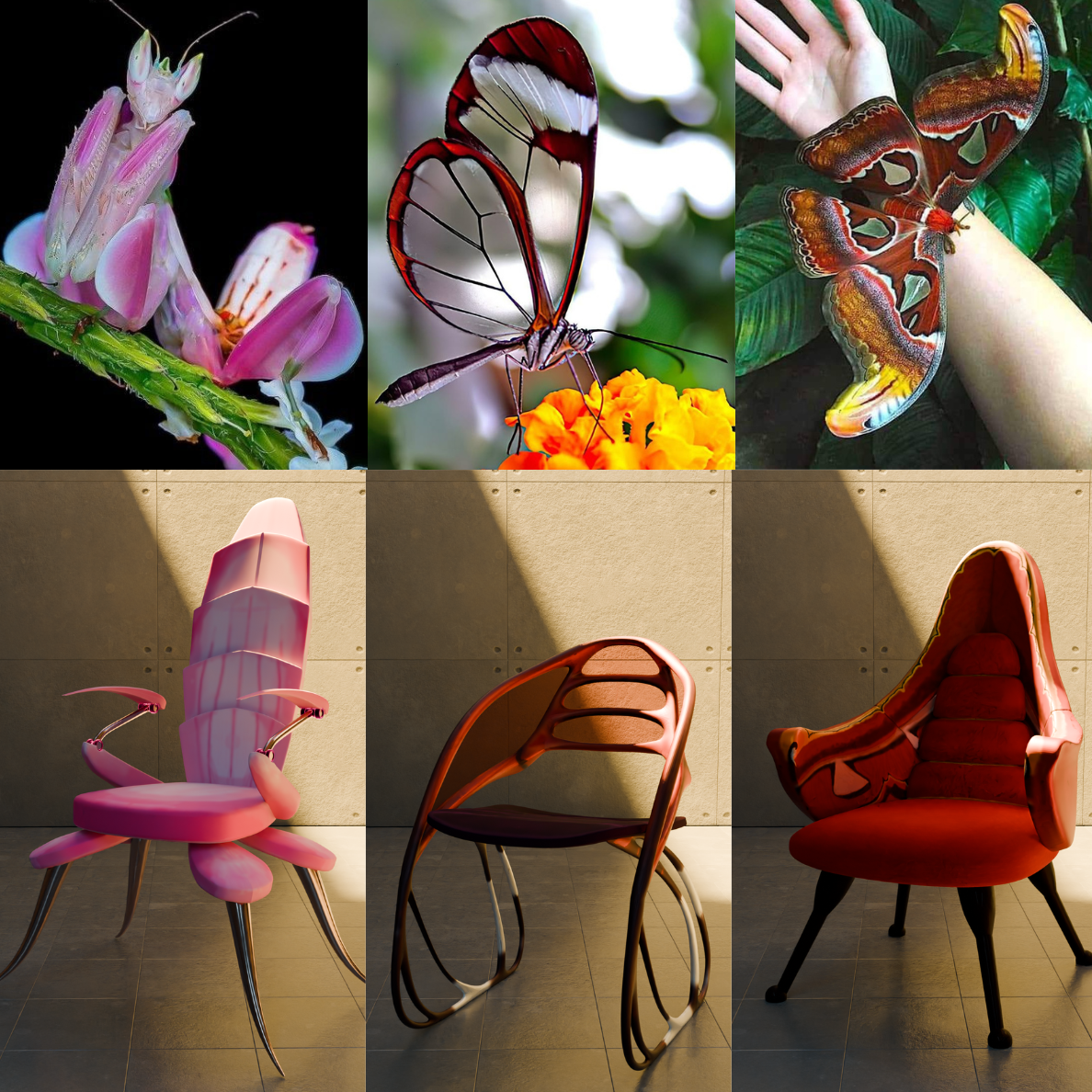
Hi, my name is Arush, an engineering student with a deep appreciation for design and the process of making ideas tangible. The world around us is filled with structures and systems refined over millions of years. Inspiration does not always come from other pieces of furniture — sometimes it comes from something unexpected: a wing, a petal, a transparent surface, or even the posture of a small insect.
In this project, I challenged myself to explore how the beauty, structure, and behavior of insects can be translated into conceptual chair designs. Rather than replicating their forms, I studied how they survive, move, and interact with their environment and abstracted those qualities into furniture.
Supplies
- A computer capable of running 3D modeling software
- 3D modeling software (I used Blender)
- Rendering engine for visualization
- Sketchbook and pencil for initial concept sketches
- Reference images of the Atlas Moth, Orchid Mantis, and Glasswing Butterfly
- Basic knowledge of 3D modeling and form development
Selecting the Insects

To make the design process more challenging and less predictable, I decided to randomly select the insects that would inspire my chairs. Instead of carefully choosing them myself, I asked ChatGPT to name five random insects.
The results were: Atlas Moth, Orchid Mantis, Goliath Beetle, Glasswing Butterfly, and Assassin Bug.
From these, I selected the Atlas Moth, Orchid Mantis, and Glasswing Butterfly. Each of these insects represents a different survival strategy and structural language, making them ideal foundations for three distinct chair concepts.
Research and Observation


I began by gathering reference images to study the form, proportions, and structural details of each insect. I used Pinterest to collect visual material and organized everything in Milanote, separating sketches, references, and notes into structured boards. It helped keep the research process clear and organized.
Once I had a solid visual understanding, I researched the behaviors and survival strategies of each insect, identifying specific features that could be translated into my chair designs.
Concept Sketching (Atlas Moth)

Before I started sketching, I looked up some interesting facts and behaviors of the Atlas moth. One detail that stood out to me was that adult Atlas moths do not eat — they store all the energy they need during their caterpillar stage. This means their adult bodies must be as efficient as possible. Inspired by this, I decided to keep the chair concept simple, avoiding flashy shapes or unnecessary elements and focusing on the bare minimum required for function.
I began by creating rough thumbnail sketches, exploring different ways the chair could be formed while maintaining the moth’s overall silhouette. While studying reference images, I noticed that when an Atlas moth’s wings are relaxed, they form a continuous curved shape. When flipped upside down, this shape resembles the back of a barrel or tub chair with an extended backrest.
If the wings are slightly bent inward, they naturally form two armrests. Placing a cushioned seat between them completes the basic structure of a chair. However, since the back and armrests would be a single rigid form, they could feel uncomfortable. To solve this, I added cushioning to the backrest, positioning it where the moth’s abdomen would sit between the wings. I shaped the back cushion to resemble the segmented abdomen, subtly reinforcing the insect reference. The legs were simplified and shaped to resemble insect legs.
For materials, the wing structure forming the back and armrests would need to be rigid. This could be achieved using a supportive internal frame padded with foam and covered in fabric or artificial leather, or potentially molded plastic. The legs could be made of wood for structural stability.
Since the cushioned seat represents the body or head of the moth — which is covered in fine hair — I chose velvet as the material. Velvet is soft and has a short, fur-like texture that subtly reflects the moth’s surface. The same material would be used for the back cushioning to maintain consistency.
Concept Sketching (Orchid Mantis)
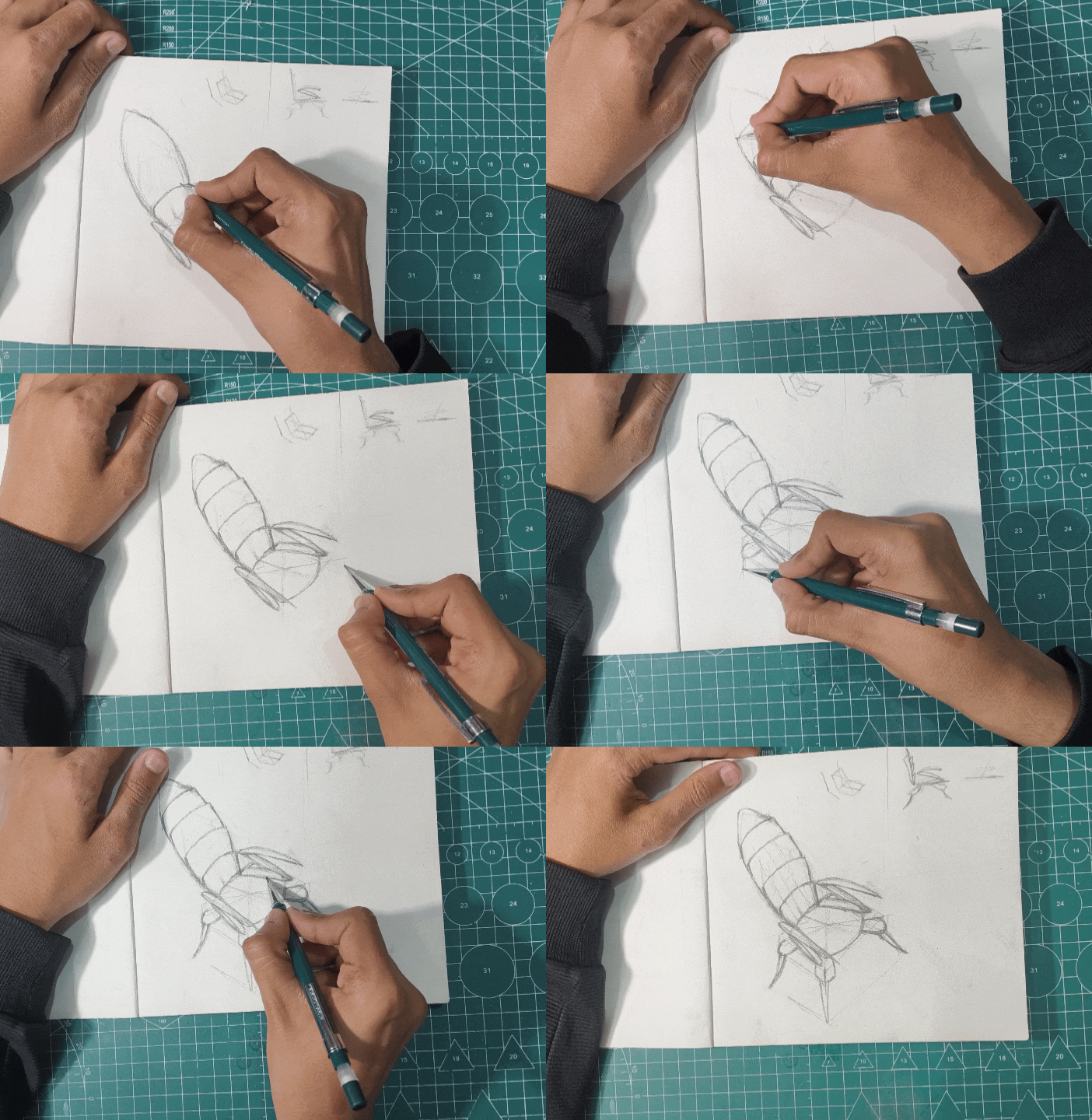

The defining feature of the Orchid Mantis is its ability to look and behave like a flower in order to attract insects searching for nectar. While the Atlas Moth concept focused on efficiency and minimalism, the Orchid Mantis is all about visual attraction and deception. Because of this, I decided to make this chair design bold and expressive.
I began with thumbnail sketches, but initially found myself stuck. To move forward, I listed the key features of the insect: two jointed forearms, a long segmented abdomen, and a flower-like overall appearance. From this, I developed a clear direction — two jointed, adjustable armrests inspired by the mantis’ forelegs, a long abdomen-shaped backrest, and broad legs designed to resemble flower petals when viewed from above.
For materials and color, I focused heavily on the mantis’ pink tones, shading, and surface patterns. The forearms of the mantis are already visually striking, but to push the design further, I introduced pink-bronze accents to enhance the bold, almost theatrical character of the chair.
Concept Sketching (Glasswing Butterfly)


Unlike the Atlas Moth and Orchid Mantis, which rely on dominance and attraction, the Glasswing butterfly survives through subtlety and transparency. Its wings are nearly invisible due to the absence of colored scales, leaving behind a delicate membrane supported by visible structural veins. This balance between fragility and strength became the foundation of my design approach.
After brainstorming different directions, I developed a concept where the chair’s body is primarily constructed from a visible, organic wireframe structure. The curves are fluid and skeletal, echoing the natural vein patterns found in the butterfly’s wings. The backrest incorporates glass inlays — transparent panels surrounded by a clean white frame — referencing the clear membrane of the wings supported by structural edges.
While researching further references, I came across the Butterfly Chair designed by Eduardo García Campos, whose side profile strongly resembles butterfly wings. The flowing, structural silhouette aligned perfectly with the direction I was exploring, so I incorporated a similar wing-like side profile into my final design to reinforce the inspiration.
For materials, the structural frame could be constructed from lightweight metal such as aluminum, allowing strength without visual heaviness. Powder-coated steel tubing could also be considered for added rigidity while maintaining slender proportions. For the seat cushion, I selected a smooth, slightly reflective fabric such as satin or a silk-blend upholstery to subtly mimic the delicate shimmer found on a butterfly’s body.
Creating the 3D Model (Atlas Moth)


I started by importing the reference images into Blender and aligning them for guidance. To model the wings, I began with a plane, added loop cuts, and shaped it to match the wing silhouette. Once the form felt right, I extruded it for thickness and applied a Subdivision Surface modifier to smooth it out.
Using a Mirror modifier for symmetry and a Simple Deform modifier, I bent the wings inward to form the armrests. I then refined the surface in Sculpt Mode to add subtle creases and adjust proportions.
For the back cushions, I subdivided a cube and used an Array modifier to create segmented sections inspired by the moth’s abdomen. The seat cushion and legs were modeled in a similar way, keeping the geometry simple while maintaining smooth, organic curves.
Creating the 3D Model (Orchid Mantis)

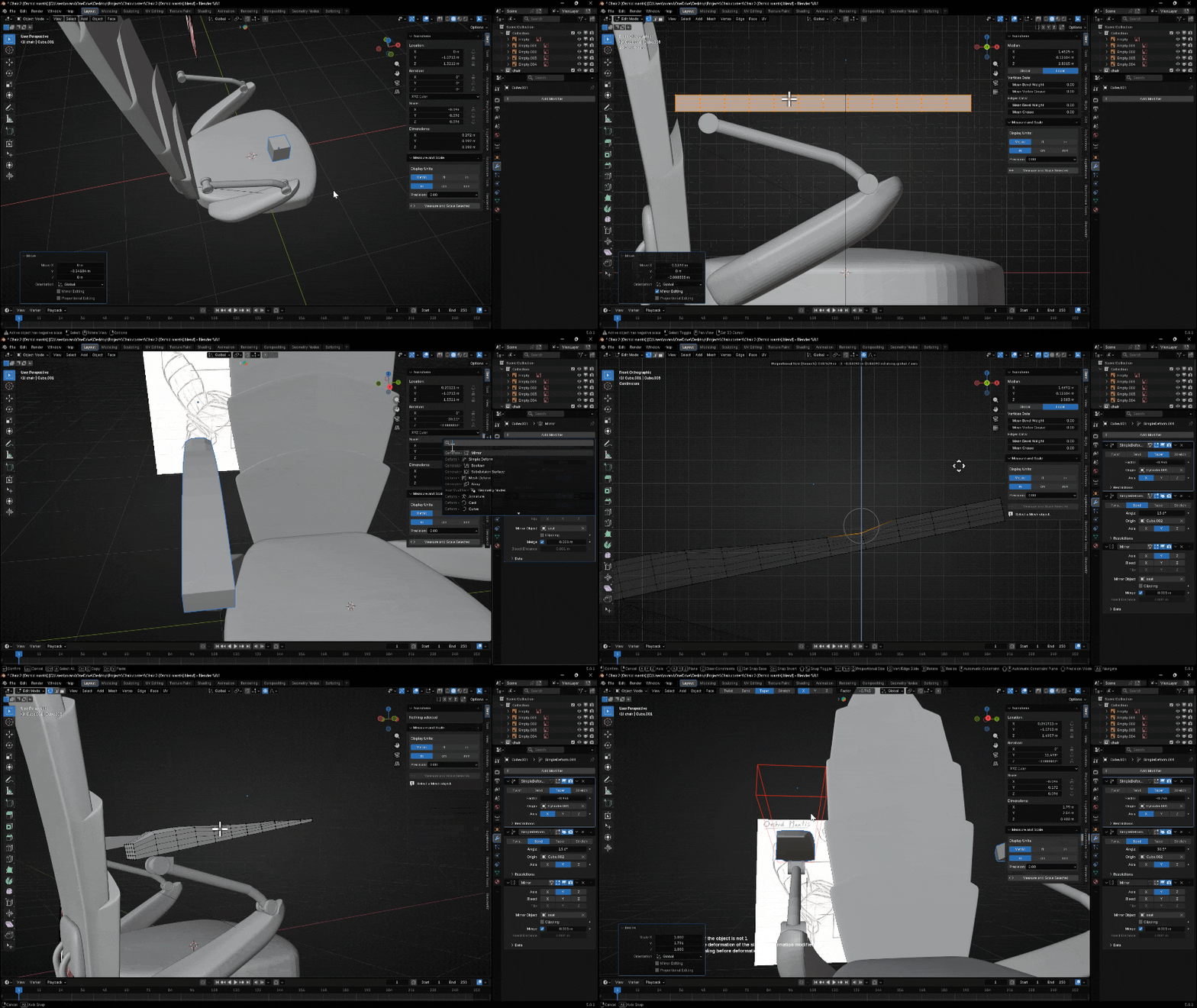


I used a similar modeling approach for the Orchid Mantis chair, but there were some key differences. The backrest required more detailed shaping compared to the Atlas Moth chair. While modeling the layered sections, I had to be careful to avoid overlapping geometry caused by the folds in each segment.
To reflect the mantis’ jointed forelegs, I divided the armrests into three separate sections. This made them easier to model and allowed for articulation if I wanted to adjust their position later.
One important design decision was maintaining the overall silhouette. When viewed from above, the chair needed to resemble a flower — echoing how the Orchid Mantis mimics petals to attract its prey.
Creating the 3D Model (Glasswing Butterfly)


The modeling process for the Glasswing chair was completely different from the previous two designs. To achieve the desired wireframe look, I first created the overall outline of the chair using a plane. I then used the Knife tool to manually draw the internal connections between the outer edges, forming a vein-like structure inspired by the butterfly’s wings.
Once the structure was defined, I applied a Wireframe modifier, which converted the mesh edges into tubular forms, creating the skeletal frame I was aiming for. After refining the proportions and adding slight subdivision for smoother curves, I moved on to the glass panels.
The glass sections were much simpler to create. I shaped separate planes to fit within the frame and applied a glass material using the BlenderKit add-on. This helped achieve the transparent, lightweight appearance characteristic of the Glasswing butterfly.
Texture Painting (Atlas Moth)


Now I moved on to texture painting and material selection, the stage that gives each design its distinct character.
I began with the back cushions, which were inspired by the segmented abdomen of the Atlas moth. Each section of the abdomen is separated by a subtle yellow connection line, which became a key detail in the backrest design. I layered different shades of warm browns and muted tones to recreate the textured appearance of the moth’s body.
For the seat cushion, I applied a velvet fabric texture using the BlenderKit add-on. The soft, slightly reflective surface helped reinforce the moth’s velvety texture. The legs were given a dark wood material to create contrast and ground the design visually.
The most detailed part of this process was painting the wing patterns. I divided the wing surface into sections and gradually built the pattern layer by layer. I carefully recreated the Atlas moth’s distinctive markings while preserving the rich dark brown areas to maintain depth and vibrancy in the final look.
Texture Painting (orchid Mantis)


Unlike the Atlas Moth, the Orchid Mantis does not have highly intricate surface patterns. Instead, its visual impact comes from subtle variations in tone and shading. To reflect this, I focused on using different shades of pink to add depth and create soft, organic transitions across the surface.
Rather than relying on complex patterns, I emphasized gradients and tonal shifts to capture the mantis’ natural camouflage and floral appearance.
To give the chair a more striking presence, I introduced pink-brass accents to the mechanical and structural elements, particularly around the armrests and joints. I adjusted the material properties to add a slight reflective quality, enhancing the bold and expressive character of the design while maintaining its organic inspiration.
Texture Painting (Glass Winged Butterfly)


The Glasswing butterfly has minimal color variation, as it relies primarily on transparency and camouflage for survival. Because of this, I kept the overall palette restrained and focused on subtle contrasts rather than bold patterns.
I used red as the base color for the body and added thin black outlines near the wing edges and around the glass panels to define the structure. To introduce variation and depth, I painted the lower section of the body in a darker reddish-black tone.
One of the distinctive features of the Glasswing butterfly is a white stripe running across the upper portion of its wings. I incorporated a similar white stripe across the darker section to reinforce the biological reference. Finally, I adjusted the transparency and material properties of the glass panels to achieve a light, airy appearance that reflects the butterfly’s near-invisible wings.
Final Rendering


For the final renders, I imported a scene created by Davide Tindellini using the BlenderKit add-on. This provided a clean studio-style environment that helped highlight the forms and materials of the chairs.
After importing the three chair models into the scene, I carefully positioned them to achieve balanced front and back lighting. I adjusted their placement to ensure the materials responded well to the light, especially to capture subtle reflections and surface details.
I then fine-tuned the HDRI and light intensity to enhance contrast without overpowering the textures. Each chair was rendered individually to emphasize its unique character, and I also created a combined render showcasing the full collection together.
Final Thought

This project challenged me to look beyond traditional furniture references and explore how inspiration can come from unexpected places. By studying the form, structure, and behavior of insects, I learned how natural systems can influence design in subtle but meaningful ways.
Each chair in Metamorphic Seating represents a different interpretation of transformation from the efficient strength of the Atlas Moth, to the expressive boldness of the Orchid Mantis, and finally the structural transparency of the Glasswing Butterfly. Rather than copying nature directly, I focused on abstracting its qualities and translating them into functional forms.
Through this process, I gained a deeper appreciation for observation-driven design and the importance of thoughtful iteration. This project reinforced the idea that even the smallest elements of nature can inspire compelling and intentional design solutions.
Downloadable Models
To make this project more accessible, I am providing the 3D models for each chair as downloadable files. Anyone interested in exploring the designs further, modifying them, or even bringing them into the physical world is welcome to use them.
Download the complete project files here:
👉 GitHub Repository: https://github.com/mrarush123/Metamorphic-Seating
( ദ്ദി ˙ᗜ˙ )