Motorizing Coffee Hand Grinder (MHW-3BOMBER R3) Into a Low Speed 12 RPM "Snow Grind" Powerhouse
by Dharma Modder in Workshop > Home Improvement
159 Views, 0 Favorites, 0 Comments
Motorizing Coffee Hand Grinder (MHW-3BOMBER R3) Into a Low Speed 12 RPM "Snow Grind" Powerhouse

 into a Slow Speed 12 RPM "Snow Grind" Powerhouse)
I’ve successfully motorized my MHW-3BOMBER R3 grinder. I noticed that my espresso quality improved significantly with a very slow, consistent grind speed. Many grinders in my opinion grind at way to high speed causing the beans to shatter, creating a lot of fines, and also create a lot of static.
Since I love light roast beans, the force needed to grind them at low RPM is high. I didn't want the motor to struggle, so I went for a high-torque approach.
The result is what I call the "Snow Grind"—the grounds come out fluffy and incredibly even. My goal was to create a build that handles the toughest beans at 12 RPM without stalling. But patience is key, this grind does take 3.5 minutes for 18grams. But speedier option at potential loss of quality are possible with different motor/gears. I did not try these other gearboxes, so try at your own risk.
The total build could be around €150 and you would have a grinder that potentially matches the quality of a very expensive (but much quicker) one.
Supplies
Hardware & Electronics
MHW-3BOMBER R3 Series Coffee Grinder

Get the Grinder Here ~ €100
54mm Spindle Mount Bracket (Grinder Clamp)

Get the 54mm Clamp Here - €12
36-36ZY Planetary Gear Motor (11RPM)

Get the Motor Here (I used the 11RPM version + optional bracket to replace the Spindle) ~ €30
36mm CNC Spindle Motor Bracket (Optional)

Get the 36mm Clamp Here - €12
Note: This 36mm bracket is optional if you choose to mount the 36-36ZY motor directly using the optional bracket
Power Supply Adapter AC 220V to DC 24V (5A)

Get the Power Supply Here - €12
DC 400W 15A Step-up Boost Converter

Get the Boost Converter Here - €3
This module allows us to "overclock" the 24V motor to 36V for significantly higher torque and performance.
DC 6-60V 30A PWM Motor Speed Controller

Get the PWM Controller Here ~ €5
(A more expensive high-frequency controller is recommended if motor noise/whine is important to you). By default it will be on, the power button can only turn it off and on afterwards. So after a powercut it will start automatically, so do not use)
90-30v Waterproof High-Current Metal Button Switch (16–22mm)

Get the Button Switch Here ~ €4
Or chose the ZK-BMG DC5-30V/9-60V PWM DC Motor Governor, which also has a button and can set a higher inaudible frequency ~ €9 (I have not tested this one)
XB30*40 Flexible Spider Plum Coupling (8mm)

Get the Coupler Here - €4
Magnetic Extension Drill Bit Holder (60mm)

This acts as the interface between your shaft coupler and the grinder's hexagonal input.
Zinc Plated Hexagon Socket Threaded Insert Nuts (M6)

Gearbox & Motor Options (Choose your RPM)
When ordering your motor from the links above, you will need to select the correct RPM version from the seller's menu. Choose based on your priorities:
1. THE TESTED SETUP (The "Snow Grind" Powerhouse)
Selection: 36-36ZY Motor - 11 RPM
Torque at 36V: 255 kgf·cm (Stall)
Best For: Maximum torque and ultra-slow, consistent grinding speed. It is nearly 8x stronger than needed, ensuring it will never slow down even on the lightest roasts. Max speed 15 RPM.
2. THE SPEED OPTION (Standard Hand-Grind Speed)
Selection: 36-36ZY Motor - 58 RPM
Torque at 36V: 135 kgf·cm (Stall)
Best For: A faster workflow. At 36V, this will run at approximately max 60-80 RPM, matching manual grind speed while maintaining a 4x torque safety buffer, and should also work at 12 RPM.
3. THE SILENT THEORY (Experimental Noise Reduction)
Selection: 36-36ZY Motor - 160 RPM
Torque at 36V: 75 kgf·cm (Stall)
Best For: Reducing high-pitched whine. By using a fast gearbox and dialing the PWM way down, the internal motor spins slower. It still provides double the required torque to crack the beans.
4. 32GP-31ZY Small Motor with speed controller and bracket - BUDGET OPTION - €24
Selection: 32GP-31ZY Motor - 57 RPM
Torque at 36V: 105 kgf·cm (Stall)
Best For: DIYers on a tight budget. It is less robust than the 36ZY series but handles the R3's requirements. Get the 32GP-31ZY here. Power supply might be too small if used with Step-up Boost Converter, so buy your own.
Tools
Hexagonal Self-Adjustable Ratchet Ferrule Crimping Tool Kit

Get the Crimping Tool Kit Here
I already had these, but they so simplified my life. I now always add the sleeves to any stranded wire and I never get issues anymore with loose connections or shortcuts. I like the hexagonal version not the square one.
Note: These are affiliate links to help fund my next projects like my coffee roaster and tempeh incubator.
The Drive Train Assembly
Assemble the drive train first so you can use it as an alignment jig for the rest of the build.
- Prepare the Coupler: The 60mm magnetic bit holder might be a tight fit for the Plum/Spider clamp. Hack: Force a flathead screwdriver into the gap on the side of the coupler and tap it with a hammer to wedge it open. Once widened, hammer the bit holder in and tighten the bolt.
- Mount the Motor: Attach the motor bracket (either the 36mm CNC clamp or the stock motor plate).
- Join the Spine: Connect the Spider clamp to the motor shaft and tighten bolt. Finally, slide the hex input of the R3 grinder into the bit holder. You now have a solid "spine" to align against your baseplate.
Alignment & Baseplate Mounting
This is the most time-consuming part. Precision here saves your motor bearings from premature wear.
- Alignment: Lay the drive train on your baseplate. You may need to chisel out a small recess for the grinder clamp or add washers or other height on the motor bracket to ensure the shaft is perfectly horizontal and straight. A slight angle is okay, but aim for perfection.
- Marking & Drilling: Once aligned, mark your drill holes.
- The Insert Nut Trick: Drill a small pilot hole all the way through. Then, use a wider bit to drill only 1cm deep. This allows the M6 insert nut to "catch" the wood easily; as you screw it in, it will force itself into the tighter pilot hole for a rock-solid grip.
- Bolt It Down: Use the 70mm M6 bolts for the grinder clamp. The 57mm stock bolts are too short to reach the inserts properly.
- The Stand: Secure your baseplate to a stable surface. I used an old reclaimed crate for a rugged, industrial look.
Housing the Electronics
You need a control panel for your power switch, the PWM potentiometer, and the speed display.
- The Control Box: Drill holes in a project box or plate for your power button and the potentiometer dial. Cut a rectangular opening for the PWM controller display.
- The PWM Mod: I found the built-in power button on these PWM controllers can be unreliable. I recommend removing/bypassing it and using a high-quality external power button instead.
- Component Placement: Mount the Step-Up converter where you can still reach the brass tuning screw. You may want to fine-tune the voltage once the system is under load.
Wiring & Soldering
Follow this sequence to ensure your "overclocked" power delivery is safe and switchable.
- Input: Connect the 24V Power Adapter (+ and -) to your main power button. If you aren't comfortable soldering, buy a button with screw terminals.
- Voltage Boost: From the button, go to the Input of the Step-Up Converter.
- Speed Control: Connect the Output of the Converter to the PWM Controller.
- Motor: Connect the PWM "Motor" terminals to the motor. If it spins the wrong way, just swap these two wires.
- Recommended: use the Crimping tool to add a sleeve over all stranded wires.
Calibration & "Snow" Tuning

Now it's time to find your 12 RPM sweet spot.
- Set the Ceiling: Turn on the power. It should start at 24V. Use a multimeter on the Step-Up converter output and turn the dial until you hit 36V. If the in is at the bottom the blue item with the screw on the left side handles the voltage. (If you don't have a multimeter, time the rotations: 60 RPM is exactly 1 rotation per second). So time the RPM based on which motor you selected. I believe the screw on the right is to limit the amperage, but I did not look into this. I believe you can limit the current here and so prevent the motor from breaking the gears if it gets caught in a stone.
- Find the Percentage: Your PWM display shows a percentage (0-100%). Use the dial to slow the motor down.
- Now Load Test: At what percentage can you now maintain 12 RPM while grinding beans? Because of our high-torque motor, the speed should stay very consistent even with hard light roasts!
Congratulations! You now have a "Snow Grind" powerhouse capable of the most forgiving espresso extractions imaginable for a fraction of the cost of a high end grinder.
Noise Issues
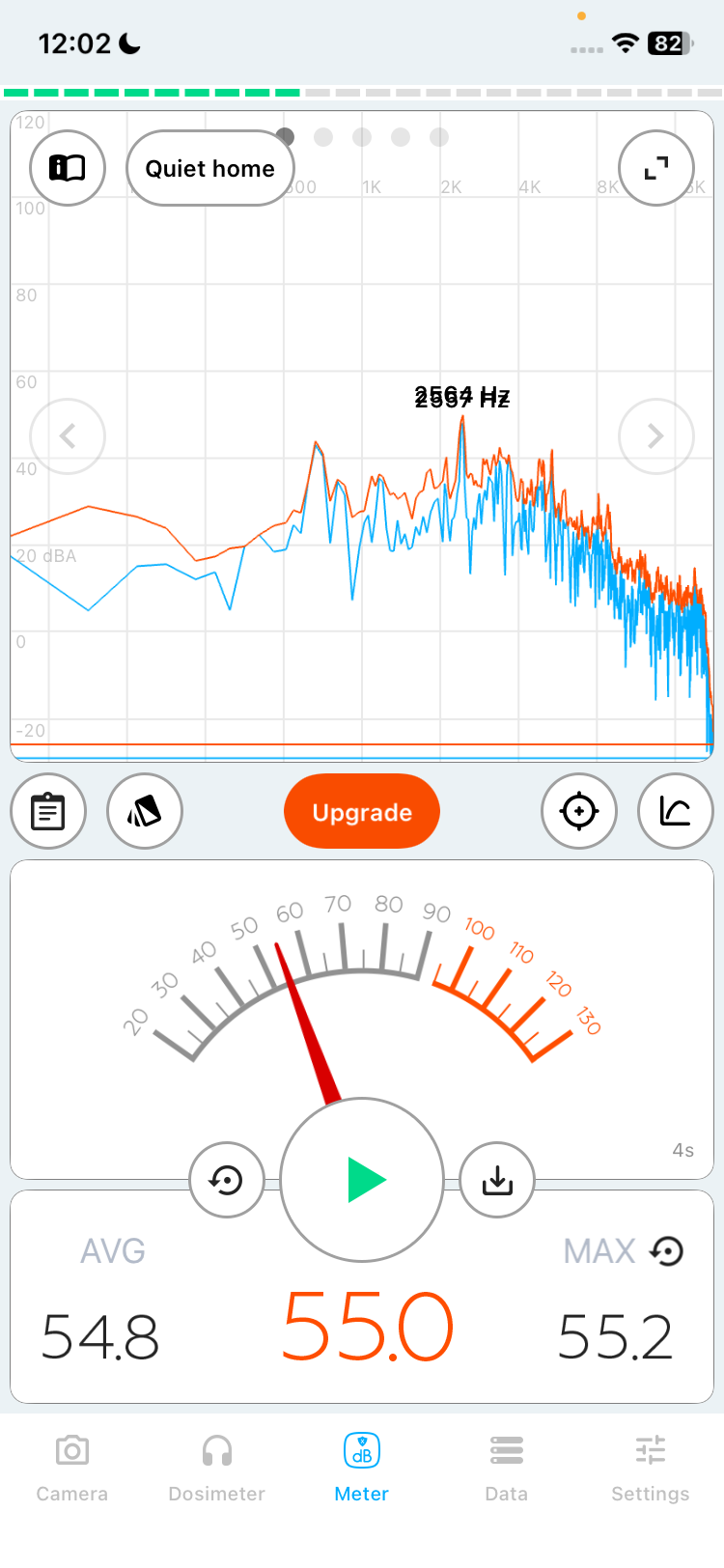


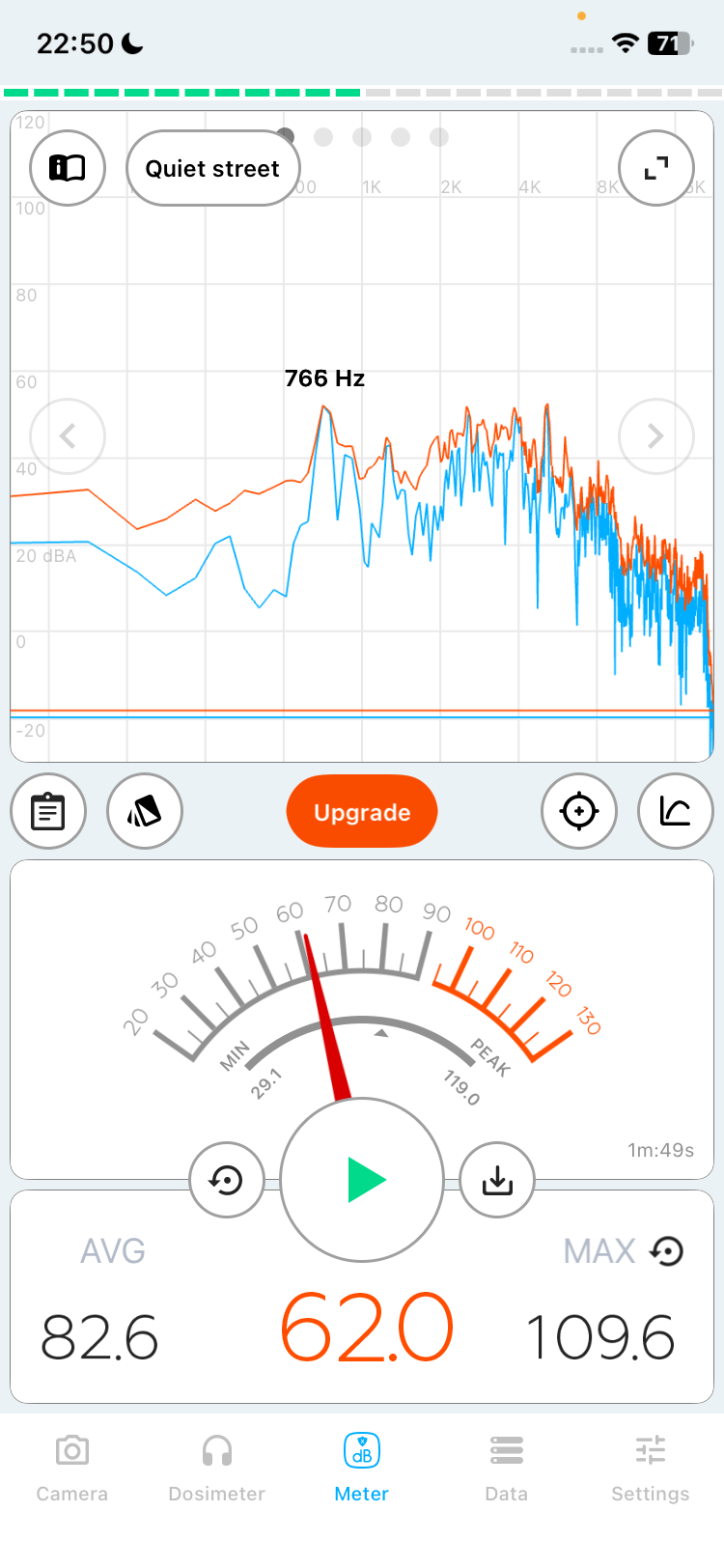
I love the quality of the grind, but I do not love the noise. Initially, at 36V, the planetary gears produced a piercing high-pitched whine that measured around 62dB idle and 68dB while grinding.
Experiments in Sound Dampening:
- Back to 24V: My first move was to remove the boost and return to 24V. This successfully eliminated the high-pitched "scream" of the motor and dropped the noise to 60dB. However, there is a trade-off: at 24V, you lose the ability to reach higher speeds (for me 15 RPM).
- Acoustic Padding: I tried applying acoustic insulation around the motor and gearbox. This brought the noise down to a comfortable 55dB, but it completely ruined the "clean" industrial 60's look of the build. Because aesthetics matter in a coffee setup, I consider this a failed solution.
The Real Solutions (Future Improvements):
- Gearbox Ratios: As discussed in the motor options, a 160 RPM (or lower) gearbox version running at a low PWM percentage would allow the internal motor to spin much slower. This would likely solve the noise issue at the source without needing any ugly padding. It is possible to buy only the gearbox, but I have yet to find how to dissamble it. Also it is possible to buy the same motor at lower speeds, but then we would need to redo the calculations to get the right gearbox.
- The 20kHz PWM Search: Part of the noise is electrical. Standard PWM controllers operate at frequencies audible to humans. To fix this, we need a controller with a frequency of 20kHz or higher. At that level, the switching noise is beyond the range of human hearing.
It seems this controller ZK-BMG DC5-30V/9-60V PWM DC Motor Governor, fits all the boxes with adjustable frequency and enough power, it also features a power button. I will order this one, together with the
