Mr2 Sw20 Power Steering ECU Reverse Engineering
247 Views, 1 Favorites, 0 Comments
Mr2 Sw20 Power Steering ECU Reverse Engineering
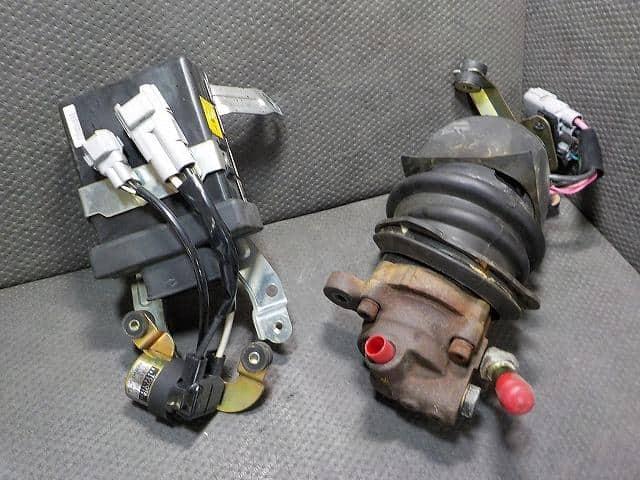
This guide is intended for anyone repairing the factory electronic power steering system in the Toyota MR2 SW20, as well as those transplanting the SW20 power steering setup into a project car and expecting it to behave exactly like it did from the factory. It’s also relevant if you’re considering replacing the original ECU with an aftermarket controller commonly found on AliExpress.
If your SW20 has suddenly lost steering assist and the Power Steering (PS) warning light is illuminated, there’s a high chance you are dealing with Error Code 13 — a fault associated with the MTH signal (motor drive / torque feedback circuit) from the power steering motor.
This is one of the most common faults encountered when restoring or troubleshooting the MR2’s electronic power steering system.
The PS ECU is designed with aggressive protection logic. If it detects abnormal voltage or current on the motor (MTH) circuit — whether due to wiring faults, incorrect grounding, motor issues, or signal mismatch — it will immediately shut down the motor to protect itself. Because of this fast shutdown behavior, symptoms can be extremely brief. The motor may twitch or operate momentarily before the ECU cuts power, making diagnosis frustrating and misleading.
In this guide, I’ll explain:
- How the MTH circuit actually works
- Why Code 13 is triggered
- How to properly test the wiring and motor connections
- How to safely diagnose without damaging the ECU
- And how a simple 10 kΩ series resistor placed in the correct location can help protect the ECU while confirming whether the issue lies in the harness, motor, or signal circuit
Understanding how the protection logic works is the key to solving this fault properly — especially when mixing early 3-wire motors with later 2-wire ECUs during swaps or custom installations.
Supplies
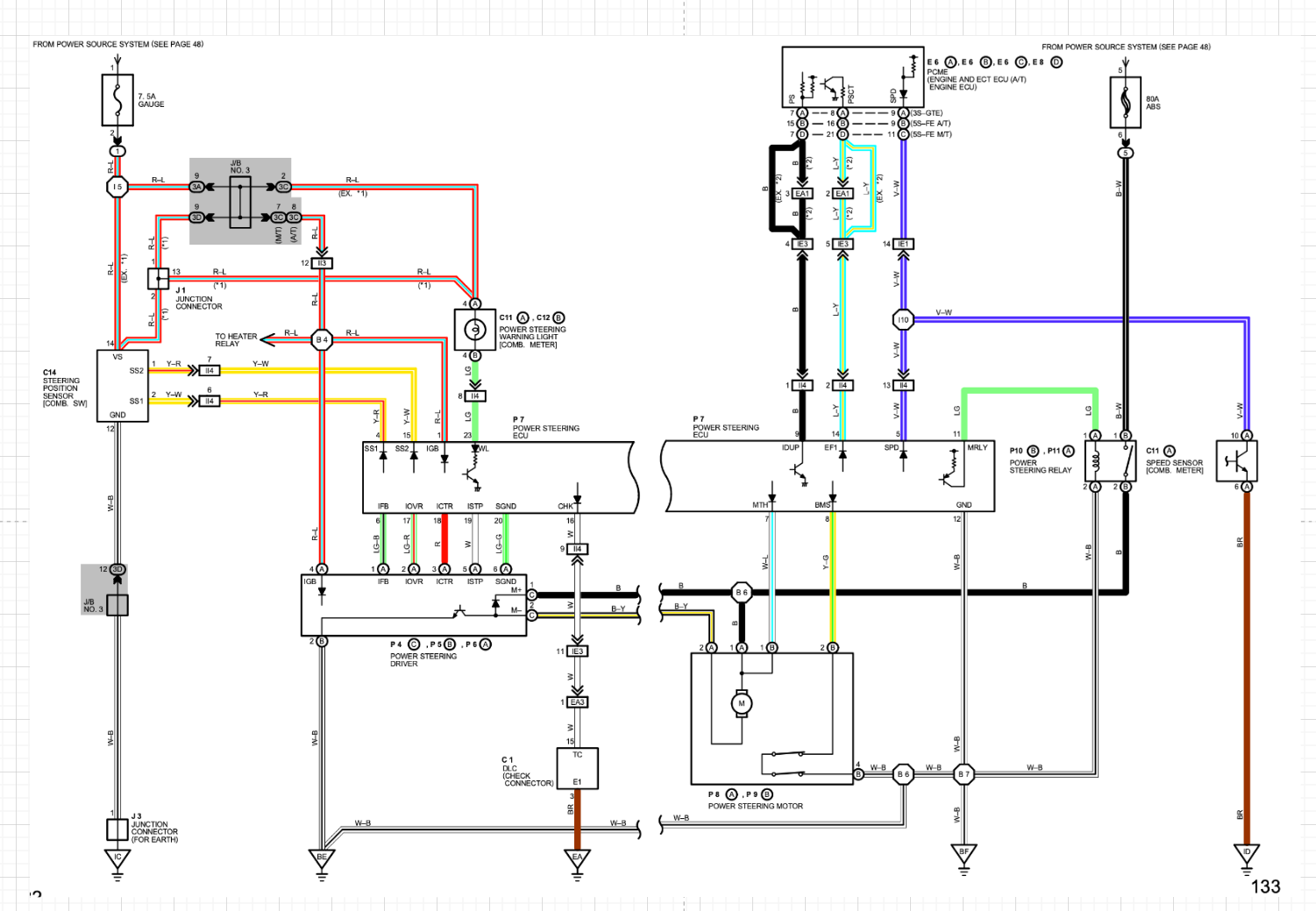


- Many thanks to shinny who have outlined the solution here.
- Link to the service manual gen 1
- After market 100amp motor controller from Aliexpress
- Wiring diagram and fault code retrieval attached
PS ECU
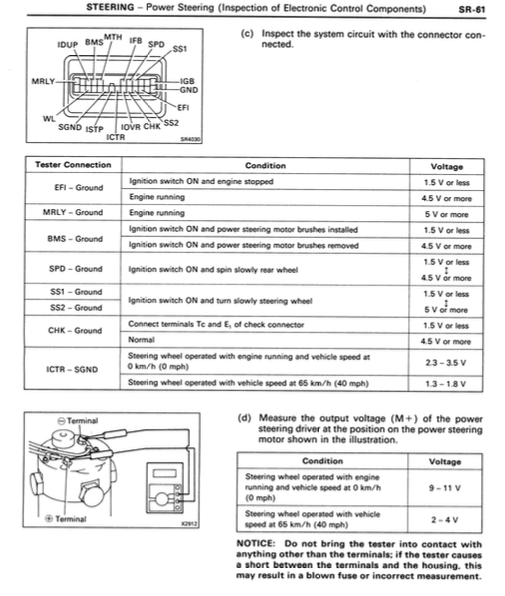
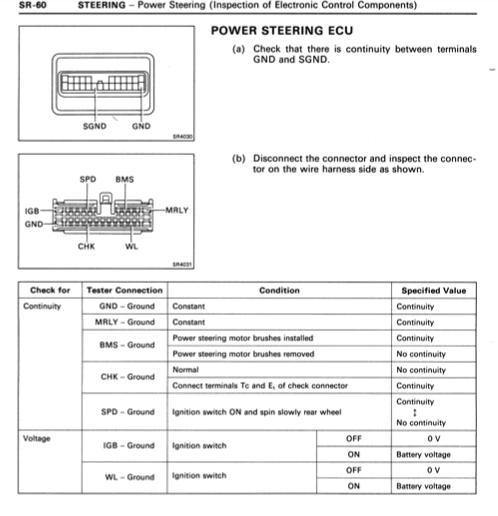
Terminal Function How it works / Notes
WL
Warning Lamp
Sends a signal to illuminate the PS warning light on the dash when a fault occurs by pulling low (e.g., torque sensor fault, code 13).
SS1 / SS2
Steering Sensors (likely angle or torque sensing inputs)
Read from sensors to determine steering input and load. Works with MTH to calculate required motor assist, operating at 5v range.
SPD
Vehicle Speed Input
Receives speed info from the speed sensor. ECU adjusts power assist based on speed — less assist at higher speeds operating at 5v range.
IGB
Ignition +B (12–13 V supply)
Powers the ECU and sends voltage to the motor relay circuit. Typically hot with ignition ON.
CHK
Diagnostic / Self-check
Used during ECU self-test routines; may pull low to enter diagnostic mode outputting error code via WL.
IDUP
Idling status
Engine ECU
EFI
Engine ECU PSCT control logic
Switching off the power steering ECU in an emergency by pulling low.
MRLY
Motor Relay Control
Outputs a ground or positive signal to energize the power steering motor relay, which connects +B to the motor positive terminal.
BMS
Brush wear / motor monitor
Monitors motor brush status; sends signal back to ECU if brushes are worn or voltage anomalies detected.
MTH
Torque sensor output (red wire)
Measures voltage applied to ps motor. Different year motor have different readings.
2 (black, red) wired, black is the ground, red voltage ranges from 0.5 V (minimal torque) down to 10 V (maximum torque) at the motor end (after 1995).
3 (white, blue, red) wired voltage ranges on red near 14v range (post 1995) ground is on the chasis
ECU reads this feedback to confirm the motor is doing what is meant to be doing giving the correct assist. There is a possibility mis-match may be due to the different model years or electrical noise where resistors may be needed.
PS Driver

| Terminal | Function | Notes |
|---|---|---|
| IFB | Feedback from driver module | Sends back motor current or status info to ECU. ECU uses this to adjust assist. |
| IOVR | Overcurrent / protection input | Monitors if the driver module or motor current exceeds safe limits. Can trigger ECU to shut off assist. |
| ICTR | Control signal to driver | Likely controls motor current or PWM duty cycle for assist. |
| ISTP | Stop signal / interlock | Prevents motor operation in certain unsafe conditions. |
| SGND | Signal ground | Provides low-noise ground reference for ECU-to-driver signals. |
PS Motor
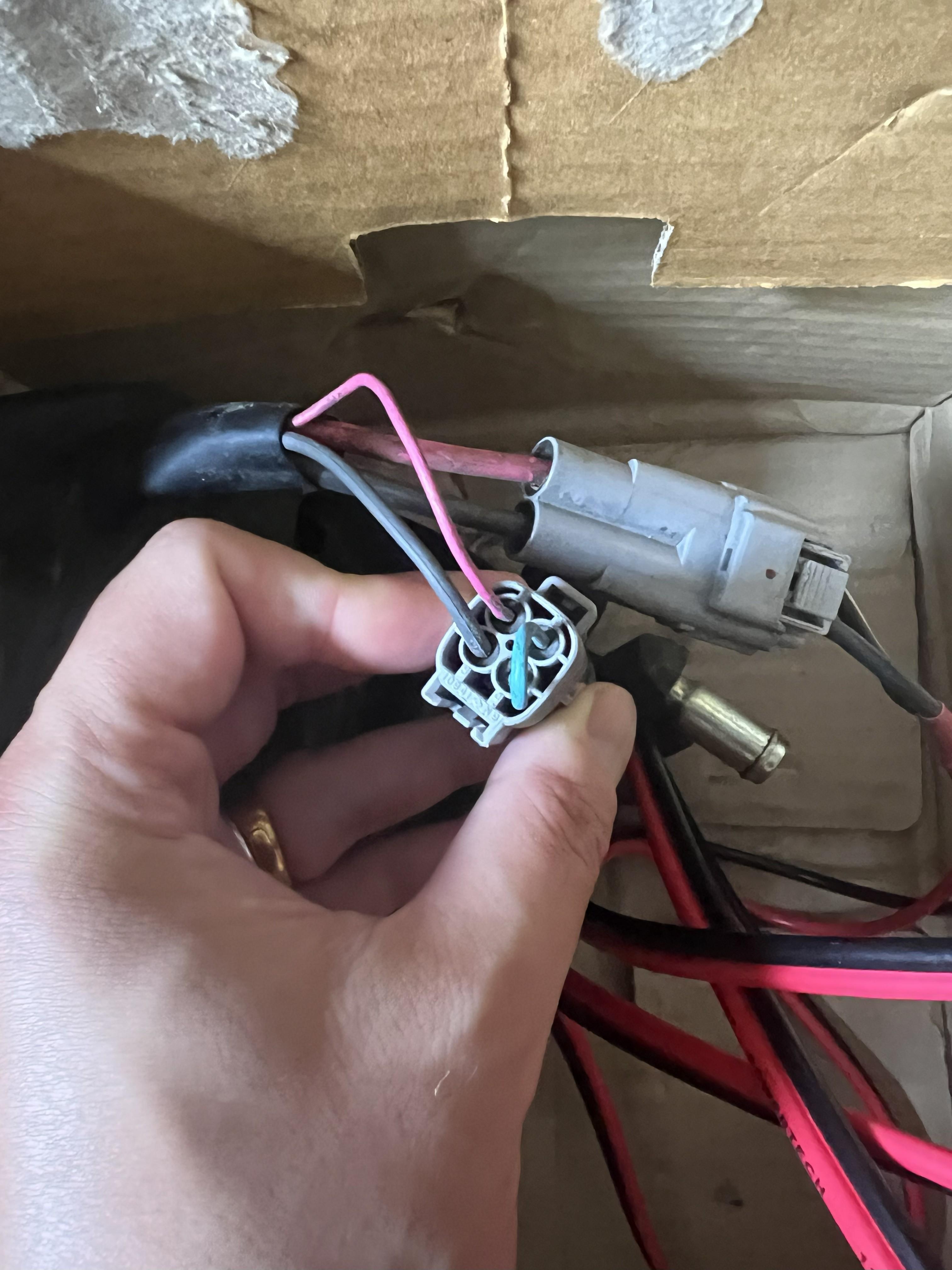
Motor terminals
- Positive terminal (+) → Connected to motor relay controlled by MRLY from ECU. Relay closes → motor gets +13 V.
- Negative terminal (−) → Connected to driver module; driver module switches to ground as required to control motor current (PWM or direct drive).
This design allows the ECU to control motor current precisely, while using the relay for high-current connection to +B.
Torque sensor (MTH) wiring
- Red wire, MTH → Signal to ECU.
- Voltage behavior:
- Minimal torque (wheel at rest / free) → ~13 V
- Maximum torque (hard turn) → ~2 V
- Purpose: ECU reads this analog voltage and calculates how much power assist the motor should provide.
- Any wiring issues (open, short, corrosion) will cause abnormal readings → ECU sets code 13 → PS warning light ON, it may also be caused by a mismatch ECU where 5v signal is expected.
Motor Bushes sensor (BMS) wiring
- Supplying voltage/current to the motor brushes.
- Monitoring brush wear or motor load indirectly by measuring brush voltage/current.
If the brushes wear out or the connection is poor, the ECU may detect abnormal current and trigger a warning (like a PS warning light).
How Everything Work Together
How the system works together
- Driver applies torque → MTH sensor outputs voltage proportional to torque.
- ECU reads torque voltage (MTH), steering sensor signals (SS1/SS2), and vehicle speed (SPD).
- ECU calculates how much motor assist is needed.
- ECU sends control signals to driver module (ICTR, ISTP) to modulate motor current.
- Motor positive powered via relay (MRLY), motor negative switched by driver module.
- Feedback signals (IFB) allow ECU to monitor actual motor behavior and adjust as necessary.
- ECU reads motor bushes voltage (BMS) indicating if they are worm and need replacing.
- Any anomaly in sensor signals, motor current, or wiring → ECU sets fault (code 13, etc.), illuminates WL, set MRLY negative.
- ECU will output code 11 if torque voltage is not detected