Professional Multifunctional DI Box
by lisneth in Circuits > Electronics
50 Views, 0 Favorites, 0 Comments
Professional Multifunctional DI Box


Direct Injection (DI) boxes are essential tools in professional audio setups, but most commercial units are limited to simple signal balancing or basic splitting. This project takes the concept much further.
In this Instructable, I’ll walk you through the design and construction of a Professional Multifunctional DI Box — a 2-channel input, 4-channel output active DI box with built-in preamplifiers, signal conditioning, soft clipping, filtering, and balanced line drivers.
This unit is designed for studio, live sound, and broadcast environments, where signal integrity, flexibility, and low noise are critical.
What This DI Box Can Do
✔ Accepts two independent audio sources
✔ Works with microphone-level or instrument-level signals
✔ Converts unbalanced signals to balanced line-level outputs
✔ Splits each input into four isolated outputs
✔ Includes individual preamplifiers for each input
✔ Features noise filtering and soft clipping
✔ Designed for long-distance, low-noise signal transmission
This makes it ideal for:
- Live stage setups
- Studio recording
- Broadcasting
- Re-amping and signal distribution
- Complex routing without signal degradation
System Overview
At a high level, the signal flow is:
Input → Preamplifier → Noise Filter → Gain Control → Soft Clipper → Active Splitter → Balanced Line Drivers
Each input channel is fully independent and processed through identical circuitry, ensuring consistent performance across all outputs.
Design Concept
The core idea was to combine multiple audio functions into a single professional-grade unit:
- DI Box
- Microphone Preamp
- Signal Splitter
- Balanced Line Driver
Instead of passive transformers, this design uses active op-amp stages, which allow:
- Precise gain control
- Lower distortion
- Better frequency response
- Compact and cost-effective implementation
Input Stage – Unbalanced and Balanced Sources

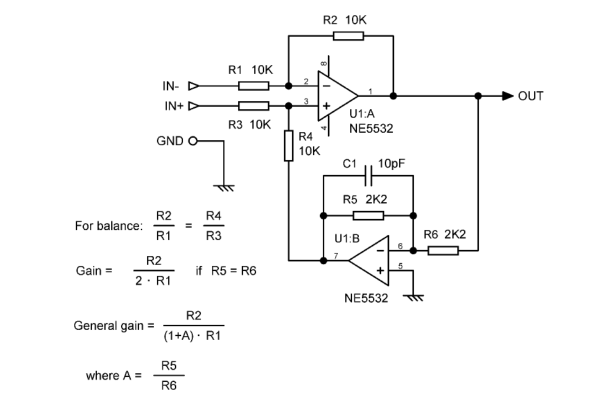
Each channel begins with a high-impedance input amplifier, allowing it to handle:
- Dynamic microphones
- Musical instruments (guitar, bass, keyboards)
- Line-level sources
The input stage ensures:
- Minimal loading on the source
- Stable frequency response
- Excellent noise performance
Coupling capacitors remove DC offsets and protect the following stages.
Preamplifier Section
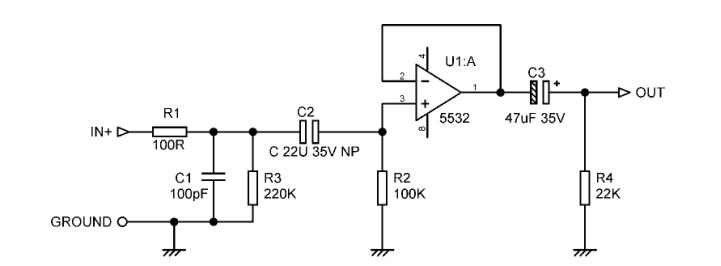
Each input channel has its own dedicated preamplifier, built around low-noise operational amplifiers.
Key features:
- Boosts microphone-level signals to standard line level
- Adjustable gain for matching different sources
- Optimized resistor values for low noise and stability
This stage ensures weak signals can be amplified cleanly before further processing.
Soft Clipper Protection
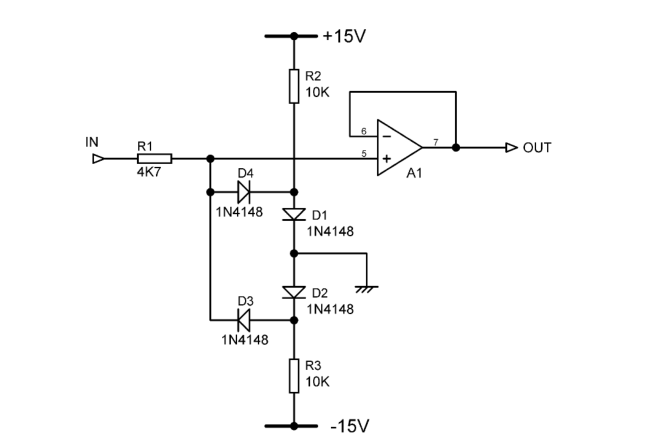
To prevent harsh distortion and protect downstream equipment, a soft clipping circuit is included.
Unlike hard clipping, soft clipping:
- Smoothly limits peaks
- Preserves musical characteristics
- Prevents sudden overload distortion
This is ideal for unpredictable live signals such as vocals or instruments with wide dynamics.
High-Pass Filter
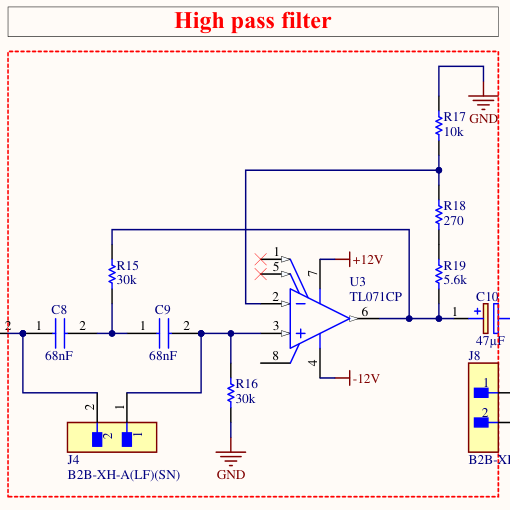
After the preamplifier and initial noise filtering stages, the signal is routed through a dedicated high-pass filter (HPF) section.
The purpose of this stage is to:
- Remove unwanted low-frequency components such as handling noise, stage rumble, and DC drift
- Improve overall signal clarity, especially for microphones and live instruments
- Prevent low-frequency energy from unnecessarily consuming headroom in later stages
The cutoff frequency is chosen to preserve the audible bandwidth of musical signals while attenuating subsonic frequencies that do not contribute to the desired audio content.
By placing the high-pass filter before signal distribution, all downstream outputs benefit from a cleaner and more controlled signal.
4-Way Signal Splitter
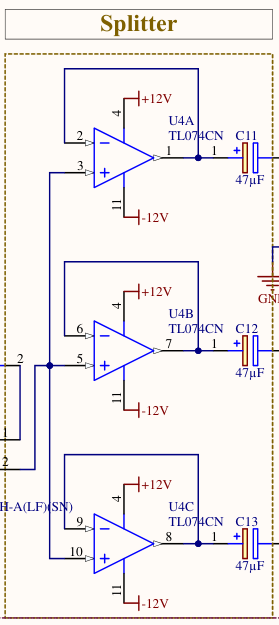
Once properly conditioned, the signal is fed into a 4-way active signal splitter.
This section allows each input channel to be distributed to four independent outputs without signal loss or interaction between outputs.
Key advantages of the active splitter design include:
- Constant signal amplitude across all outputs
- No impedance loading effects
- Preserved phase and frequency response
- Reliable operation with long cable runs
Each split output is buffered, ensuring that connecting or disconnecting one output does not affect the others.
Balanced Line Driver Outputs
Each of the four split signals is then routed to a balanced line driver stage, converting the internal signal into a professional-grade balanced output.
Balanced outputs provide:
- High immunity to electromagnetic interference
- Excellent common-mode noise rejection
- Compatibility with mixers, audio interfaces, and stage boxes
This makes the DI box suitable for both studio installations and demanding live sound environments.
Why This Design Is “Professional Grade”
What separates this from typical DIY DI boxes:
- Fully active signal path
- Dedicated preamps per input
- Soft clipping protection
- Multiple isolated outputs
- Balanced line driving
- Designed for real-world audio environments
This makes it suitable not just for hobby use, but for serious audio work.