Tailless Delta & Stndrd. Config. Mechanical Pencil Gliders
by zdedesigns in Workshop > Science
34665 Views, 342 Favorites, 0 Comments
Tailless Delta & Stndrd. Config. Mechanical Pencil Gliders

Welcome! To make these gliders, you’ll need fine motor skills, attention to detail, and patience. If you're new to making flying things, the guidance of someone who knows about aircraft and flight will come in handy, especially when it comes to testing and trimming the gliders.
If you are a teacher and plan to use these for a class project, you may want to have students work in pairs or small groups. Note that the tailless delta is easier to build than the other. For fun and some additional learning, I recommend a distance competition, a control competition (such as flying through a ring at a certain distance), or a combination of the two.
Here are some possible prompts for builders to answer.
CALCULATIONS
- What is the mass of each glider?
- What is the wing span of each? (Once the glider is constructed, measure a straight line from tip to tip.)
- What is the wing area of each? (As with the wing span, you should be referring to a planform.)
- Using the mass and wing area, calculate the wing loading of each glider.
COMPARISON
- Which design seems to have more yaw stability? What might account for this?
- Which seems to have more roll stability? What might account for this?
- Which seems to have a better glide slope?
- If you were a pilot, and these were full scale aircraft, which would you rather fly? Explain.
CREATION
- What modification do you plan to implement, and on which glider? What do you hope the modification will do for the glider?
- If designing something entirely new, what considerations are foremost in your mind?
Supplies
- sheets of 8.5" x 11" card stock; 65 lb. (175 gsm)
- plastic mechanical pencils; 15 cm long (with pocket clip on main tube, not plunger; more information below)
- pencil tip erasers
- scissors
- glue stick
- metal ruler and hobby knife
- clear adhesive tape
Prepare Pencil
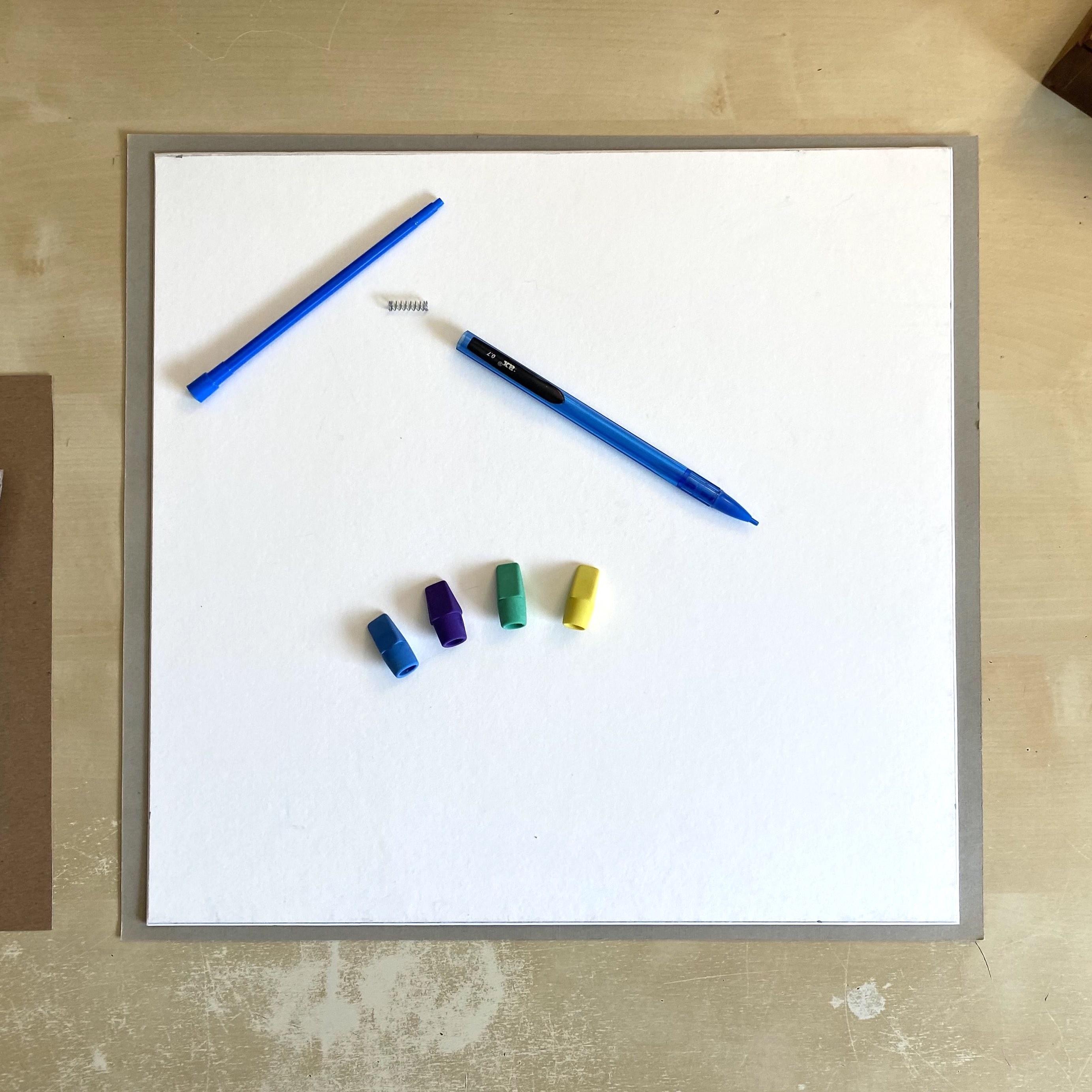

Find a mechanical pencil, preferably one that has a broken spring or is otherwise unusable as a pencil. It should measure 15 cm long, have a hexagonal shape, and have a pocket clip on the main tube. It cannot have the clip on the plunger/erase part because that part will be removed. I like Bic mechanical pencils for this project.
Remove the cap of the pencil and the components inside, then put the cap back on.
Delta—Print Plans & Cut Out Shapes


Print the plans onto a sheet of card stock. Use 65 lb. card stock, or 180 gsm. Gluing two sheets of lighter material together, such as some decent quality 90 gsm paper, could work (and thank you codemind).
Carefully cut out the shapes. If you plan to use a hobby knife, make sure it's very sharp. Younger builders should get permission from an adult before using a hobby knife.
Downloads
Glue & Make Creases


Before using your glue stick, double check that you're working on the correct side of the card stock piece. Applying a thin and consistent layer of glue, and attach the brace piece to the top of the main wing. Use a straightedge to start creases on all of the dotted lines. Start with the center line. In so doing, you will make the wing dihedral. The wingtips should rest about 5 degrees above horizontal.
Raise the interior elevons by about 5 degrees. Raise the slim outer elevons by just a few degrees. Carefully check for symmetry of the left and right sides.
Finish Wing

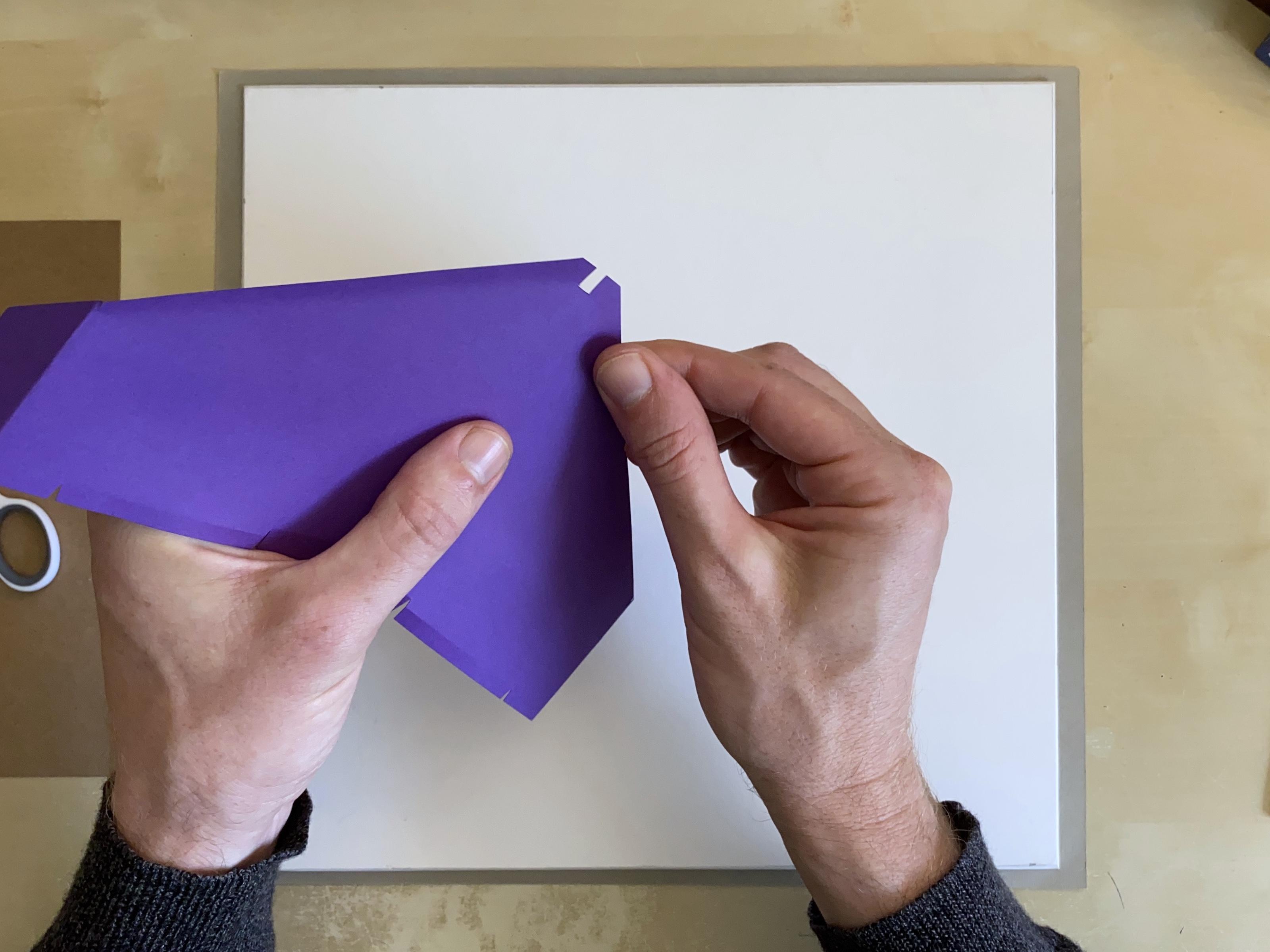

Increase the angles at the wing tips to 90 degrees, thereby defining the vertical stabilizers / winglets. Now, use your thumb and fingertips to gently pinch along the leading edge to curl the card stock down slightly. Repeat several times, working incrementally, until the card stock holds the shape.
Before sliding the wing into place, check that the notch at the forward point of the wing is wide enough. Depending on the brand of pencil you're using, the clip may be too wide and you'll need to widen the notch.
Secure Wing to Pencil


Get a strip of tape measuring 8 cm and make a reference mark in the middle. Find the point on the bottom of the fuselage (the pencil) that is 7 cm back from the very front of the wing. This is as far forward as the strip of tape will reach. Carefully adhere the tape to the fuselage (sticking to the sides) and then the bottom of the wings. Avoid pulling down on the wings while doing this.
Standard Config.—Print, Cut Out Shapes, & Make Creases
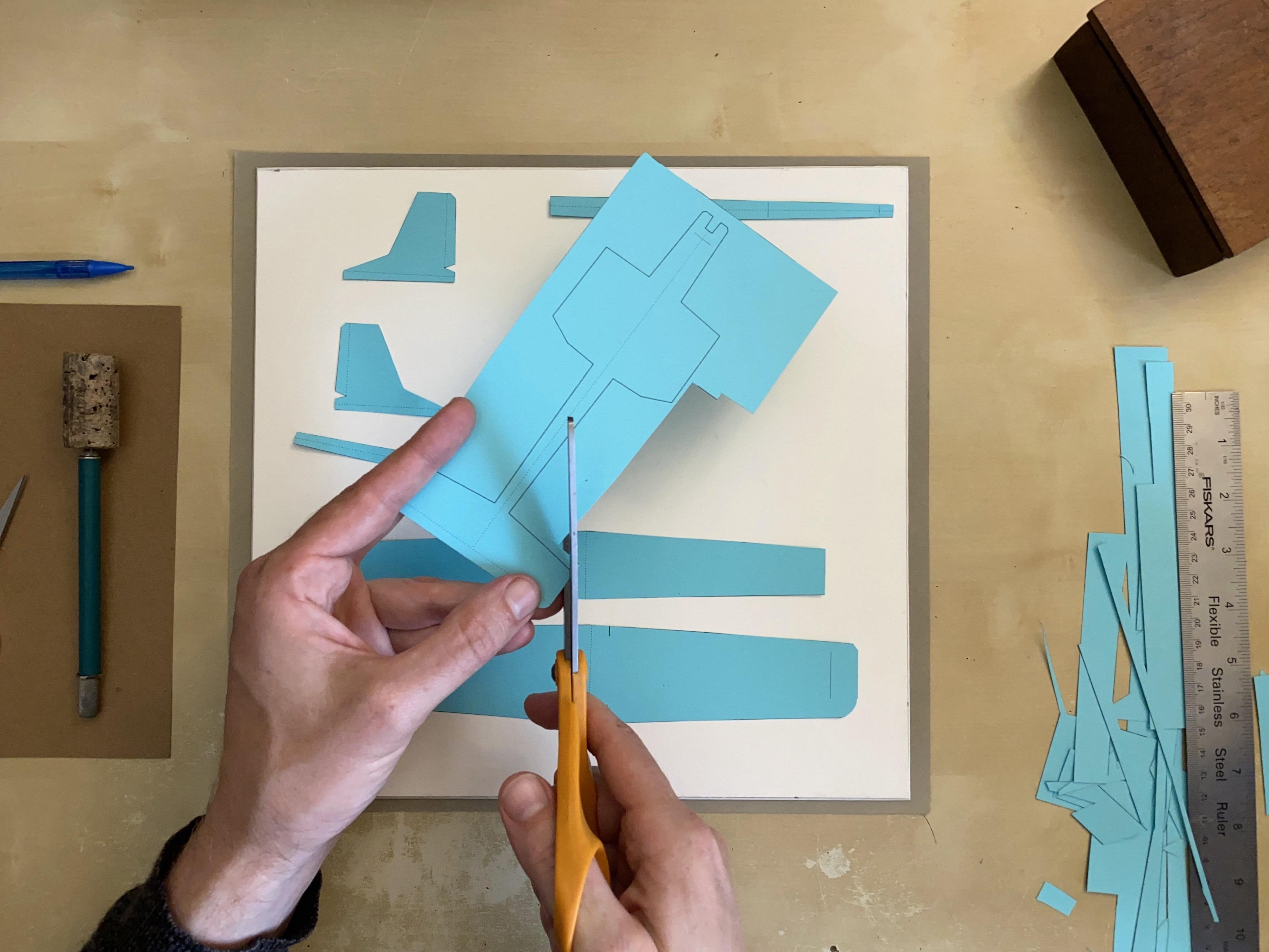
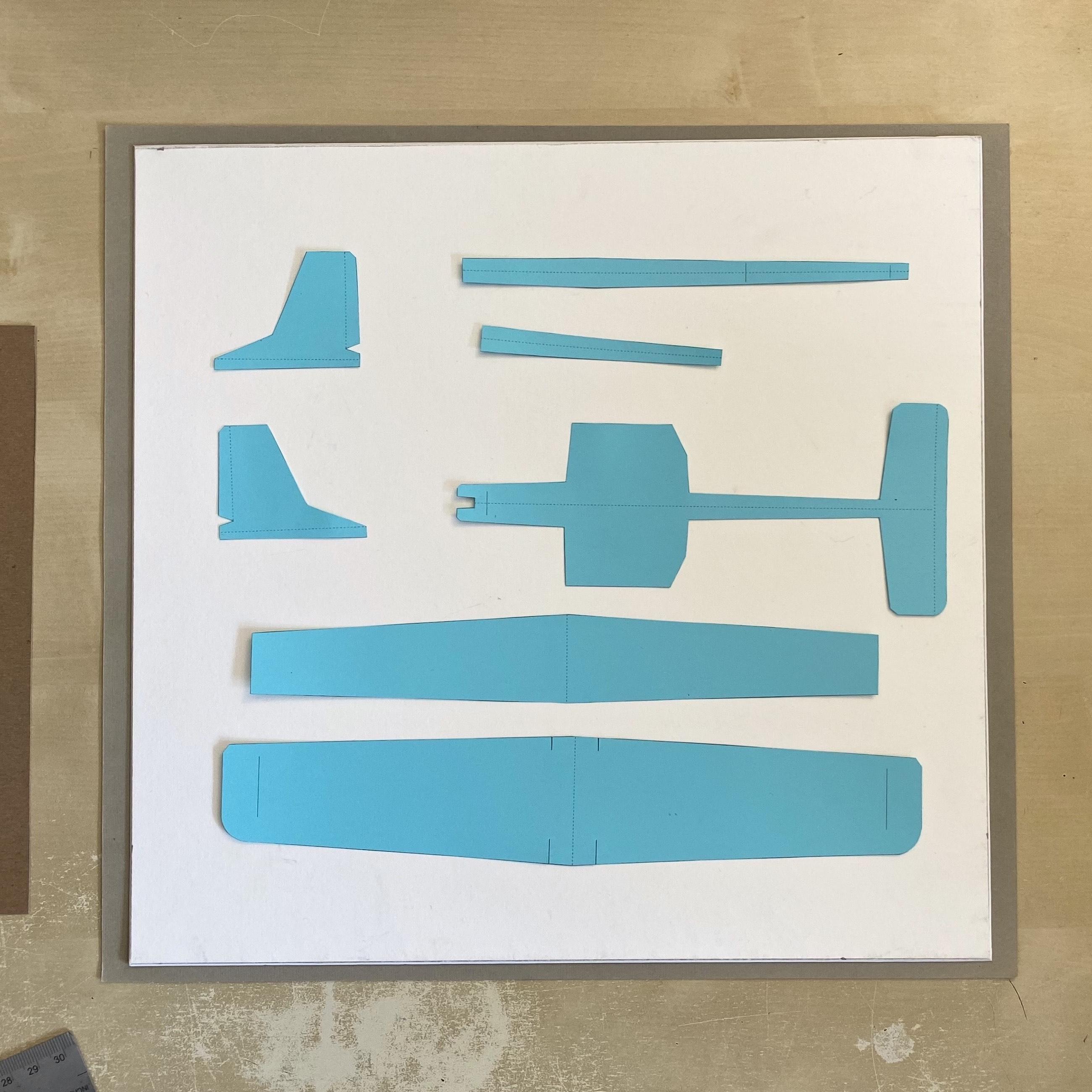
The standard configuration glider is more complex to build. Expect to spend about 45 minutes working on it.
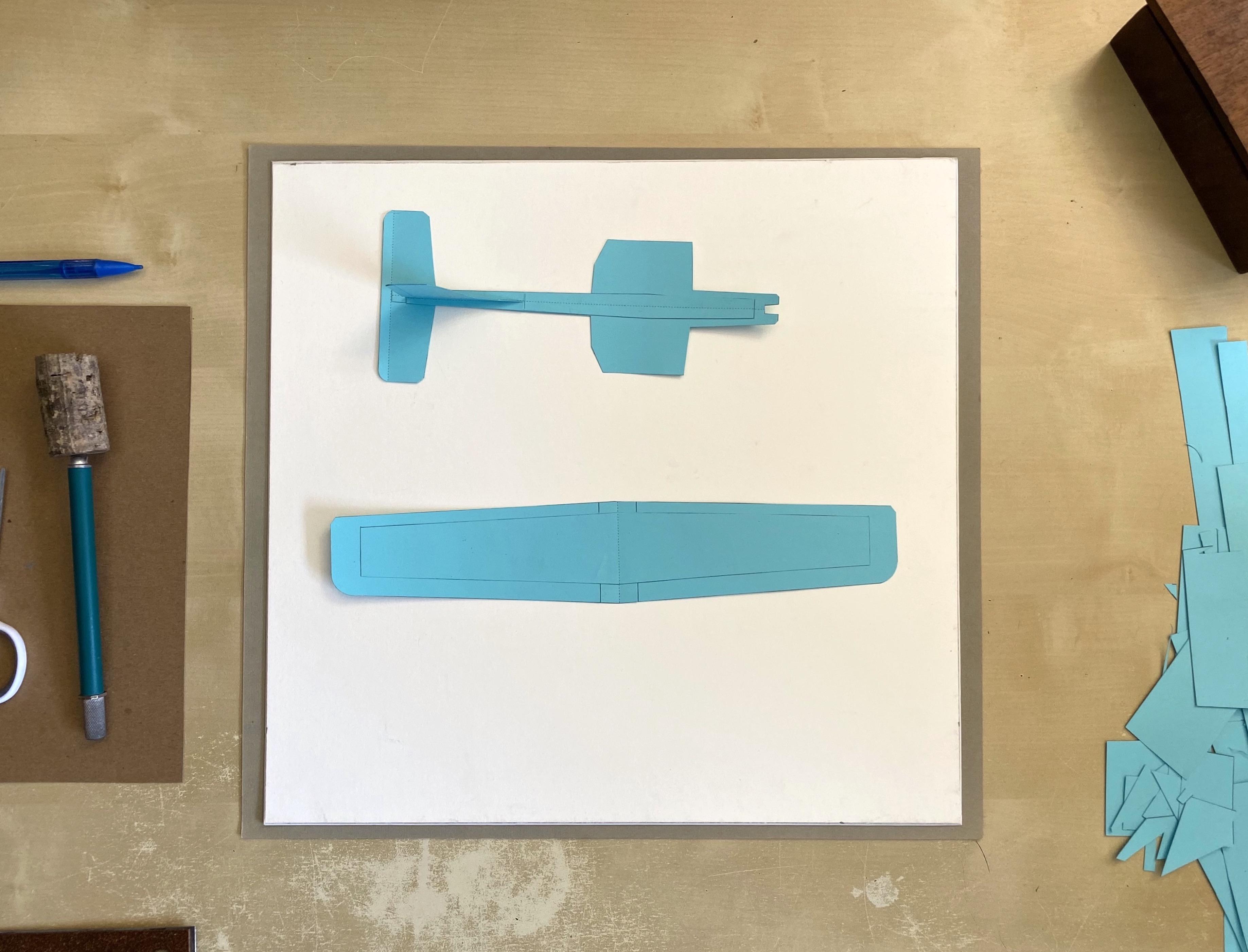
Cut out the shapes carefully, and then start creases on the dotted lines. The elevator (at the trailing edge of the horizontal stabilizer) should be raised about 8 degrees.
Downloads
Fuselage & Fin Work


Glue the long narrow fuselage strip to the top of main piece, as far forward as the notch. Glue the shorter strip (8.5 cm long) to the bottom, with its aft end 1 cm from the end of the main piece
Glue the smallest strip across the bottom of the horizontal stabilizer. It crosses over the strip that was attached previously, flush with the end of it.
Bend the tabs at the bottom of the two vertical stabilizer pieces to 90-degree angles. Apply glue to one of the vertical stabilizers, but only the main panel, not to tab. Unite the two pieces. After the glue has set for a couple of minutes, apply glue to the tabs and attach the stabilizer to the tail of the glider. Use the reference lines for placement.
Wing Work
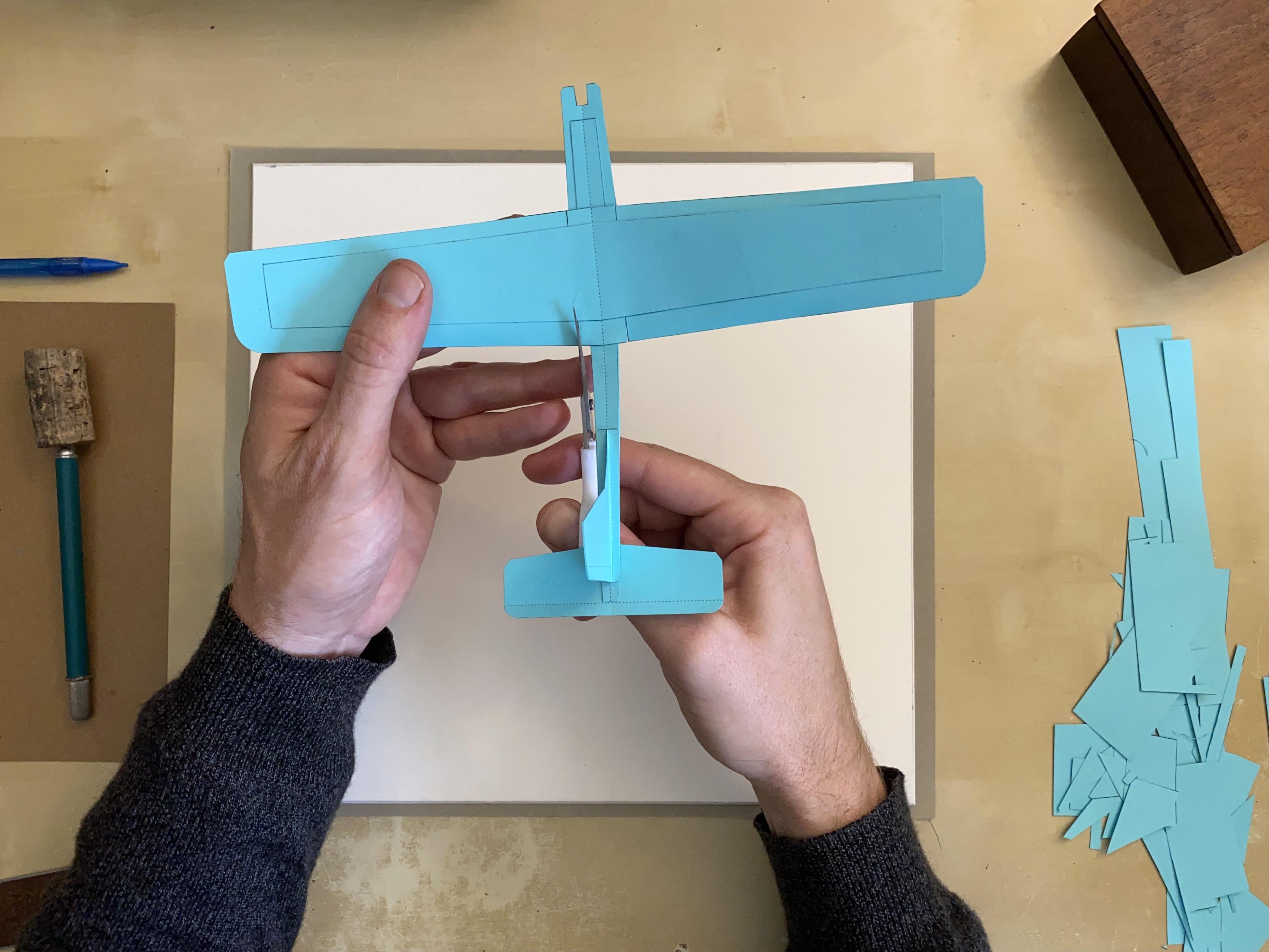

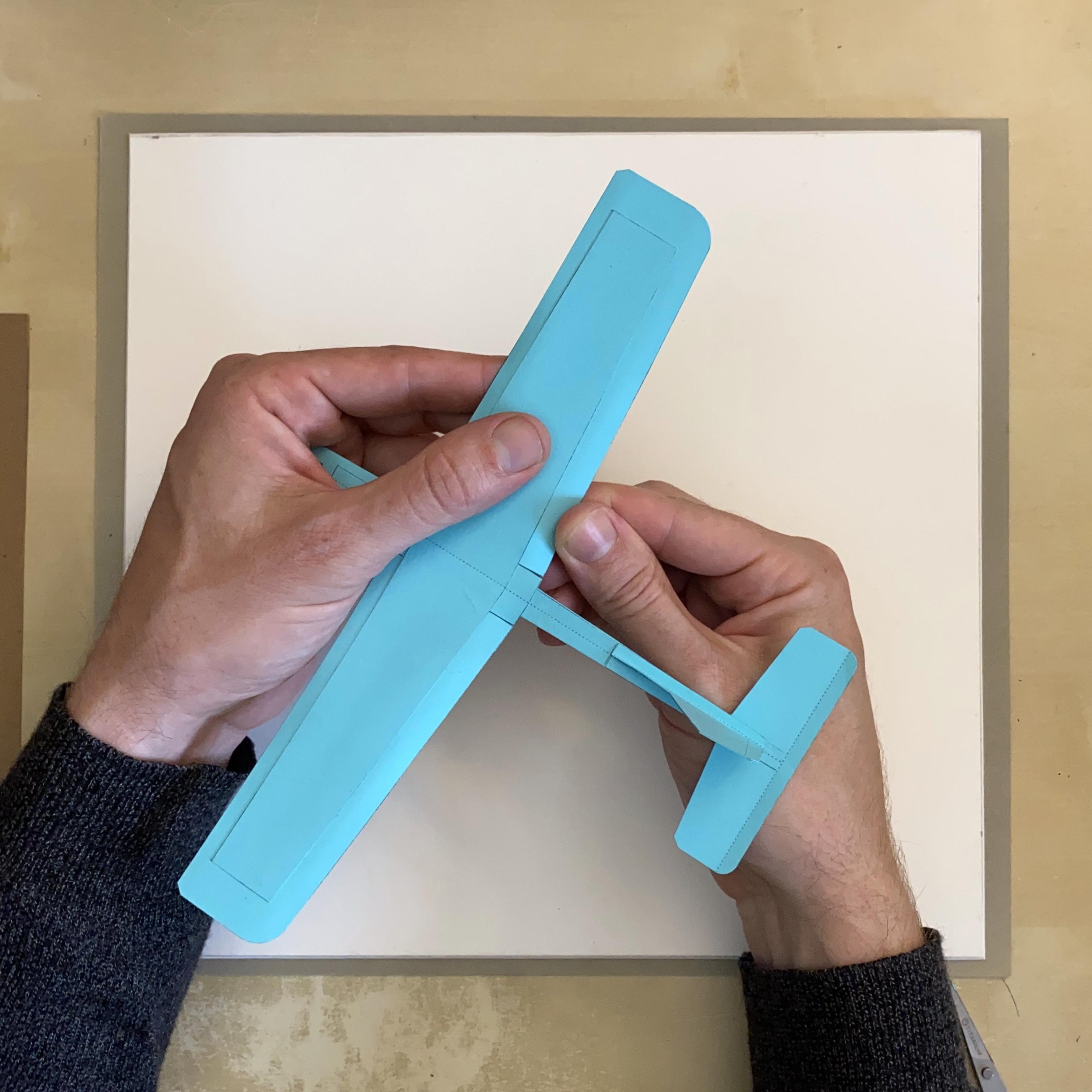
Glue the wing brace to the top of the wing and let the glue set for a minute. Establish the crease on the center line, if needed. The wing tips should be about 7 degrees above horizontal.
Apply glue to the wing roots. Carefully attach the wing. Make sure it is perpendicular to the fuselage.
Cut the four short black lines near the center. Now give the wings a slight undercamber by repeatedly pinching along the leading and trailing edges. Go slowly and check the left and right often for symmetry. A reference curve is in the plans.
Secure Main Piece to Pencil
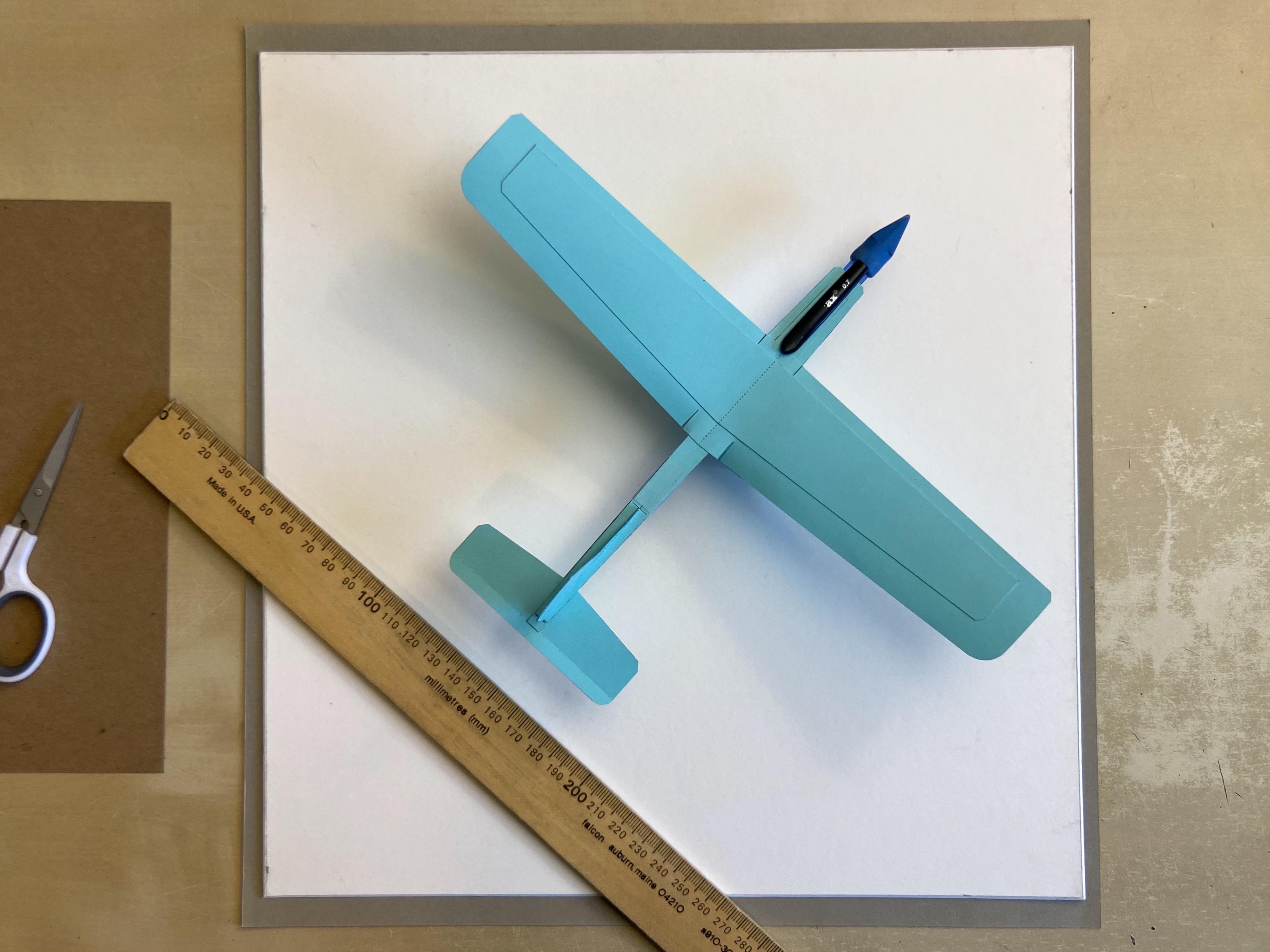


Slide the wing into place on the pencil. Get a strip of adhesive tape measuring 7 cm. Find the point on the bottom of the fuselage (the pencil) that is 5 mm back from the leading edge of the wing, and mark it. This is as far forward as the tape will reach. Make a mark at the center of the strip of tape, and stick this point to the pencil, then carefully pinch the tape to the sides of the pencil and then along the underside of the wing to the left and right. It is difficult to get the tape in a straight line, so go slowly. Lastly, get 4 cm of tape and attach it to the top of the fuselage, a few millimeters in front of the vertical stabilizer, and wrap it down under the pencil, one side at a time.
Test Flights and Trimming
Trimming refers to small adjustments of an aircraft's control surfaces and/or weight distribution in order to achieve a desired flight path.
If possible, do the tests and trimming indoors. Throw the gliders gently and level.
A tendency to roll left or right is most likely a result of asymmetrical wings. Inspect the wings meticulously and try to correct any mismatch. If the standard configuration glider is gently turning right or left with just a slight roll, address that with the rudder: deflect the rudder left to correct a right turn, and right to correct a left turn. With the delta, you should be able to correct the tendency with adjustments to the outer elevons. Deflecting the left outer elevon down should correct a slight roll to the left, and vice versa. You could also warp the trailing edges of the stabilizers a small amount, forming subtle rudders.
If the standard glider is descending too quickly, raise the elevator by a few degrees. If that doesn't help, try pushing the eraser a bit further back, if there is room to do so. On the other hand, if the glider is pitching up, try adjusting the elevator to a more neutral (flatter) position, or moving the eraser forward. With the delta, use the inner elevons to influence pitch. Deflect both slightly down to correct a tendency to pitch up, and vice versa. Note that the outer elevons also influence pitch, but for the sake of simplicity, it may be better to leave them alone.
Lastly, don't forget to have fun! If they don't fly well, keep in mind that everyone who has ever made a glider has felt that disappointment. Keep trying, and you will get better!
Video [optional]
)
If you are a student, do not watch this! No, seriously, you shouldn't. Preserve your objectivity for testing and comparison of the two gliders.