Team Aluminati Aluminum Alloy Design Competition
by DMSE OSU Team Aluminati in Workshop > Metalworking
66 Views, 0 Favorites, 0 Comments
Team Aluminati Aluminum Alloy Design Competition

The goal of this project was to design an aluminum alloy with the most desirable properties: highest 0.2% offset yield strength, total elongation, and electrical conductivity. Material choices were limited to copper, zinc, silicon, magnesium, iron, on top of a minimum of 90% aluminum in the alloy, with the final thickness ending up between 2 and 3mm.
Supplies
Alloying Components
- Commercially Pure Aluminum Shot
- Aluminum Foil
- 50% Al – 50% Si alloy
- 50% Mg – 50% Al alloy
- 6% Ti in Aluminum
- 60% Mn – 40% Al alloy
Tools and Lab Equipment
- Induction Furnace
- Rolling Mill
- Steel Cast
- MTS Criterion Model 43
- EcoMet 30 Manual Grinder-Polisher
- Buehler SimpliMet 4000 Compression Hot Mounting Machine
- Belt Sander
- Olympus GX53 Inverted Microscope
- Band Saw
- Hydraulic Shear
- Router Table
- Tensile Bar Routing Template
- Wilson Rockwell 574 Hardness Tester
- Custom Cooling Cart
- High Temperature Lab Furnace
- Calipers
- Zetec MIZ-21
Other Materials Used
- Phenolic mounting powder
- 240 grit, 320 grit, 400 grit, and 600 grit Silicon Carbide grinding paper
- 6 μm diamond paste with diamond extender
- 3 μm diamond paste with diamond extender
- 0.05 μm colloidal silica with water as a lubricant
- Keller’s reagent (mixed acid solution composed with a standard formulation of 5 mL HNO3, 2 mL HF, 3 mL hydrochloric acid (HCl), and 190 mL distilled water.)
Alloy Selection


Granta was used to screen aluminum alloys based on the team’s criteria (>10% elongation, ≥40% IACS conductivity, and >10 ksi yield strength). A 6000-series alloy was selected for its balance of these properties.
Two alloys were considered after some research: 6022 and 6063.
6022 offered high conductivity (~54%), elongation of 10–25%, and yield strengths between ~20 and 45 ksi. This wide range is based off the thermomechanical processing done to it, which factored into the decision whether or not to produce it.
6063 showed properties similar to heavily worked 6022 (for example, 6022-T62) and is widely used in extrusion, suggesting good elongation and conductivity with a more stable, predictable yield strength. Its high conductivity was attractive, as other alloys of its type had a higher complex formula with similar results. It is also simpler to produce with it being closer to pure aluminum and room to add elements and test different processing techniques.
Ultimately, 6063 was chosen for two reasons:
- Its simpler composition reduces sensitivity to impurities during casting. With our raw materials, 6022 risked exceeding allowed impurity limits (impurities > 0.1% and Fe >0.35%), which could heavily impact its properties
- It is easier to fine-tune alloying elements and target performance values comparable to 6022 without managing a more complex formulation while still being able to maximize our results.
Our goal was to prioritize conductivity and ductility, with yield strength secondary (but still maximizing it when possible).
For the custom 6063, 0.60 wt% magnesium was added to form Mg2Si precipitants with silicon, since that should help strengthen the alloy. A total of 0.39 wt% Si was added, with 0.35 wt% to form the Mg2Si, and 0.04% to form α-Al15(Fe,Mn)3Si2,which groups together with an added 0.07 wt% manganese that helps prevent β-AlFeSi. This helps with abnormal grain growth during the homogenization step. 0.2 wt% titanium was added as a grain refiner to help with overall microstructure as thermomechanical processing occurs. Ti however is a trace element in Al and usually is avoided. But other components like iron and zinc were unavoidable, as they may have contaminated the raw materials, so Ti was used to hopefully offset it and lessen their impact.
References:
Hatch, John E. Aluminum Properties and Physical Metallurgy. ASM International, 1984, DOI: 10.1361/appm1984p001.
Avalos, Adolfo Galván, et al. Effect of the Fe/Mn Ratio on the Microstructural Evolution of the AA6063 Alloy with Homogenization Heat Treatment Interruption. [Basel], vol. 14, 2024.
Thermomechanical Processing Selection
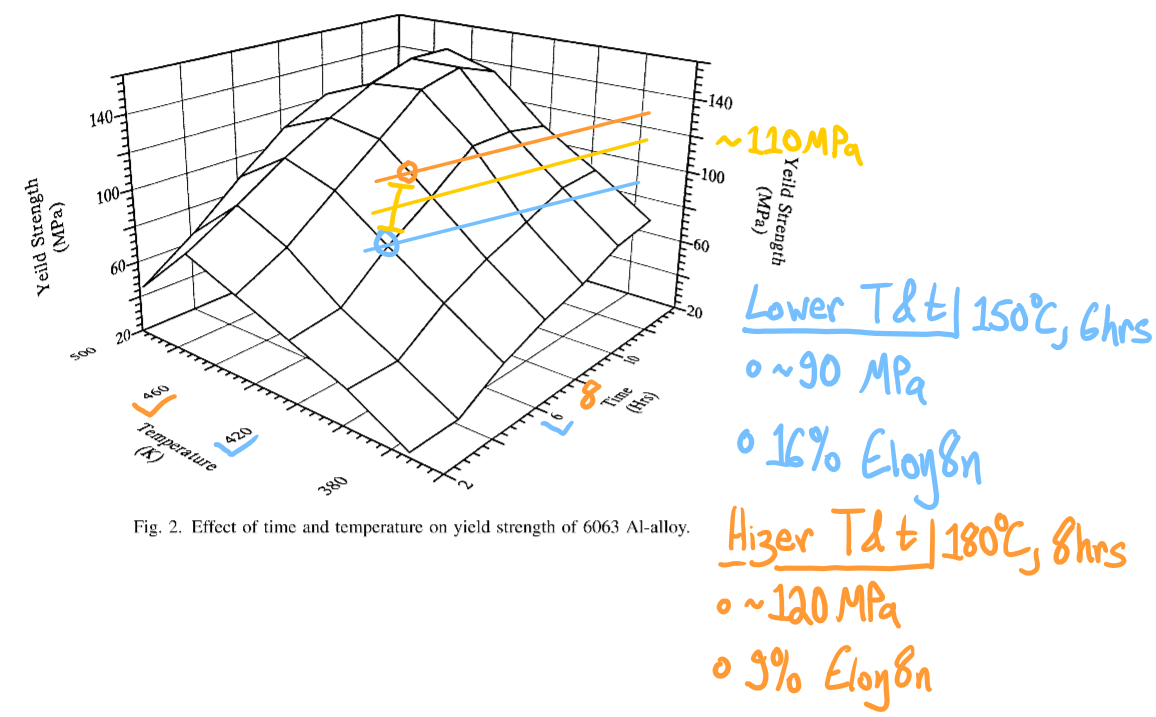


With the given Al-6063 alloy in mind, the team set out to optimize our specific alloy's strength and ductility through the proper formation and management of our expected Mg2Si and α-Al15(Fe,Mn)3Si2 precipitates primarily along the Al-matrix's grain boundaries.
After reviewing relevant ASTM standards and metallurgical literature, the following thermomechanical processing plan was devised to achieve a T6 temper with hopes of maximizing ductility without excessively sacrificing yield strength:
- Casting - Use the weight percentages specified in step 1 to form a workable ingot of Al-6063.
- Homogenization - Dissolve coarse Mg2Si grains and transform as many β-AlFeSi particles to α-Al15(Fe,Mn)3Si2 to achieve as uniform of a microstructure as possible in two heat treatments:
- Hold at 580 °C for 6 Hours (Actually at 590 °C)
- Then at 290 °C for 2 Hours
- Hot Roll - Achieve a bulk reduction in our ingot's thickness to fit competition specifications without changing the overall spatial concentrations of our precipitates.
- Preheat ingot to 450 °C and reduce thickness to 4-6 mm
- Solution Heat Treatment - Dissolve any remaining Mg and Si particles into Al-matrix solution or desired Mg2Si and α-Al15(Fe,Mn)3Si2 precipitates.
- Hold at 530 °C for 30 minutes
- Immediately remove from furnace and water quench
- Cold roll to desired 2-3 mm competition specification
- Precipitation Heat Treatment - Re-precipitate regions of the Al-matrix which became supersaturated during Hot Rolling and Solution Heat Treating to achieve a complete, uniform Al-6063-T6 ingot.
- Hold at 150 °C for 6 hours
- Remove final Al-6063 Product!
References:
3D Time-Temperature Comparison plots adapted from "Influence of aging parameters on the mechanical properties of 6063 aluminum alloy" by Siddiqui, Abdullah, and Al-Belushi.
Solution and Precipitation Heat Treatment Guidelines adapted from ASTM Standard B918/B918M - 20a "Standard Practice for Heat Treatment of Wrought Aluminum Alloys"
Casting


The additive metals were measured by weight so the excess aluminum could be calculated correctly. The bulk aluminum (98.9wt% Al) was liquified before adding the additional metals. 0.6wt% Mg, 0.06wt% Mn, 0.39wt% Si, and 0.02wt%Ti were added to the crucible and mixed with a stir rod. The Magnesium additives was wrapped in aluminum foil and pushed to the bottom of the mixture to prevent them from being exposed to oxygen in the surrounding air. (The extra aluminum from the foil was accounted for) After the elements were completely melted and combined, a group member poured the molten metal into the mold as shown in the images. Once everything cooled down we were able to remove the mold and inspect our alloy.
Homogenization


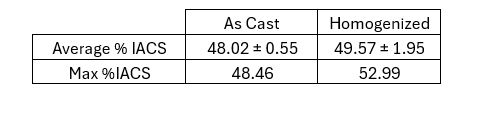
The team's thermomechanical processing for our Al-6063 alloy-to-be began with:
- Target Homogenization: 580 °C for 6 h and step cool at 250-300 °C for 2 hours
- Purpose: Achieve higher electrical conductivity
- Achieved Homogenization: 590 °C for 6 h and step cooled at 290 °C for 2 hours
- From as cast to homogenization, electrical conductivity increased by about 1.5% IACS on average
References:
Charts adapted from Y. Birol, “The effect of homogenization practice on the microstructure of AA6063 billets,” Journal of Materials Processing Technology, vol. 148, no. 2, pp. 250–258, May 2004, doi: 10.1016/j.jmatprotec.2004.01.056.
Hot Rolling


The cast Al-6063 was sectioned transversely in the middle, providing two equal samples (which will be called Sample 1 and Sample 2 going forward). The rolling mill was prepared in advance; the rollers were preheated to 180°C and covered in boron nitride to protect the rollers and prevent the aluminum alloy from adhering. The samples were individually heated to 500°C in an attached induction furnace, then pushed using a custom stainless steel push rod into the mill. The samples were brought back up to temperature before each subsequent pass through the mill.
Due to plans for future rolling, the samples were not rolled to their final competition thickness, but rather to an intermediate thickness to allow for future cold rolling. During the rolling process, Sample 1 developed a pronounced crack, but it failed to propagate during subsequent rolling passes. Sample 1 was rolled 6 times with a final target of a 9 mm reduction to a thickness of 3.63 mm. Sample 1 was then sectioned longitudinally in the middle, with Section 1 having an actual thickness of 3.71 mm and Section 2 having an actual thickness of 3.68 mm. Once completed, the sections were placed on a cooling cart and cooled with a fan.
Sample 2 was rolled 5 times with a final target of a 9 mm reduction to a thickness of 3.93 mm. It did not develop any notable defects and was not sectioned; its final measured actual thickness was 3.71 mm. During the final rolling pass for Sample 2, the leading corner of the sample caught the edge of the mill on the output side. Fortunately, the contact was very minor, and a small piece of the corner was sheared off rather than the sample becoming stuck in the mill. Once completed, the sample was placed on a cooling cart and cooled with a fan.
Solution & Precipitation Heat Treating


After hot rolling, the team went through the three step process which would ultimately lead to our Al-6063's aging treatment and the desired T6 temper.
- All alloy samples were placed in a Lindberg/M Box Furnace and held, as planned, at 530 °C for 30 minutes.
- Precisely as 30 minutes had elapsed, all samples were dropped into a water quenching bath.
- All quenched Aluminum samples were then Cold Rolled to ~2.8 mm to fit the 2-3 mm competition tensile testing bar thickness requirement.
- All properly thinned samples were placed in another Lindberg/M Box Furnace (shown above), held at the planned 150 °C for 6 hours, and allowed to cool to room temperature overnight to stabilize into their final
Preliminary Testing


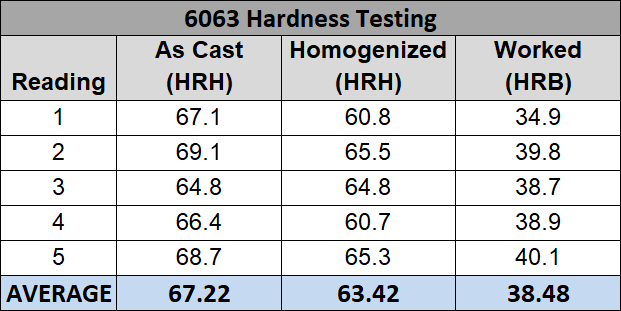

Prior to the competition, three forms of testing (tensile, hardness, and conductivity) were performed on the finished Al-6063 alloy to provide insight into the material properties of the finished Al-6063 before the competition.
For tensile testing, a hydraulic shear and routing table were used to cut and form tensile specimens out of a sheet of the finished Al-6063 alloy. An MTS Criterion Model 43 was then used to perform tensile testing; the data from this can be seen in the stress vs. strain graph and the table. The 0.2% offset yield strength was much higher than expected and was relatively consistent across all samples tested. The elastic modulus was much lower than expected and had a high range of variability in the samples tested. Both of these results differ significantly from what was expected from the chosen TMP.
Rockwell hardness testing was performed on the Al-6063 between thermomechanical processing steps, first with the Al-6063 as-cast, then after homogenization, and finally with the finished worked Al-6063. The tests were performed using a Wilson Rockwell 574 Hardness Tester, with five tests being performed on each sample. The hardness readings were comparably consistent across all processing steps.
Electrical conductivity was measured in %IACS and tested using a Zetec MIZ-21; this was one of the properties that had been optimized for in the alloy selection process, so the high conductivity readings were welcomed and expected.
Optical Microscopy


Homogenized Sample
When the homogenized alloy was looked under the microscope, it was apparent that large voids had formed, notably one that is akin to a Jack-o-lantern (image 1 and 2). These voids were present throughout the samples we analyzed. The grains were relatively large as well, with some larger 125µm (best seen in image 3). This is what was intended as that helps with producing a higher value in electrical conductivity.
Even though it is difficult to see, image 4 shows small dots scattered around. Those are small precipitants that are occurring along the grain boundaries. This is better seen in image 3, where even though the etchant used dissolved many of the smaller precipitants, it is now easier to see where they formed. We assume that those might be the alpha precipitants that were formed by adding extra Si. However, 5 and 6 show that many of the voids were also appearing along the grain boundaries.
Post thermomechanical processing sample
Starting with image 7, the precipitants are noticeably compacted post rolling. These are the smaller precipitants that are along the grain boundaries. Having them this compact was unforeseen, as may have caused the alloy to weaken. The addition of titanium may have caused them to pool at the boundaries, grow when homogenized, and compressed together when rolled. The voids were also stretched as well. Image 8 shows a void being compressed and elongated, along with showing that our grain boundaries may have been compromised by them. These grains were still large and showed signs of being elongated but did not seem as compressed (image 9). This may have left us a softer material, but one that was still harder to cut than other 6000 series alloys.
These voids were not small by any means either, some reaching upwards of 300µm. In one of our tensile tests, these voids were visible to the naked eye and led to a lower yield strength than expected (image 10).
It is difficult to tell exactly without using some time of spectroscopy, but some of those voids along the grain boundaries are beta phase, while the darker "blobs" seen in the etched samples are the alpha phase, which makes the alloy much softer as well.
Competition Results


Of the original six tensile bars that had been created for preliminary testing and the competition, four had been used, leaving the choice for the competition sample between two samples. One of the remaining tensile specimens appeared to have large lamination defects running lengthwise along the specimen, so the choice was made to use the other tensile bar specimen, which had no apparent defects upon a visual inspection.
The chosen sample had a final electrical conductivity of 49.10 %IACS, a 0.2% offset yield strength of 191.9 MPa, and an elongation at fracture of 8.4%. All of these values were within or slightly above the range of preliminary testing results. As noted in the preliminary testing section, both the 0.2% offset yield strength and the elongation at fracture were very different from the research values. Overall, we achieved 1st in conductivity, 7th in 0.2% offset yield strength, and 6th in elongation at fracture, with an ultimate placement of 8th in the competition.
Analysis

Setting out to achieve a yield strength in the range of 90-120 MPa, a percent elongation of 9-16%, and an electrical conductivity above 45%, the team was moderately surprised by our resultant tensile testing samples yielding well above expectation and not elongating as much as we had hoped with consistent testing values between 180-240 MPa and 3-8% elongation, respectively. While electrical conductivity for our Al-6063 samples was stellar at 49.10%IACS, the alloy's overall performance left some questions and design intention wanting.
Some detailed possible causes of these relatively large differences could lie in the list below; however, the team's overall goal of developing, processing, and being able to test a derivative Al-6063 alloy and learn a great deal from the experimental, hands-on process was achieved.
- The team's first homogenization heat treatment was planned at 580 °C for 6 hours. However, due to furnace availability and capability this treatment was done in a high temperature furnace which was not intended to hold temperatures precisely at this relatively "low" level and fluctuated beyond this upper limit of 580 °C eventually holding at 590 °C for the majority of the 6-hour treatment.
- While early on in the alloy's processing, this overstep in heating could have contributed to inaccurate aging calculations and treatments down the processing path.
- The team judged the referenced GRANTA composition specifications for Al-6063 to include significant but small amounts of trace elements as "allowable contaminants" rather than "necessary components", both due to limitations on available raw alloying materials and to simplify processing within reasonable limits.
- Thus, all percentages of trace elements were replaced with increased amounts of Titanium, Magnesium, and Silicon to rely on their known precipitation hardening and grain refining effects.
- This bulk replacement of all other trace elements may have been an overstep into processing simplification and may have contributed to the relatively "overhardened, under-ductile" result the team achieved while still seeing comparable electrical conductivity, as to be expected with an unaffected percentage of total Al in the final alloy.
- Finally, the increases in yield strength and consequent reduction in expected ductility could simply be due to the team's inexperience with manually processing Aluminum. As shown in step 10's micrographs, while the bulk material was relatively uniform with the desired dispersion of precipitate particles, nearly all Al-6063 final samples had sparse but large voids (on the order of hundreds of micrometers in some cases, and readily visible to the naked eye in others), which could focused fracture stresses in these relatively large structural irregularities.