Tensegrity Stool - Floating Furniture Designed in Solidworks
by jnell61072 in Design > 3D Design
127 Views, 0 Favorites, 0 Comments
Tensegrity Stool - Floating Furniture Designed in Solidworks
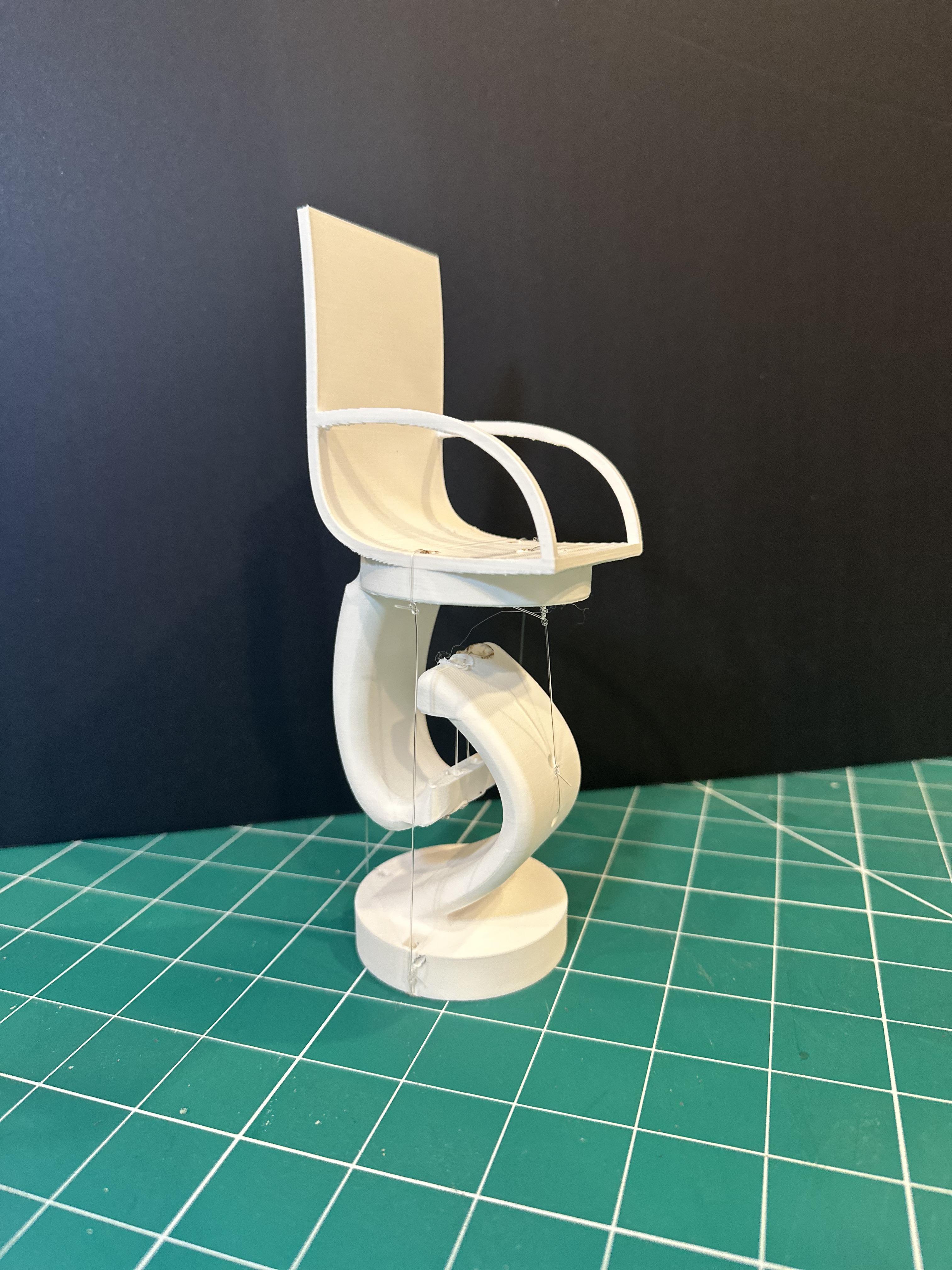
Tensegrity structures have always fascinated me. The idea that thin strings in tension can suspend solid objects in midair.
I wanted to explore this concept not as a simple table, but as sculptural furniture.
This project began as a full-scale stool designed entirely in SolidWorks. The design was later scaled down in PrusaSlicer to create a 3D printed model that demonstrates real structural capability.
Despite being lightweight and printed at only 10% infill, the final model supports over 25 pounds of force, proving the strength of tension-based engineering.
Supplies

Materials
- Sunlu White PLA Filament
- Used to print both the natural compression base and seat platform.
- Clear Fishing Line
- Used for all tension components.
- 5 total cables
- Cut into ~10 inch sections each (extra length makes knot tying and tension adjustment easier)
- 3D Printed Parts (2 Total)
- Compression base
- Seat platform
- Both parts were designed with integrated string-routing holes to prevent slipping and ensure alignment.
Tools
- Prusa MK4S 3D Printer
- PrusaSlicer
- SolidWorks (for CAD design)
- Scissors (for cutting and trimming fishing line)
Concept Sketching & Structural Planning

Before opening SolidWorks, I began with hand sketches.
I sketched:
- A view of the seat platform
- A side profile of the base structure with a layout showing how the tension strings would suspend the seat
At this stage, I focused on proportions and balance. Because tensegrity structures rely on symmetry and equal tension, I needed to ensure the seat geometry and base alignment would distribute force evenly across all cables.
I also decided early on that I did not want a traditional straight column base. Instead, I chose a sculptural design that used natural looking curves. This made the design more visually dynamic and modern.
This sketching phase allowed me to:
- Plan string anchor locations
- Visualize load paths
- Determine how many cables would be required
Modeling the Seat Platform in SolidWorks

After finalizing the sketch, I transitioned into SolidWorks.
I began by designing the top seat platform first. This ensured that the primary load-bearing surface was dimensionally accurate before building the supporting structure.
Using:
- Sketch tools
- Mirror
- Extrude Boss/Base
- Fillet
- Extrude Cut
- Sweep Cut
I created a clean circular platform with consistent thickness. Since this piece would carry all applied loads, its geometry needed to be stable and evenly weighted.
Designing the top first established the reference geometry for the rest of the model.
Designing the Natural Compression Base

Next, I designed the lower compression structure.
Instead of a straight support, I modeled a curved spiral form that would:
- Provide visual interest
- Act as the compression member
- Create a strong base footprint
The curved shape was extruded and refined to ensure:
- A wide enough base for stability
- Smooth curvature for structural continuity
- Proper vertical alignment beneath the seat
This compression member works in opposition to the tension cables by resisting inward forces while the strings pull upward.
Tension and Refinement

Once the main geometry was complete, I refined the design.
This was accomplished by the:
- Added fillets to smooth sharp edges
- Cleaned transitions between surfaces
- Improved curvature flow for a more polished appearance
These refinements served both aesthetic and structural purposes:
- Reduced stress concentration points
- Improved print quality
- Created a more finished furniture-like look
At this point, the model contained two separate solid bodies, the seat and the compression base, which do not physically touch in the final assembly.
With both compression elements modeled, I moved to engineering the tension system.
I added:
- Four evenly spaced corner string anchor holes
- One central vertical anchor hole for the primary load-bearing cable
These holes were intentionally modeled into the CAD design rather than added afterward. This ensured:
- Precise string placement
- Reduced slippage
- Improved alignment during assembly
- Repeatable construction
Symmetry was critical. All anchor points were positioned to balance forces evenly and prevent tilting.
Scaling and 3D Printing

The model was originally designed at full scale, then scaled down in PrusaSlicer for prototyping.
Initial scaling made string installation difficult, so I increased the scale to allow easier tension adjustment.
Print details:
- Printer: Prusa MK4S
- Material: Sunlu White PLA
- Layer height: 0.2 mm
- Infill: 10%
- Print time: 4h 18m
- Printed in two separate parts
The low infill demonstrates that structural integrity comes from tension geometry rather than solid mass.
Setup and Aseembly


After the chair finished printing it was removed from the print bed. Furthermore the support material used to support the complex geometry of the chair was removed so the assembly could be started.
The tensegrity system uses:
- 4 corner tension lines
- 1 central load-bearing line
- Total: 5 fishing wire cables
Clear fishing line was used to preserve the floating illusion.
Assembly process:
- Knot one end securely. (Shown in the image above)
- Pull the opposite end tight manually.
- Adjust tension symmetrically to achieve balance.
Early versions collapsed because string alignment shifted, causing the seat to tilt.
To solve this:
- I re-tightened individual lines
- Balanced tension incrementally
- Adjusted until the structure leveled perfectly
This iterative process was critical to achieving stability.
Load Testing

To validate the structure, I gradually applied weight to the seat.
The stool successfully supported over 25 pounds without failure.
This confirms that even thin fishing line can carry significant load when arranged properly in tension.
Why This Design Is Unique
- Curved compression geometry (rare in tensegrity builds)
- Circular stool aesthetic
- Designed full-scale before scaling
- Functional load-tested prototype
- Demonstrates engineering principles in furniture form
This project merges:
- Structural physics
- Digital fabrication
- Sculptural design
Functional furniture engineering