The Ballastool: the First Adjustable Self-righting Stool
by pak1987 in Workshop > 3D Printing
220 Views, 3 Favorites, 0 Comments
The Ballastool: the First Adjustable Self-righting Stool
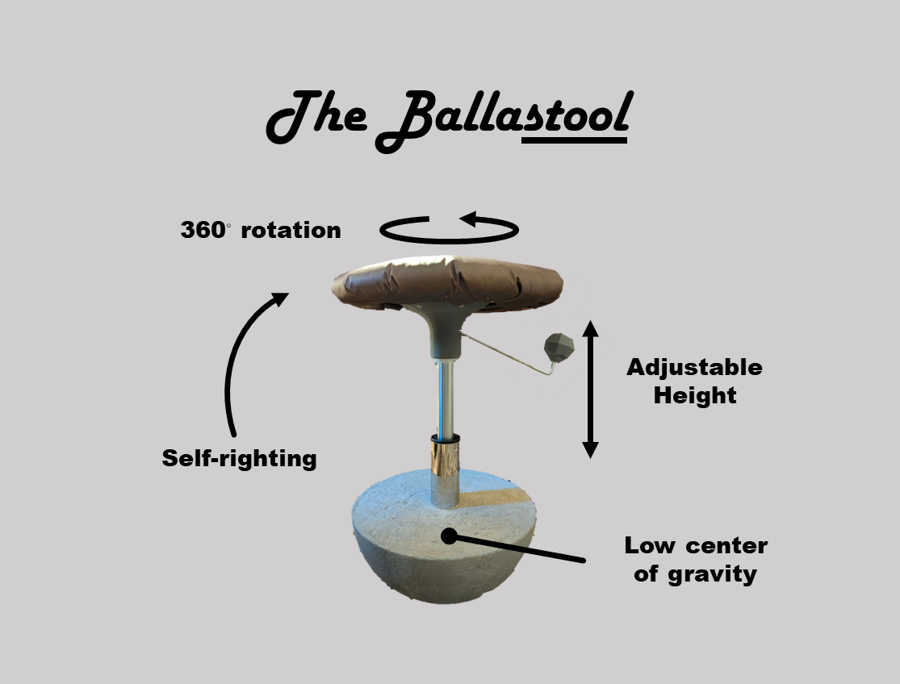


The Ballastool is simply a stool with a ballast instead of legs or wheels. You will be forgiven for thinking it meant "balance stool" as it does that also. That's right, the weight at the base of this stool is such that the center of gravity is very low, and just like the ballast of a buoy or roly-poly (tumbler) toy, when it is rocked, tipped, or moved, it will return to an upright position (just not if you're still sitting on it). And so long as you do not lean too far and your feet are firmly planted, the experience isn't too different from sitting on a yoga exercise ball. And it is far more interesting to look at.
The Ballastool also has 360 spin and an adjustable height (depending on the pneumatic piston used). Alternatively, it can be made without these features to save on materials costs.
Caution: This stool is not designed or intended to keep from tipping over when supporting the weight of a person. Like a exercise ball, if you lean backwards, forwards, or to the side too far, you may fall.
Supplies
3D printer
3D printer filament
Computer with 3D design software (autodesk)
30-50lbs concrete mix
1-3x fasteners
Vegetable oil or mold release
clay or other mold gap filler
Pneumatic chair piston
5-7inch metal rod like a tent stake
0.5-1inch thick and at least 12x12inch tall and wide sheet of wood
Screws
Staple gun and staples.
Optional:
Sodium silicate concrete sealant.
Design and Print Your Concrete Mold


The base of the Ballastool needs to be heavy in order to effectively lower the center of gravity for the whole chair and keep it wobbling back upright. Here are some instructions for how to do this with concrete in a 3D printed mold, however, other heavy materials like resin, hardwood can be used so long as they are sturdy.
The concrete base, or ballast, of the ballastool needs to be a half sphere and about 10-12 inches wide. Any bigger and the stool will be to heavy to move. At 12 inches in diameter, the final stool was already around 40-50lbs.
Instead of designing and 3D printing, you can halfway fill the interior of a large ball so long as it is of the appropriate dimensions, can support the weight of the concrete, and you don't mind ruining it.
To design a 3D printed mold, it's best to break it into quarters. This helps with printing (not everyone can have a large 3D printer bed) and with the release of the concrete.
- Start by creating a simple arc in the sketch tool. It only needs to be a quarter of a circle with a diameter of 12 inches.
- Extrude a plane from this arc and thicken it into a body. Only a 1mm is necessary.
- Then select the 1mm face of the body and "revolve" it around to 90 degrees. It should now look like a quarter of a half sphere.
- Create a sketch beneath the new body and extrude up a circle to encompass just the outside of the sphere to thicken the walls and give it a firm base to sit on. You may have to split the extruded cylinder using the curve of the sphere as the cutting tool.
- Add 1-2 holes to the thickest part of the support structure and fillet the inside so it rounds into a recessed dome. You should extrude a slightly smaller dome on the opposite side, such that the inset dome joins with the protruding dome of the adjacent piece. This will help lock the mold together when concrete is being poured.
- Shrink or thicken any walls necessary to keep it from being too flimsy or wasting too much printer material.
- Save as a mesh and send to your slicer.
- Print each quarter of the half sphere mold separately. It can use up to 150-250g of printer filament and take 4-6hrs, so I recommend optimizing the infill and other slicer options and keeping it in draft quality (0.28mm layer height).
Assemble Mold and Pour Concrete


Once all 4 quarters of the 12inch halfsphere are printed it's time to pour the concrete.
- First, sand your molds as necessary to get rid of bits of plastic preventing the molds from fitting together snuggly.
- Loop 1-3 straps, rope, or bands around the assembled mold to hold it together.
- Fill any remaining gaps between the mold pieces with clay.
- Spray or spread a thin layer of vegetable oil or mold release on the mold to help remove the concrete after it cures.
- Mix up 1/2 to 2/3 of a bag of concrete mix with enough water to make it workable. Make sure the concrete mix permits thick pours i.e., greater than 4 inches.
- Pour the slurry into the mold and center and level the pneumatic chair piston while it hardens. The size of the piston and the depth you insert it into the concrete will ultimately determine the max height of the stool.
- Let the concrete completely cure before removing the straps and extracting your half-sphere of concrete.
- Scrub off any clay and dust on the surface.
- Optional: after drying, apply a concrete sealant.
This stool is not recommended for uncarpeted surfaces as it may scratch and damage flooring or may slip. If you don't like the look of bare concrete or want it to be softer, feel free to cover in felt or similar materials.
The base of the stool is heavy, so take caution when moving. If it's weight is a concern, consider shrinking the size of the mold and use a sphere volume calculator and the density of concrete to calculate the weight ahead of time. As mentioned, you can also use other materials instead of concrete or even try to add a filler to leave voids in the concrete to lighten it. However, lightening the weight too much will defeat the purpose of the ballast and the stool won't self-right.
Design the Seat.


If you already have a seat, perhaps even the one the pneumatic chair piston belonged to, then congratulations, you are finished. You might also have opted to not use a pneumatic piston and instead stuck a rod or stick into the concrete. These are equally valid approaches if all you are after is creating a new unique ballasted base to your stool. However, if you want to make this something truly unique and customized, here is how to create your own seat base complete with pneumatic piston engagement rod for lowering or raising the height of the stool.
The pneumatic piston you recycled or purchased will have a button at the top to allow air in or out in order to raise or lower the height. The base of the seat needs to therefore include a means to engage this button while seated. Here is how I achieved that in this version of the Ballastool.
- First, measure the height and diameter of the rod protruding from the pneumatic piston (when fully lowered) as well as the height and diameter of the button on top.
- Create a sketch in your design software with two circles, one 0.2-1mm wider than the diameter of the piston and the other 1/3-1inch bigger. Extrude the space between them to become the shaft that hugs the inner piston. But don't extrude it so far that it would bump into the main body of the piston when lowered.
- On the top of this shaft, add another sketch to snuggly fit the button on top and a bit of room above it for the lever that presses down on it. Make this shaft only parly closed so that the lever can enter the space. A round hump on the top of the window will allow the metal rod to apply leverage on the button when lifted.
- Fuse it all together with a base plate 4-6inches wide and place a large fillet between them to make the whole thing sturdy.
- Place screw holes around the base and extending out the top to allow for attaching the base to the wooden seat.
- Save as mesh and send to 3D printer.
- You will also want to design and print a small cylinder to attach to the metal lever that fits inside the smaller shaft and applies pressure to the button, i.e., a "button pusher."
Prepare and Attach the Seat


The most important thing to consider when creating your seat and cushion is that you don't want the seat to be heavy or the center of gravity will rise out of the concrete sphere and it will no longer be self-righting.
Here are the steps to making a simple seat which will attach to your printed seat base.
- Cut a 12 inch diameter circle into a 0.5-1inch thick piece of wood.
- Once cut, center your seat base in the middle of the circle of wood and screw it down.
- Find a rod (I used a tent stake) and attach it to the "button pusher" once it is inside the smaller shaft of the seat base. You can attach it by heating the rod and pressing it into the plastic or by gluing it securely in the printed hole. You'll want to place this on the pneumatic piston to ensure that it properly engages the button when the rod is lifted.
- Optionally: design and print a decorative knob to place on the other end of the lever rod.
- Use your wooden seat as a template to cut the padding and fabric of your choice.
- Use a staple gun to secure the fabric on the underside of the wooden seat.
- Place the now completed seat onto the pneumatic piston of the concrete base. If it wobbles, rotates, or otherwise is not stable, you can glue it in place. But be sure not to get glue on the button of the pneumatic piston.
Congratulations, your Ballastool is finished!
Alternative Ballastool Designs


If you are fortunate enough to have a large 3D printer, you might also consider printing the seat entirely. If you want to have the Ballastool collapse into a ball at it's lowest setting, then here is a design for you to consider. I just wish I could make it myself. While the padding will ultimately be pretty thin, if you can place the top of the pneumatic piston as close as possible to the top, you might be able to lower the seat such that it fully obscures the piston and makes a sphere. Rather than a lever, which would be unreachable when lowered, you can make a tapered ribbon that, when pulled, would apply downward pressure on the piston's button. Of course I can't confirm this design works or would be at all comfortable, but it sure does look cool. Please post pictures if you manage to make it.