The Enraged Mirror
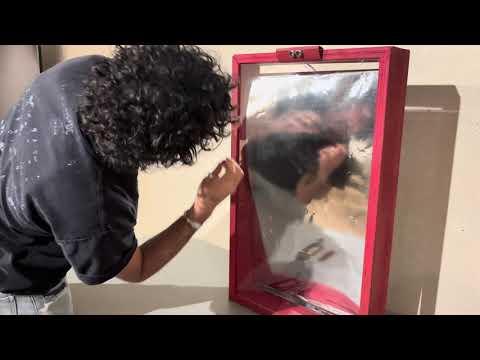
Hailing from a household of mean and condemning people, the Enraged Mirror had never been appreciated for what it is. Its owners subjected it to long years of self-depreciation that resulted in an act of rebellion. One dreadful day, the Enraged Mirror suddenly turned red and shook violently each time the owner would look at their reflection.
The Enraged Mirror is a useless machine designed around the conventional use of a mirror. While mirrors are used to accurately reflect real-world images, the Enraged Mirror does the opposite—a useless machine.
Supplies
Arduino Components
- 1x Arduino Nano R4
- 1x Ultrasonic Sensor
- 30x Wires
- 4x Vibration Motors
- 1x Transistor
- 1x Breadboard
Materials
- Plywood to construct 50cmx10cmx80cm frame
- 1x Sheet of clear acrylic for protective front
- 1x Sheet of reflective mylar
- 1x Dowel for support
Initial Idea

At the start of the brainstorming, we knew we wanted a machine that opposed its conventional use. While we had ideas of a piano that played random notes among other things, the idea of a useless mirror stood out most to us.
We knew we wanted to have ultrasonic sensors detect people and cause a mechanism to shake our mirror. After careful consideration, we decided that a reflective mylar with motors attached would be the best way to distort the mirror.
Material Choice & Frame Design
![abc [Converted].png](/proxy/?url=https://content.instructables.com/FC9/6MG4/MM9W8QPS/FC96MG4MM9W8QPS.png&filename=abc [Converted].png)
The most important step of our process was choosing the scale of which we are working. We wanted to design a mirror that would be sufficient to reflect the upper half of the body. We dialed-in on a plywood frame 80cm tall by 50cm wide, and added 10cm of depth to accommodate for all the components and spacing for the vibration.
For the front and the backing, we chose to use clear removable sheets of acrylic to allow easy access and view to the circuits, as well as providing a clear protective element for the reflective mylar. When cutting the frame, we added slits, holes, and notches to fit all the components and wiring in properly.
Finally, to support our narrative, we spray-painted the frame red.
Downloads
Testing & Coding


We began our coding process by individually testing each component. First, we experimented with the ultrasonic sensor, getting used to its sensitivities and outputs. Then, we worked with the vibration motors in tandem with the transistors to understand how the components fit together.
After understanding each component, we created a draft of our circuit in Tinkercad to help with organization, then began testing and fine-tuning the sensor output mapping and the vibration strength to achieve the desired effect on the reflective mylar.
Assembly
.gif)
The assembly process was fairly simple as we had our frame, reflective mylar, and circuit all constructed. We first glued our frame and pulled the mylar taut using the dowel as support. Then, we reassembled the circuit onto the mylar, and had a final opportunity to fine-tune our sensors and motors.
Thanks to the earlier process steps, assembly was a breeze!
Conclusions

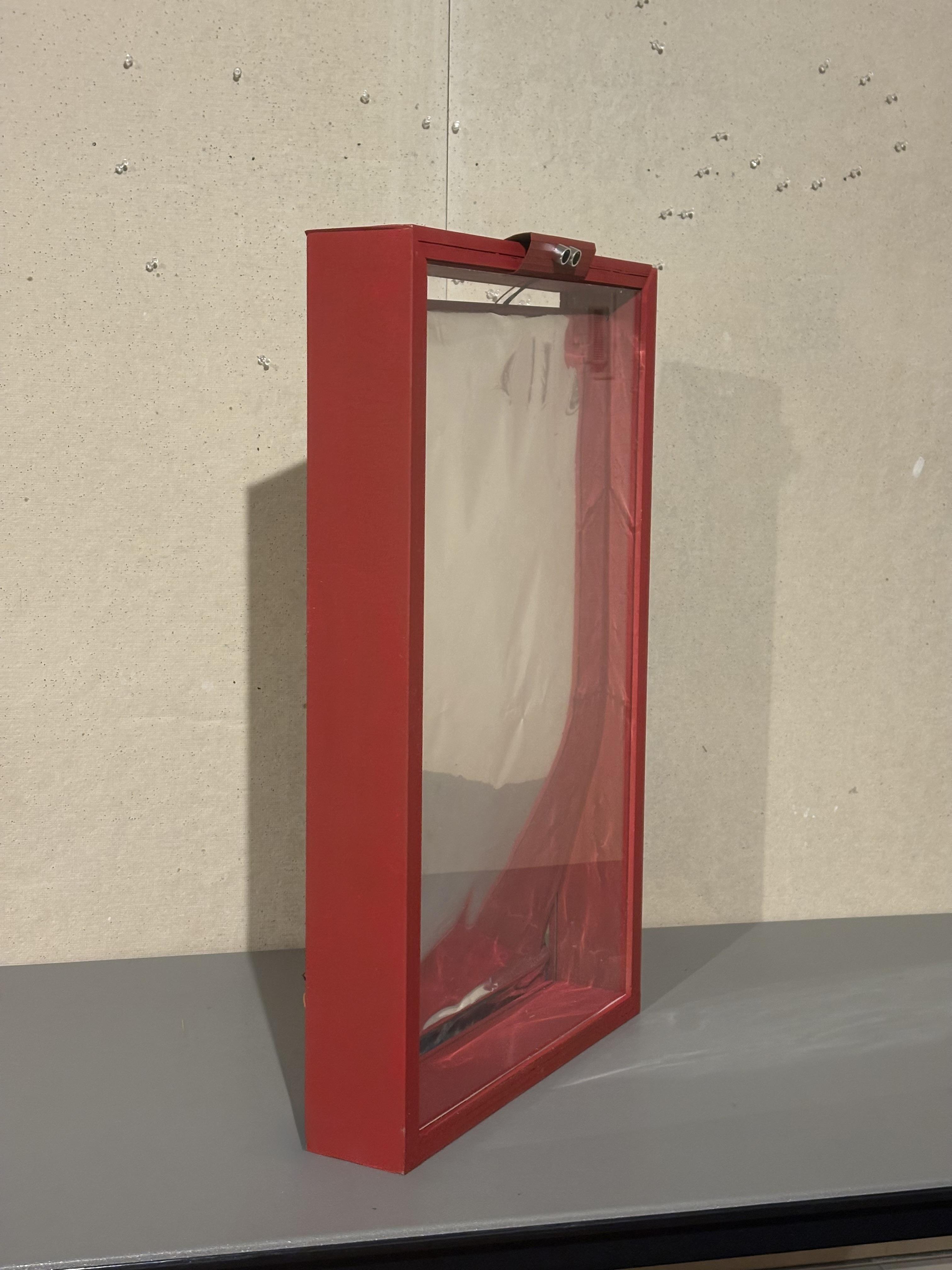
Our process had many speed bumps.
The first issue was the reflective mylar. The material is electrostatic, making it delicate and easy to crease. While we tried our best to keep it flat it was near impossible to keep it void of imperfections. It was also quite a challenge to keep it taut and reflective while allowing enough room for it to vibrate.
Another issue was the Arduino components. They worked out in the end, but the ultrasonic sensor callibration was finicky and sensitive. The motors required transistors as they required higher amps than the digital pins could provide which required careful testing to figure out how to use. Additionally using 4 motors on the Arduino board without an external power source split the voltage to a point where none of the motors could operate at maximum strength. Finally, we had an issue putting together the wires. Because the motor wires did not have connection points, in order to ensure the best connection we would have to solder the wires together. However, we lacked a soldering iron and solder and instead used electrical tape and made the wires prone to disconnecting.
The mirror distortion worked well. While our original idea was to vibrate the entire mirror, our material options ended with us distorting the reflective material itself. We found this effect more effective but it was not our expected outcome.
Thanks to our experience in the workshop, constructing the frame was a very smooth process. And with our other modelling tools, fitting the other parts into the mirror was also quite simple.
We learnt a lot throughout the process. From experience with the all the Arduino components to working with the our material options, the experience was novel to us all. While the mechanics were difficult to work with, we were overall very pleased with the final results. It was very fun bouncing our ideas off one-another and we are looking forwards to continuing to work with future Arduino projects!