The “Pink Spey Stinger” – a Northeastern Pacific Squid Imitation Fly for Skeena System Steelhead.
by jaapackalkman in Outside > Fishing
18 Views, 0 Favorites, 0 Comments
The “Pink Spey Stinger” – a Northeastern Pacific Squid Imitation Fly for Skeena System Steelhead.
The Pink Spey Stinger
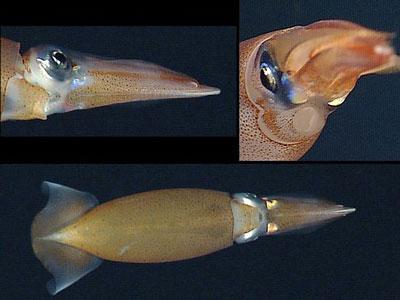
Marine steelhead feed on a variety of foraging species. Fish and squid are the prevalent food sources for steelhead in the Northeastern Pacific. As steelhead mature their diet shifts towards squid. Skeena River steelhead migrate as juveniles, in the spring, towards the open ocean, Northwesterly, and return towards the Skeena after 2-3 years, migrating in a Southeasterly direction. The feeding range overlaps with several species of Gonatid Squid, which play an important role in the ecosystems of the North Pacific. The most prevalent North Pacific squid species; the Minimal Armhook Squid varies in length, to a maximum adult size of 15 cm. These squid are usually a pale white, pink, in coloration, but when stressed will turn a more intense orange/pink.
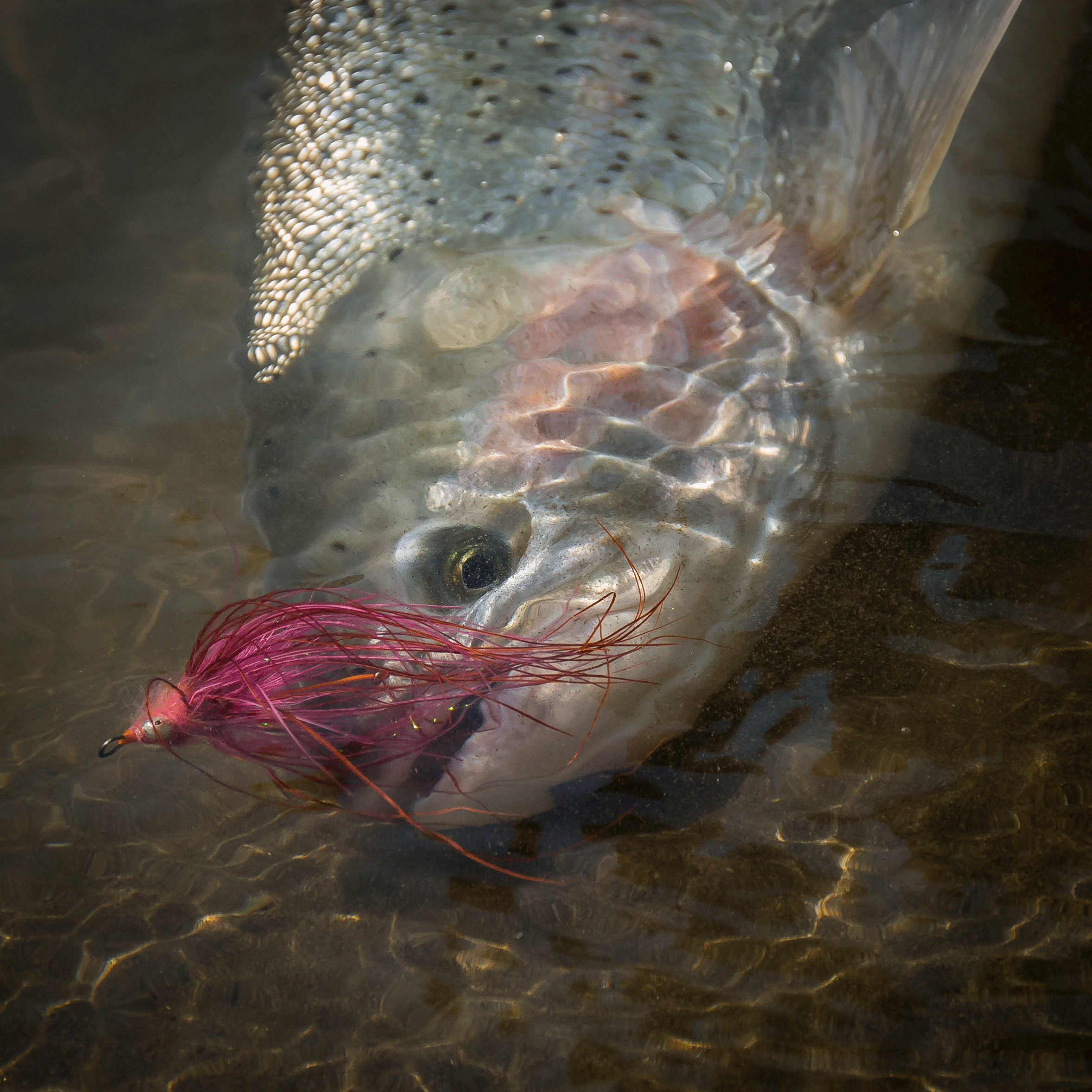
About 15 years ago I designed the Pink Spey Stinger steelhead fly as a artificial fly imitation for Gonatid Squid for fresh, early run, Skeena River Steelhead. The fly has proven very effective over the years. It is also a very good late season, cold water, upper system fly. Here is a step-by-step instruction of the original pattern.
Supplies

Materials: Ostrich Spey Plume (orange and pink), Veevus 10/0 thread (orange), SRFS Stinger Shank, Seperfli Plush Chenille (pink), Dubbing (orange), SRFS bead chain eyes, SRFS stinger loop material (orange), Nutria (orange).
Tie in Thread

Step 1: Tie in your thread and cover the shank with Thread.
Create Stinger Loop
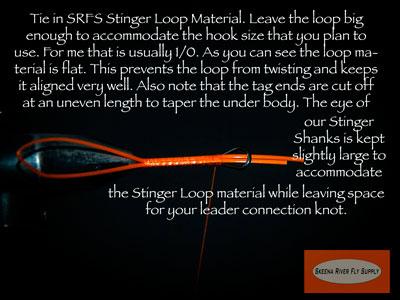
Step 2: Tie in SRFS Stinger Loop Material. Leave the loop big enough to accommodate the hook size that you plan to use. For me that is usually 1 or 1/0. As you can see the loop material is flat (oval). This prevents the loop from twisting and keeps it aligned very well. Also note that the tag ends are cut off at an uneven length to taper the under body. The eye of our Stinger Shanks is kept slightly large to accommodate the Stinger Loop material while leaving space for your leader connection knot.
Folded Stinger Loop
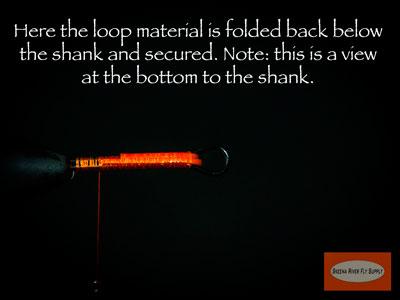
Step 3: Here the loop material is folded back below the shank and secured. Note: this is a view of the bottom of the shank.
Soak the Ostrich Spey Plume
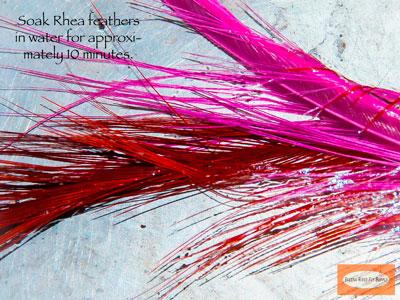
Step 5: Soak the Ostrich Spey feathers in water for approx. 10 minutes prior to stripping the Ostrich Spey Plume.
Strip Ostrich Spey Feather
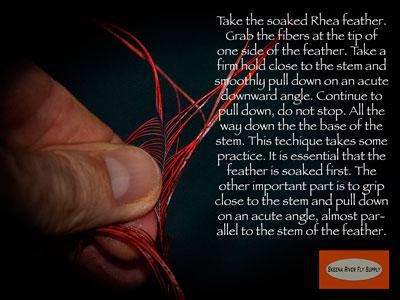
Step 5: Take the soaked Rhea feather. Grab the fibres at the tip of one side of the feather. Take a firm hold close to the stem and smoothly pull down on an acute downward angle. Continue to pull down, do not stop. All the way down to the base of the feather stem. This technique takes some practice. It is essential that the feather is soaked first. The other important part is to grip close to the stem and pull down on an acute angle, almost parallel to the stem of the feather.
The Feather Hackle Strip
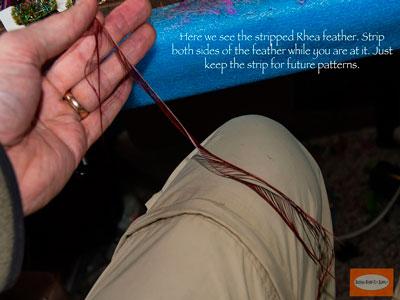
Step 6: Here we see the stripped Rhea feather. Strip both sides of the feather while you are at it. Just keep the strip for future patterns.
Create the Nutria Support
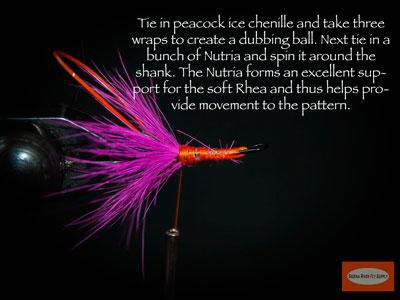
Step 7: Tie in the Chenille and take three wraps to create a dubbing ball. Next tie in a bunch of Nutria and spin it around the shank. The Nutria forms an excellent support for the soft Ostrich and thus helps provide movement to the pattern.
Hackle the Ostrich Feather Strip
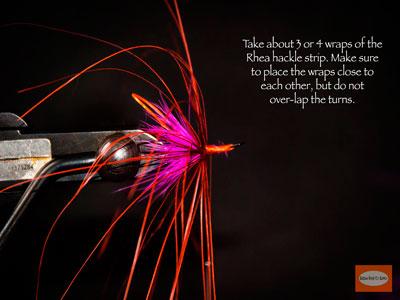
Step 8: Take about 3-4 wraps of the Ostrich hackle strip. make sure to place the wraps close to each other, but do not over-lap the turns.
Hackle the 2nd Ostrich Strip
Step 9: Now take the second (pink) Ostrich hackle strip, tie it in and again take 3 to 4 turns.
Tie in UV Shimmer Flash

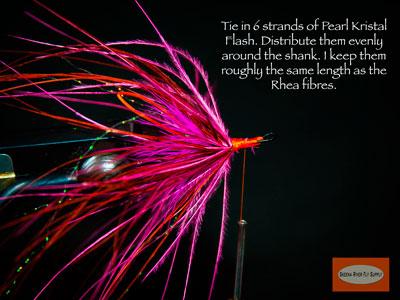
Step 10: Tie in 6 strands of Pink UV Shimmer Flash. Distribute them evenly around the shank. I keep them roughly the same length as the Ostrich fibres.
Tie in Bead Chain Eyes
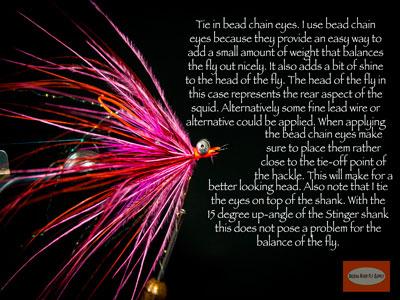
Step 11: Tie in bead chain eyes. I use bead chain eyes because they provide an easy way to add a small amount of weight that balances the fly out nicely. It also adds a bit of shine to the head of the fly. The head of the fly in this case represents the rear of the aspect of the squid. Alternatively some fine lead wire or substitute could be applied. When tying in the eyes make sure to place them rather close to the tie-off point of the hackle. This will make for a better looking head. Also note that I place the bead eyes on top of the shank. With the 15 degree up-eye of the Stinger Shank this does not pose a problem for the balance of the fly.
Dub the Head
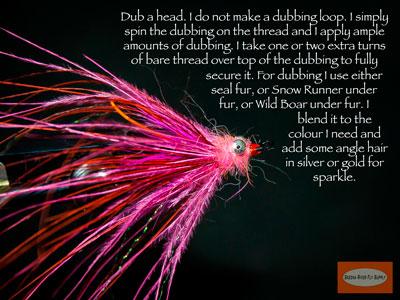
Step 12: Dub a head. I do not make a dubbing loop. I simply spin the dubbing on the thread and I apply ample amounts of dubbing. I take one or tow extra turns of bare thread over top of the dubbing to fully secure it. For dubbing I use either seal fur, or Snowrunner under fur, or Wild Boar under fur. I blend it to the colour I need and add some angle hair in silver or gold for sparkle.
Finished Fly


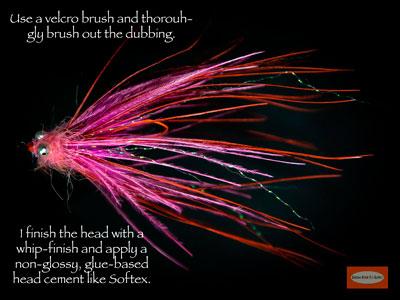
Step 13: Use a velcro brush and thoroughly brush out the dubbing. I finish the head with a whip-finish and apply a non-glossy glue based head cement, like Softex, or Super Glue. Done!