Wakizashi Katana
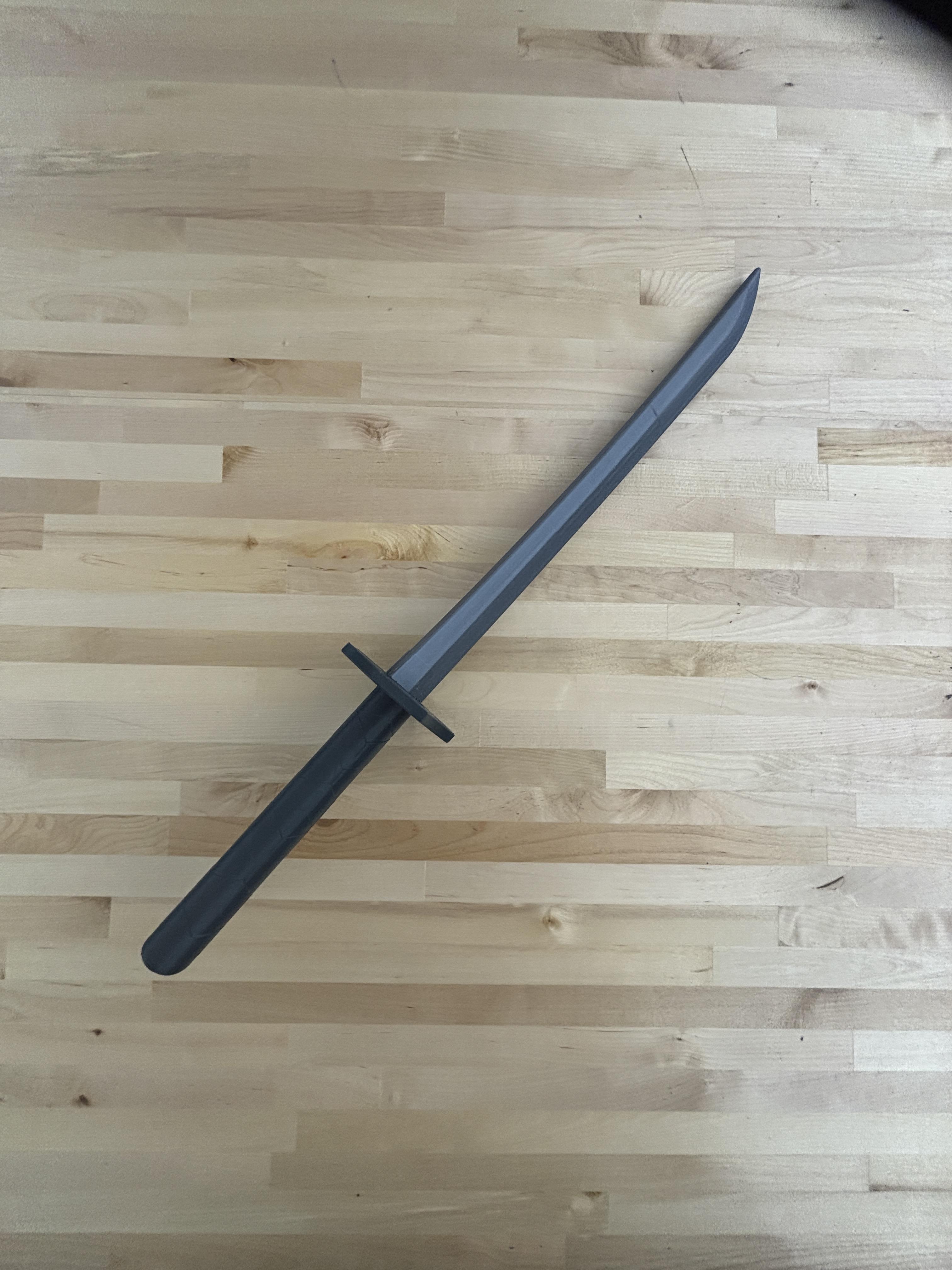

For my Engineering Passion Project in my class with Ms. Berbawy, I chose to make my own katana.
I designed and 3d printed a wakizashi which is a type of katana that is shorter than the standard blade you might think of. I have always wanted to have my own katana and thought designing and printing one myself would be cool. I chose the wakizashi because they are a bit unusual and slightly less common. I got inspiration for my desgin from pictures I found online.
Supplies
Equipment
- Prusa MK3S+ and XL
- Metal File
Material
- PETG or PLA filament
- 20 in Metal dowel, ⌀5 mm
- 3 in Metal dowel, ⌀5 mm
- 1.5 in Metal sleeve, ⌀6 mm; 1 mm thick
- Loctite 4011 glue
Software
- Onshape
- Prusa Slicer
Research
At I first had to find the dimensions of each part, so I searched through the internet and also found the size difference between a regular katana and a wakizashi. Through this process, I chose the smallest measurments that normally a wakizashi would be.
Guard


I used Onshape to sketch the guard, extruded it 7 mm, and added 1 mm fillets. I engraved flower and vine designs by using free images and added it to the surface of the guard then did a 0.2 mm remove extrude to emboss them onto the face. I then added two dowel holes to attach it to the handle and blade.
Downloads
Handle


I created a sketch of the full handle and extruded it 24 mm, with the diamond pattern extruded 23 mm. I added a 14 mm fillet to the corners and a 11 mm fillet to the bottom, then reused the guard holes and made another 30 mm, and a 5 mm hole for the dowels. The entire handle is 200 mm long, with the dowel holes extending 180 mm.
Downloads
Blade


I created a 2D sketch of the blade, extruded it 10 mm, chamfered the front with distances of 14 mm and 3 mm, created a 20 mm offset plane from the bottom for the habiki, sketched on that plane and the bottom face and lofted between them, then removed extrude a 6 mm hole 20 mm deep, cut the inner hole 350 mm deep, and finally made the next hole 40 mm deep.
Downloads
Slicing


Then exported all the parts in STL format and placed them into Prusa Slicer. After that, I cut the blade in half to fit the build plate and added a raft to the bottoms of the parts. See the pictures for details of my slicer settings.
Assembling


After 3D printing all the parts of the wakizashi, I removed the rafts and filed the parts where they were rough. I then inserted the metal dowel and metal sleeve into the holes. After that, I used loctite 4011 to glue the two parts of the blade together. I didn't glue on the guard or handle because they fit tightly with just a friction fit.
Ta da!! Wakizashi complete!